4 October, 2026 | 12:33 AM


Bring back Ballots
04-10-2026 12:00:00 AM
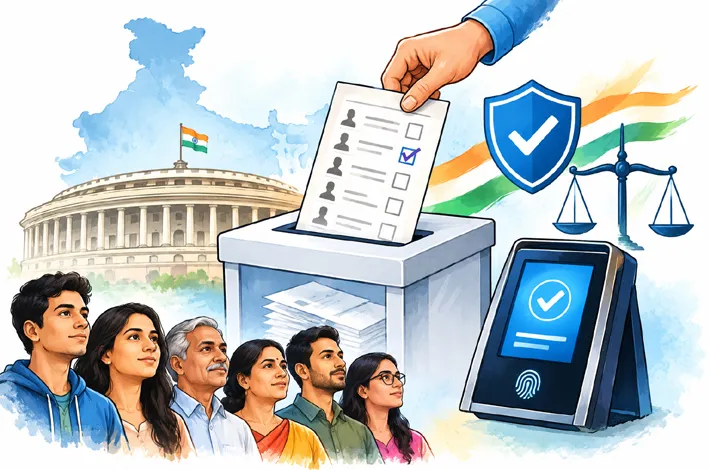
India must revisit ballot papers with a tech-hybrid model for fair elections to restore public trust
All these countries back paper ballot
Europe (predominantly paper-based) Germany, Netherlands, United Kingdom, France (mostly paper; limited machines in some municipalities), Finland, Norway, Denmark, Sweden, Italy, Spain, Portugal, Ireland, Austria, Switzerland (mainly paper, with some limited online options), Belgium (mixed but paper common), Romania, and most other EU countries. Germany’s Constitutional Court ruled pure electronic voting unconstitutional in 2009 due to transparency concerns. The Netherlands abandoned machines and returned to paper. North America: Canada (federal and provincial elections use paper ballots; some municipal optical scan)
United States (vast majority of voters use paper ballots—hand-marked or ballot-marking devices that produce a paper record—tabulated by optical scanners; pure paperless electronic machines are now rare and declining). Asia-Pacific and others: Japan, Australia (federal elections use paper ballots, often scanned), Israel, New Zealand (primarily paper), South Korea (mostly paper with some electronic elements in limited cases).
Latin America and elsewhere Uruguay, Chile, Colombia, and many others rely mainly on paper. Most African and additional Asian countries also use paper ballots as the standard method.
metro india news I hyderabad
Allegations of large-scale irregularities in India’s electoral process have intensified public debate, particularly among younger voters. Leader of Opposition Rahul Gandhi and several opposition parties have claimed manipulation of results through Electronic Voting Machines (EVMs) and voter list alterations spanning multiple election cycles. Some former Chief Election Commissioners have voiced concerns over transparency and institutional independence.
These charges, denied by the Election Commission of India (ECI) and rejected in key Supreme Court rulings that upheld EVMs with Voter Verifiable Paper Audit Trail (VVPAT) systems, have nevertheless fuelled widespread calls—especially from Gen Z and civil society—to return to traditional ballot papers. The core issue is not nostalgia but restoring verifiable public confidence in the world’s largest democracy. India’s shift to EVMs in the 1990s and full nationwide adoption later addressed real problems of the paper era: booth capturing, ballot stuffing, high rates of invalid votes (sometimes exceeding victory margins in dozens of constituencies), and slow, error-prone manual counting.
Standalone, non-networked EVMs with VVPAT have delivered speed, eliminated most invalid votes, and made large-scale physical fraud harder. The ECI emphasises rigorous protocols—random allocation, multi-layer sealing, CCTV, candidate agents, and sample VVPAT verification—with official data showing zero mismatches in tens of thousands of checked machines covering crores of votes. The Supreme Court has repeatedly affirmed the system’s integrity while expanding sample checks.
Still perception matters as much as process. In a polarised environment, the “black-box” nature of electronic recording fuels distrust. Voters cannot independently audit software or hardware the way they can examine physical paper. This gap explains why many of the world’s most developed democracies continue to rely primarily on paper ballots or paper-centric hybrids rather than pure direct-recording electronic machines.Global preference for paper: evidence from advanced democraciesInternational data from the International Institute for Democracy and Electoral Assistance (IDEA) shows that only about 19% of countries (34 of 178 surveyed) use any form of electronic voting at national or sub-national levels.
Europe remains predominantly paper-based. Germany’s Constitutional Court ruled electronic voting unconstitutional in 2009 for lacking transparency and public verifiability. The Netherlands abandoned machines after a decade and returned to paper. The United Kingdom, Finland, Ireland (after costly pilots), and most other European states stick to hand-marked or scanned paper ballots. Canada uses paper for federal and provincial elections. Israel, despite its technological prowess and constant cyber threats, retains the classic paper ballot in a blue box.
Japan never scaled electronic systems widely. In the United States, the majority of voters now use paper ballots marked by hand or ballot-marking devices, tabulated by optical scanners that leave a durable paper trail. Paperless direct-recording electronic (DRE) machines have declined sharply after security experts, including those from Harvard, Stanford and the Brennan Center, highlighted vulnerabilities to undetectable software manipulation and the impossibility of meaningful audits without a paper record.
Post-2016 concerns accelerated the shift toward voter-verifiable paper. Even where technology assists, the paper ballot is treated as the official record of intent. Reasons are consistent across these nations: paper provides end-to-end verifiability. Voters can see and confirm their mark; observers can watch the count or recount; statistical audits can compare machine tallies against physical ballots. Electronic systems, however sophisticated and offline, remain opaque to ordinary citizens. Cybersecurity experts note that while remote hacking of isolated machines is difficult, insider access, supply-chain risks, or undetectable code changes pose theoretical threats that paper largely eliminates.
Public trust, not just technical security, is the decisive factor. When results are contested, a physical trail allows independent verification that software logs cannot fully replicate in the public mind. A practical hybrid path for India.A pure return to 1990s-style paper ballots in a country with nearly a billion electors would be logistically daunting, environmentally costly, and prone to the very frauds EVMs curbed. The solution lies in integrating paper’s transparency with modern technology—creating a hybrid system that maximises both auditability and efficiency. Voters would mark paper ballots (or use ballot-marking devices that print a human-readable ballot with optional QR or barcode encoding). These ballots would be deposited in transparent or sealed boxes under multi-party observation.
At the close of polling, optical scanners or high-speed tabulators—already proven in Canada, parts of the US, and the Philippines—would rapidly count marks while retaining every physical ballot for audits and recounts. Random risk-limiting audits, statistically designed to detect discrepancies with high confidence, would become routine rather than exceptional. Blockchain or distributed ledger technology could secure the aggregation of scanned results and chain-of-custody logs without controlling the vote itself, providing immutable public records of transmission from booth to final tally.
Additional layers are feasible: biometric or digital voter authentication at the booth to prevent impersonation while preserving secrecy; real-time public dashboards showing turnout and sealed-box status (without revealing individual votes); AI-assisted image analysis for detecting anomalous ballot patterns or duplicate markings during counting; and mandatory 100% or high-percentage VVPAT-style verification where machines assist. Symbol-loading and machine commissioning could remain under multi-party video scrutiny. For remote or special categories, limited and heavily audited postal or electronic options could exist, but the core national vote would rest on paper.
This model addresses scale: scanners process thousands of ballots per hour, far faster than pure hand-counting yet slower and more observable than pure EVM tallies. Invalid votes can be minimised through clear design and voter education, while physical ballots enable full recounts when margins are tight. Environmental impact can be mitigated with recycled paper and digital archiving after statutory retention periods. Cost would rise initially for scanners and logistics but could be offset by longer equipment life and reduced litigation over opaque results.
Rebuilding legitimacy
The current controversy—voter-list revisions, internal ECI dissent reports, and opposition demands for pre-revision rolls and ballot voting—underscores that institutional trust is fragile.
Allegations remain contested; the ECI maintains all decisions were collective and procedures robust. Yet when substantial sections of the electorate, including digitally native Gen Z, question outcomes, democracy itself suffers. A transparent hybrid system does not require admitting past wrongdoing; it simply prioritises the appearance and reality of fairness that paper uniquely provides.
India pioneered large-scale electronic voting for pragmatic reasons. The next evolutionary step is not technological regression but a mature synthesis: paper for verifiability, technology for speed, security and accessibility. Countries that abandoned or limited pure electronic systems did it with a clear-eyed recognition that elections must be trusted by ordinary citizens, not merely certified by experts. In a nation as diverse and politically competitive as India, restoring that trust through visible, auditable ballots—augmented by the best available tools—is both feasible and necessary for the health of its democratic future