5 October, 2026 | 12:30 AM


Cong, CJP divide against NDA
05-10-2026 12:00:00 AM
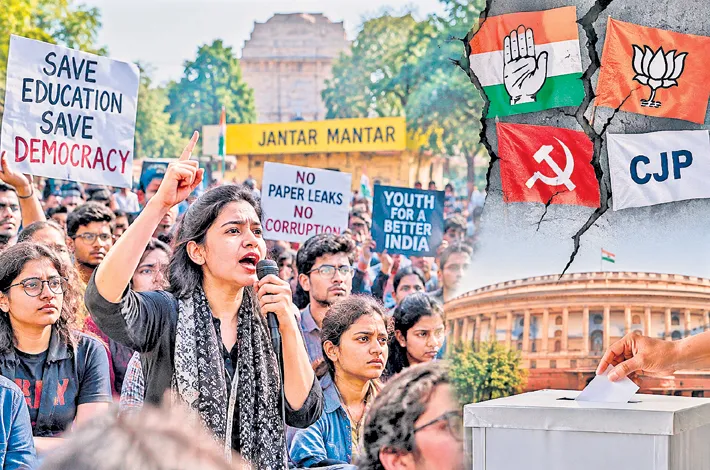
The broader challenge for anti-NDA forces lies in translating issue-based mobilisation into sustained electoral coordination. Education system failures and institutional credibility questions have provided common ground. Differences in approach—Congress’s institutional experience versus CJP’s outsider appeal—create friction
metro india news I hyderabad
The political landscape in India in 2026 has been marked by intense opposition activity against the NDA government led by the BJP. Criticisms have focused on governance failures, alleged anti-democratic measures involving the Election Commission, and various scams. Within this environment, the Congress party and the newly formed Cockroach Janata Party (CJP) have both positioned themselves as critics of the ruling dispensation. Observations from sections of the public and Congress supporters highlight a lack of full coordination between these two forces, raising questions about the effectiveness of the broader anti-BJP challenge.
The CJP emerged in mid-2026 from student-led agitations at Delhi’s Jantar Mantar. The protests centered on irregularities in competitive examinations, particularly paper leaks associated with the National Eligibility cum Entrance Test (NEET). The movement gained rapid visibility through social media and on-ground mobilisation, culminating in the resignation of Union Education Minister Dharmendra Pradhan. CJP leaders framed the outfit as a youth-driven platform focused on issues such as educational integrity, unemployment, and institutional accountability. It presented itself as distinct from traditional political parties, emphasising grassroots energy over established organisational structures.
Parallel to this, Left student organisations, notably the All India Students Association (AISA), affiliated with the CPI(ML) Liberation, played a visible role.
AISA national president Neha Bora, a PhD scholar at Jawaharlal Nehru University, participated in a 23-day hunger strike during the Jantar Mantar protests alongside other activists. Congress leaders, including Rahul Gandhi, publicly engaged with aspects of this Left-led mobilisation. Reports indicate discussions between Rahul Gandhi and student leaders, media appearances featuring Bora, and amplification of the education-related grievances by Congress figures. This selective engagement allowed the Congress to associate itself with youth discontent on examination integrity without fully merging organisationally with any single platform.
Congress’s approach to the CJP itself followed a more cautious path. Party functionaries initially maintained distance from the Jantar Mantar stage occupied by CJP organisers. Media accounts from July and August 2026 describe internal Congress concerns that the CJP could function as a vote-splitting entity or a controlled opposition vehicle. Some Congress voices explicitly referenced historical precedents of agitations that later complicated the party’s position. The party supported the underlying issues of paper leaks and demanded accountability from the government, including calls involving the Chief Election Commissioner in later phases related to electoral roll revisions. However, it avoided formal alliance or joint organisational platforms with the CJP. Instead, Congress pursued parallel protests, such as sit-ins near the Prime Minister’s residence, and sought to build its own Gen Z outreach through digital interactions and events led by Rahul Gandhi.
Allegations regarding the CJP’s affiliations have circulated widely. Congress supporters and some party spokespersons have described the CJP as potentially linked to AAP interests or designed to fragment anti-incumbency sentiment in ways that could benefit the BJP. These claims draw partly from the background of certain CJP founders. Abhijeet Dipke, associated with the outfit’s early visibility, had previously worked with the Aam Aadmi Party’s social media operations between 2020 and 2023.
BJP leaders, including Delhi BJP president Harsh Malhotra, have countered by labelling the CJP an AAP proxy, pointing to overlapping demands on the Chief Election Commissioner and alleged funding patterns. Separate claims of RSS involvement have appeared in Congress-linked commentary, drawing parallels to past civil society movements, though no official investigation or documentary evidence has publicly established direct RSS control or funding of the CJP. CJP leaders have rejected these characterisations, insisting on independent status focused on youth and governance reforms. Proposals from the group have included measures such as enhanced women’s representation and restrictions on political defection.
Data on electoral and protest impact remains limited given the CJP’s recent formation. The Jantar Mantar agitation demonstrated significant mobilisation capacity among students and young aspirants, with reports of sustained crowds and national media attention. Opposition parties within the INDIA bloc showed varying degrees of engagement. Left parties and some regional outfits maintained informal channels with the CJP, while Congress prioritised organisational autonomy. Meetings of the INDIA bloc in 2026 included discussions on youth movements, with some leaders urging greater association to capture emerging discontent. Congress strategy documents and public positioning reflected a preference for supporting causes while preserving independent branding, particularly among traditional support bases wary of new entrants.
The perception among certain Congress supporters that the CJP serves to divide anti-BJP votes stems from competitive dynamics in a fragmented opposition space. India’s electoral history shows that multi-cornered contests can dilute opposition tallies in first-past-the-post systems. In states heading toward assembly elections, the appearance of an additional youth-focused platform raises tactical concerns for established parties. At the same time, the Congress’s support for Left student initiatives, such as those involving Neha Bora, indicates willingness to collaborate where ideological or issue-based alignment is clearer and organisational risks appear lower.
AISA’s explicit left orientation provided a more familiar partner compared to the CJP’s self-described non-traditional character. Government responses have included police action during protests, detentions, and counter-narratives questioning the motives of organisers. The NDA has framed such movements as disruptive or externally influenced in some statements. On the opposition side, the absence of a unified front between Congress and CJP has been noted in public discourse as a limitation in consolidating anti-incumbency. Protest outcomes, such as the ministerial resignation, demonstrated that sustained pressure on specific issues can yield results independent of full inter-organisational coordination. Subsequent mobilisations around electoral processes and the Election Commission have seen overlapping demands from multiple opposition actors without formal merger.
The broader challenge for anti-NDA forces lies in translating issue-based mobilisation into sustained electoral coordination. Education system failures and institutional credibility questions have provided common ground. Differences in approach—Congress’s institutional experience versus CJP’s outsider appeal—create friction. Neha Bora’s trajectory illustrates how Left student activism can receive amplification from Congress without requiring absorption of parallel platforms.
Whether these patterns persist will depend on future electoral calendars, the durability of youth discontent, and the capacity of opposition actors to prioritise shared objectives over competitive positioning. Available facts show a landscape of selective collaboration, mutual suspicion, and competing claims rather than a fully unified opposition front.