13 September, 2026 | 9:00 AM


Infiltration debate intensifies in West Bengal
31-05-2026 12:00:00 AM
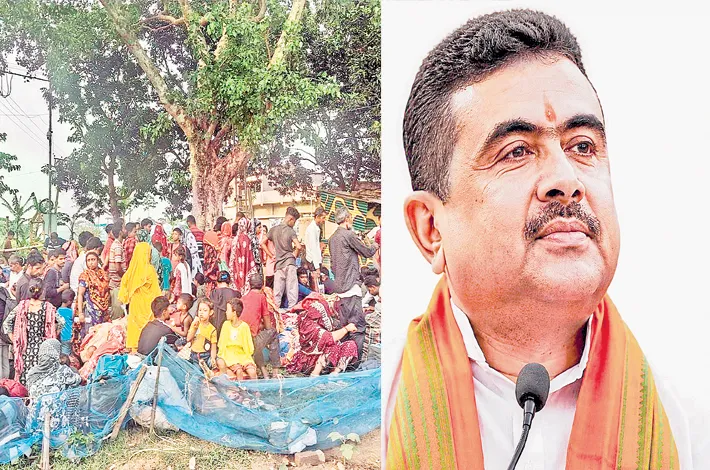
Suspected Bangladeshis queue to return
Dramatic visuals from the Hakimur border in North 24 Parganas have thrust the issue of illegal infiltration back into the national spotlight. Hundreds of alleged Bangladeshi nationals, many carrying bags and belongings, were seen lining up to return home, prompting renewed concerns over porous borders, demographic shifts, and security challenges in the state. The scenes have sparked urgent questions about whether West Bengal has become a primary gateway for illegal entrants into India and the wider implications for the country.
Chief Minister Suvendu Adhikari has issued a strong warning, stating that unchecked infiltration and inadequate border fencing have significantly altered the demographic profile of several districts bordering Bangladesh. The state government is now emphasizing fresh census data to inform policy decisions and welfare schemes, while simultaneously strengthening measures against illegal immigration. In a key development, the administration has begun transferring land to the Border Security Force (BSF) for erecting fences along vulnerable stretches of the Indo-Bangladesh border.
Official records show that around 386 suspected illegal Bangladeshi immigrants, including Rohingyas, are currently held in detention centers across the state. Bashir (likely Basirhat) accounts for the largest number with 335 detainees, followed by Murshidabad (19), Malda (9), and Dakshin Dinajpur (8). Smaller numbers were reported in areas including Baruipur, Barasat, Cooch Behar, Jangipur, Sundarbans, Bangaon, and Krishnanagar.
In a significant push to strengthen border management, the state transferred substantial land parcels to the BSF: 43 acres of purchased land and 31.9 acres of wasteland on May 20, followed by an additional 142.79 acres on May 28. Experts emphasize that fencing along the nearly 4,096 km Indo-Bangladesh border is critical for curbing illegal migration, transnational crime—including cattle smuggling, narcotics, arms trafficking, and human trafficking—and preventing exploitation by insurgent or extremist elements.
The issue has ignited sharp debate. A former DG of West Bengal Police highlighted a policy shift after 2011, alleging that the previous Trinamool Congress (TMC) government under Mamata Banerjee encouraged infiltration by issuing documents like Aadhaar, PAN, and ration cards to Bangladeshi nationals, turning them into voters. He noted that scenes of returns occurred during previous political transitions as well and stressed that visible numbers at the border likely represent only a fraction of the total infiltrators still inside the state.
A BJP spokesperson described the task ahead as “Herculean,” calling for detection, detention, and deportation as outlined by the Union Home Minister. He accused the previous regime of institutionalizing forgery, citing examples of fake documents issued through local party offices and even police involvement in passport rackets. He argued that many infiltrators received forged documents in districts like Malda and Murshidabad before spreading to other states, including Bengaluru, Uttarakhand, and Himachal Pradesh.
An advocate acknowledged lapses but pointed out that local administrators, often influenced by ground-level political leaders, played a key role in issuing documents. Many across the political spectrum broadly agreed that the problem poses a serious internal security threat, with potential for terrorists or anti-state elements to exploit weak borders. The infiltration debate coincides with renewed discussion on India’s demographic changes, fuelled by the long delay since the last full religious census in 2011. Maps comparing 1951, 1981, and 2011 data show a marked increase in Muslim population concentration, particularly in border districts of West Bengal, Assam, and other regions.
Population expert Manu Gaur noted that in 1951, around 70-75% of districts had below 10% Muslim population; by 2011, this fell to 55-60%, with increases across all higher brackets. While Total Fertility Rates (TFR) have declined across communities, he and others pointed to disproportionate growth in certain border areas that exceeds natural rates, suggesting infiltration played a role—especially evident in the 1971-81 period following the Bangladesh Liberation War. A political strategist & commentator highlighted that India’s share of the global Muslim population rose from 8.3% to 10.9%, contrasting with flatter trends in countries like Indonesia.
Hindu population percentages declined in states like West Bengal (78.5% in 1951 to 70.4% in 2011), Assam, Kerala, and Uttar Pradesh. Districts with over 50% Muslim population in 2011 include several in Jammu & Kashmir (often above 95%), Assam (e.g., Dhubri 80%, Barpeta 71%), West Bengal (Murshidabad 66%, Malda 51%), and others. A key concern raised was the gap between Total Fertility Rate (TFR) projections and actual population growth. India’s population rose from 102 crore in 2001 to over 145 crore, with absolute birth numbers suggesting higher growth than TFR estimates (which have fallen to around 2.0-2.1). Experts questioned whether TFR calculations accurately capture community-wise differences and whether illegal immigration accounts for the unexplained surplus.
Experts argue that while fertility differences exist, illegal settlement, combined with higher growth in some pockets, has contributed to these shifts, raising concerns over resource pressure, electoral dynamics, and social cohesion. Politicians as well as experts called for robust border security, accurate data through the upcoming census, and firm implementation of “detect, detain, deport” policies. The developments in West Bengal have triggered broader national questions about infiltration gateways, demographic engineering, and the long-term challenge of addressing an estimated large number of illegal immigrants across the country. As fencing accelerates and returns continue, authorities face the complex task of balancing security, humanitarian concerns, and enforcement.