26 October, 2026 | 2:28 AM


July rains ease, farm risks persist
11-07-2026 12:00:00 AM
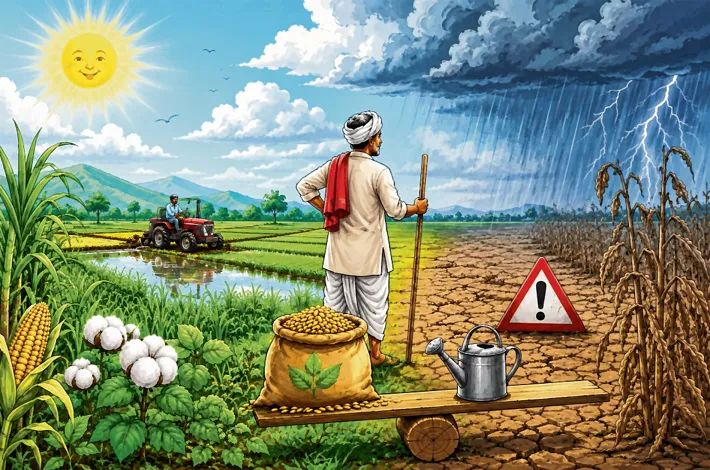
Heavy July rainfall has eased monsoon concerns, but uneven distribution, delayed sowing and weather risks continue threatening agriculture and rural incomes
Business Desk
MUMBAI
Heavy rainfall in early July has narrowed India's monsoon deficit after an unusually dry June, but the improvement has not removed concerns over the kharif season, with uneven precipitation, delayed sowing and the possibility of weaker rainfall later this month continuing to pose risks, according to a CRISIL Quickonomics report released on Friday.
The ratings agency said the recent spell of widespread showers had significantly improved soil moisture and accelerated the monsoon's advance across the country. However, it cautioned that the recovery should not be interpreted as a sign that agricultural risks have diminished, as rainfall patterns remain highly uneven across several key farming regions.
The India Meteorological Department expects July rainfall to be around 6% below the long-period average, suggesting that wetter conditions seen during the first half of the month may not persist.
A drier second half could affect crop development in areas that remain heavily dependent on timely monsoon rainfall. CRISIL said the southwest monsoon covered the entire country within 35 days, broadly matching its long-term average. Even so, it said the speed of the monsoon's advance offers only limited insight into the season's likely outcome, with the quantity and distribution of rainfall proving far more important for agricultural performance.
According to the report, abrupt shifts between rainfall shortages and excessive downpours can be just as disruptive as an overall weak monsoon.
Such fluctuations influence sowing decisions, crop establishment and yields, while also affecting rural incomes and demand across the wider economy. The uneven rainfall pattern has already slowed kharif planting. As of July 5, overall sowing was about 21% lower than a year earlier, led by declines in oilseeds, cotton, pulses, coarse cereals and other cereal crops.
Rainfall conditions have nevertheless improved considerably over recent weeks. CRISIL said the all-India rainfall deficit narrowed from 40% after a parched June to 15% as of July 8 as the monsoon gathered momentum. However, it noted that June's rainfall pattern resembled that of 2014, another strong El Niño year in which deficient rainfall persisted and weighed on agricultural production. To assess regional vulnerability, CRISIL uses its Deficient Rainfall Impact Parameter, which combines rainfall shortages with irrigation coverage to gauge the potential impact on crops.
Based on this measure, Karnataka, Bihar, Uttar Pradesh, Andhra Pradesh and Telangana continue to face significant agricultural stress, while Haryana is experiencing comparatively milder pressure.Among crops, tur and coarse cereals remain the most exposed because of their greater dependence on rainfall.
—With inputs from ANI