4 October, 2026 | 12:37 AM


Like a Sunflower
04-10-2026 12:00:00 AM
Khush Raho with Sangeeta
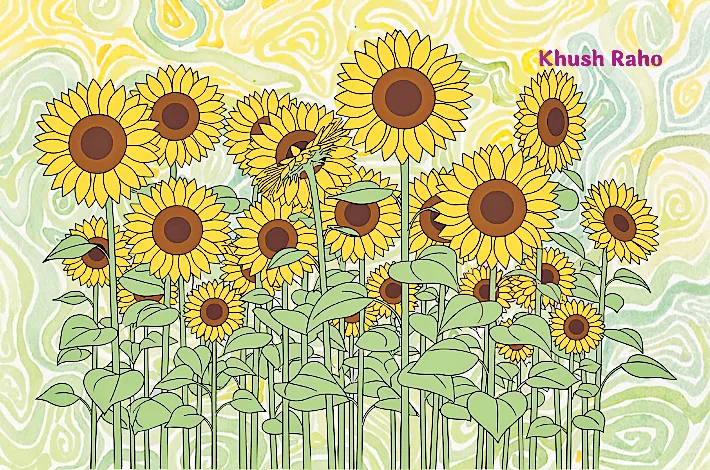
I have a preference, perhaps even an obsession, with the sun. I love being outdoors and I love sunlight, unless of course it is very warm, and in Hyderabad that can mean 43 degrees centigrade during summer months. Not surprisingly my favourite flower is the sunflower. I have made more than 100 paintings of this flower, rendered on varied material — paper, steel, ceramic, aluminium, fabric, and more. So I must honestly admit that I have a bias toward natural light and our dear sun.
From an energy point of view, the sun is the power source for all life on earth. Plants, animals, and all sentient beings need the sun to survive and to evolve, as we have over the millennia. Our pre-electrified urban and rural lives followed the sun — we rose with it and went to sleep soon after sunset.
In the last twenty years, our indoor lighting has moved from incandescent bulbs to the now ubiquitous LED lighting, in an effort to be cost effective and energy efficient. New data shows that this shift is actually very harmful to our health.
Dr Glen Jeffery, Professor of Neurobiology at the UCL Institute of Ophthalmology, and Dr Edward Barrett published their findings in Scientific Reports, describing a major human study on the effects of LED lighting. They found that indoor LEDs emit blue-heavy, short-wavelength light without the balancing long-wavelength red and near-infrared light cells need. Prolonged exposure to these wavelengths may impair cellular health and damage mitochondria in the retina and elsewhere in the body. Jeffery has compared the issue to the asbestos crisis, saying, “Mitochondria are pretty happy in red light and they are hammered by blue light.” Even warm LEDs may resemble sunlight to our eyes, but lack its full spectrum.
So why does this matter? Think of our body as a city and our mitochondria as microscopic power plants inside almost every cell. Their job is to convert the food we eat and the oxygen we breathe into ATP, the chemical fuel that allows our heart to beat, our muscles to move, and our brain to think. When our mitochondria are healthy, these power plants run cleanly and efficiently. When they are damaged, by age, or by environmental stressors like poor lighting they begin to break down and produce toxic free radicals. The consequences are serious: energy plummets, metabolism slows. Poor mitochondrial function is now understood to be the underlying driver of almost all age-related chronic diseases, including Alzheimer's, heart disease, diabetes, and vision loss.
We use fresh Prana from the sun, the earth, and the air to power our energy bodies and aura. Our chakras, the energy centres of our subtle body, receive and distribute this life force energy to the physical body via the energy channels, or nadis.
Modern science is increasingly validating what ancient wisdom always knew. Sun worship and rituals performed in sunlight predate the Egyptian pyramids. The Rigveda, one of humanity's oldest texts, contains numerous hymns to Surya, the sun deity, and the Gayatri Mantra, among the most ancient prayers know, is itself a meditation on the sun's divine radiance. Surya Namaskar, the sun salutation practised at dawn for millennia, was never merely exercise. It was a conscious act of receiving the sun's energy into the body. Our ancestors understood what Dr Jeffery's research is now confirming that the sun is not merely warmth and light, but the very source of our cellular vitality.
So let's go outdoors and bask in the radiant light of our sun. Natural sunlight burns away stale energy, fuels our body with Vitamin D, and keeps our mitochondria functioning as nature intended. A minimum of twenty to thirty minutes a day is all it takes. The sunflower always turns its face toward it. Perhaps we should too!

(Sangeeta Bhalla is an Energy Healer, Instructor, Therapeutic Aromatherapist. She can be reached at sangeetabhalla.net)