14 September, 2026 | 6:47 PM


Lotus Blooms
27-05-2026 12:00:00 AM
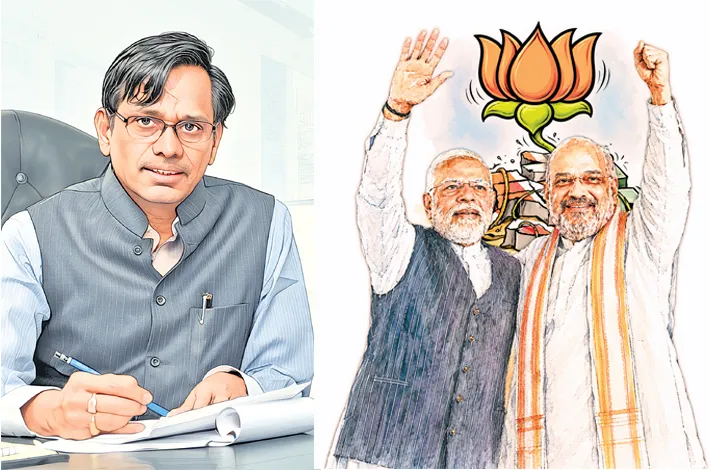
MODI-SHAH COMBINE TURNS BJP INTO POLITICAL COLOSSUS IN 12 YEARS
From a party with pockets of influence, the BJP has become a national colossus with deep roots in every corner of the country
Saffron Surge
* Narendra Modi led the BJP to three consecutive Lok Sabha victories in 2014, 2019 and 2024, transforming it into India’s dominant political force.
* Under the Modi-Amit Shah combine, the NDA’s footprint expanded from about seven states in 2014 to 22 states and Union Territories by 2026.
* The BJP built a massive grassroots machinery through booth-level mana-gement, data-driven campaigning, and membership expa-nsion crossing 11 cr.
* Key political and ideological milestones included the Ram Temple inauguration, abrogation of Article 370, nationalism-driven campaigns, and the push for Atmanirbhar Bharat.
* Welfare schemes such as Ayushman Bharat, PM Awas Yojana, direct benefit transfers, and free food grain programmes helped the BJP expand support among women, farmers and poorer sections.
Formidable duo
Modi provided the charismatic face and visionary rhetoric, framing India’s rise on the global stage. Shah supplied the organizational backbone and tactical brilliance
c l rajam
As the BJP-led NDA government completes 12 years in office on Tuesday, marking Narendra Modi’s swearing-in as Prime Minister on May 26, 2014, Indian politics stands profoundly transformed. What began as a decisive mandate against the Congress-led UPA has evolved into the BJP’s establishment as the country’s pre-eminent political force. Under the leadership of Prime Minister Narendra Modi and Union Home Minister Amit Shah, the party has expanded from a limited base to a pan-Indian powerhouse, securing victories in Lok Sabha elections and numerous state assemblies while systematically reshaping the political landscape.
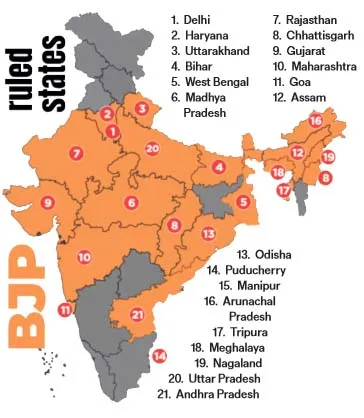
In 2014, the BJP secured 282 seats in the Lok Sabha with 31.34% vote share, delivering a single-party majority after three decades. This rose to 303 seats in 2019 with 37.46% vote share. Even in 2024, despite a reduced tally of 240 seats, the NDA coalition commanded 293 seats, allowing Modi to begin his third term. State-level gains proved equally striking. In 2014, the BJP and its allies governed around seven states, covering roughly 34% of India’s land area and 25% of its population. By May 2026, this footprint had grown dramatically to 22 states and Union Territories under NDA rule—14 directly led by the BJP—encompassing about 72-76% of the landmass and 78% of the population.
The duo’s strategy rested on meticulous planning, narrative control, organizational depth, and adaptive alliances. From the outset in 2014, Modi and Shah targeted the UPA’s vulnerabilities. They highlighted large-scale corruption scandals, including the 2G spectrum allocation and Coalgate, framing the Congress regime as mired in inefficiency and graft estimated at over Rs 12 lakh cr across multiple scams. The campaign portrayed the government as a “maa-beta ka sarkar,” directly attacking the dynastic politics of the Gandhi family and positioning Rahul Gandhi as out of touch. This anti-corruption plank, coupled with promises of good governance and development, resonated widely amid public frustration.
Modi’s oratory introduced powerful narratives that blended aspiration with cultural assertion. Themes of nationalism, Hindutva, and economic reform took center stage. The party emphasized retrieving black money stashed in Swiss banks, promising transformative benefits including Rs 15 lakh in every citizen’s account. Job creation featured prominently, with pledges of two crore jobs annually. Development initiatives like Make in India aimed to boost manufacturing. The culmination of the Ram Temple movement in Ayodhya provided a potent cultural symbol, reinforcing majoritarian sentiments while development rhetoric appealed to broader demographics. These messages were delivered through extensive campaigns, leveraging social media, public rallies, and a highly disciplined cadre.
Amit Shah’s organizational mastery proved indispensable. As BJP president from 2014 to 2020 and later as a key minister, Shah built a robust structure emphasizing booth-level management. The mantra “mera booth sabse majboot” drove the creation of strong local units, membership drives that swelled the party’s ranks to over 11 crore, and data-driven micro-management. Shah trav-eled extensively, focusing on district offices, regular meetings, and ideological training. This ground game enabled precise voter targeting, alliance negotiations, and turnout maximization.
The strategy for dismantling regional parties combined ideological outreach, alliance engineering, internal divisions, and direct competition. In Uttar Pradesh, the BJP broke the dominance of the Samajwadi Party and BSP through massive organizational expansion and welfare schemes that cut across caste lines. BSP’s influence has since waned significantly. In Bihar, alliances with JD(U) under Nitish Kumar proved fluid, with the BJP gradually asserting greater control while regional influence diminished.
Maharashtra witnessed a dramatic shift. The BJP engineered a split in Shiv Sena, leading to the formation of a faction aligned with the NDA. This move weakened a long-standing regional force and allowed the BJP to expand its footprint in the state. Similar dynamics played out with the NCP.
In the Northeast, strategic alliances and development focus helped erode traditional regional holds. In Tamil Nadu, the BJP challenged the Dravidian duopoly of DMK and AIADMK through alliances and persistent organizational work, contributing to their declining dominance by 2026. West Bengal saw one of the most striking turnarounds. Persistent efforts against the Trinamool Congress (TMC), focusing on governance issues, anti-incumbency, and cultural narratives, culminated in major gains for the BJP in recent elections, significantly eroding Mamata Banerjee’s hold.
The party’s approach involved entering new territories with tailored campaigns, recruiting influential local leaders, and leveraging central schemes for visibility at the grassroots. Welfare programs such as direct benefit transfers, Ayushman Bharat health coverage, PM Awas Yojana housing, and free food grains built loyalty across demographics, including women, farmers, and the poor. These initiatives provided tangible governance credentials that supplemented ideological messaging.
Electioneering under Modi and Shah reached new levels of sophistication. Campaigns integrated technology for voter databases, targeted messaging, and real-time monitoring. Massive roadshows, holographic addresses in earlier cycles, and relentless booth-level mobilization ensured high turnout among core supporters. Alliances were pragmatic: the NDA accommodated regional players where necessary but positioned the BJP as the senior partner. This flexibility helped in states like Bihar and Maharashtra while the party built independent strength elsewhere.
Since 2014, the BJP has won the majority of Lok Sabha and assembly elections it contested seriously. Losses remained limited—such as in some state polls due to anti-incumbency—but recoveries followed swiftly through recalibrated strategies. The 2019 victory, bolstered by national security narratives post-Pulwama and Balakot, exemplified the ability to pivot effectively. Even the 2024 outcome, while short of a solo majority, demonstrated resilience as the NDA retained power.
The duo’s political acumen lies in long-term vision executed with precision. Modi provided the charismatic face and visionary rhetoric, framing India’s rise on the global stage. Shah supplied the organizational backbone and tactical brilliance. Together, they converted anti-incumbency against the UPA into sustained pro-incumbency for the NDA through delivery on key promises like the Ram Temple inauguration, abrogation of Article 370, and infrastructure push. Narratives evolved from anti-corruption and development in 2014 to self-reliance (Atmanirbhar Bharat), cultural revival, and strong leadership in subsequent cycles.
Critics point to challenges, including unemployment concerns and uneven economic outcomes, but the electoral record underscores public endorsement of the broader direction. The BJP’s membership and cadre depth now dwarf competitors, enabling sustained pressure on opposition spaces. Regional parties that once dictated terms in coalition eras find themselves marginalized, forced into defensive postures or alliances on BJP’s terms.
Twelve years on, the Modi-Shah partnership has redefined Indian politics. From a party with pockets of influence, the BJP has become a national colossus with deep roots in every corner of the country. Their script—rooted in narrative dominance, organizational rigor, welfare delivery, and strategic opportunism—continues to unfold, setting the stage for further consolidation. As India marks this milestone, the transformation stands as a testament to disciplined execution of a clear political blueprint.