3 November, 2026 | 1:03 AM


My Hands Are Clean. The Mess Is Someone Else's Job
03-11-2026 12:00:00 AM
The unasked Questions
My mother had an interesting theory about cleanliness. She would warn us against people obsessed with cleanliness, particularly those excessively particular about ritual purity. Their homes, she insisted, were often the dirtiest. Not because they didn't care about cleanliness, but because they considered cleaning a dirty job.
Washing toilets? Disgusting. Handling garbage? Unthinkable. Cleaning drains? Certainly not something respectable people did.
And there was another complication. The people who traditionally performed these jobs belonged to castes considered unclean. So while we couldn't possibly do the cleaning ourselves, we weren't particularly comfortable having those who did it around us either. The result? Dirty toilets, kitchens and homes.
What an extraordinary arrangement! The people who created the dirt remained pure, while those who removed it were considered polluted.
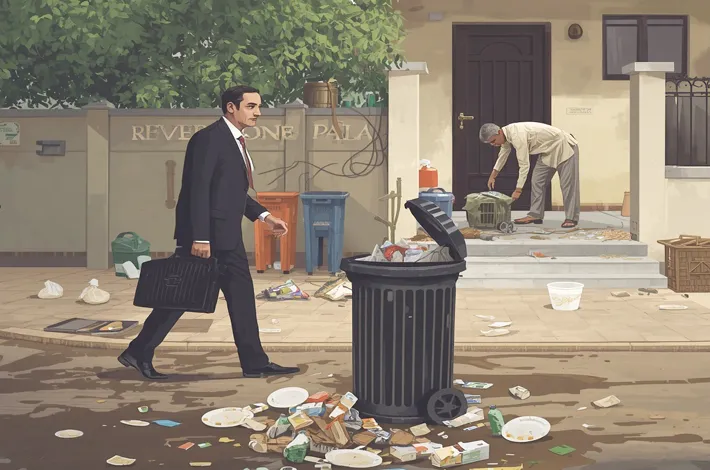
Consider the existential dilemma of the humble dustbin, standing practically empty, with used plates precariously balanced on its lid and rubbish piled all around it.
Why would anyone carry a dirty plate all the way to a dustbin and then leave it on the lid?
Simple. The dustbin is dirty. One cannot possibly touch it to open the lid.
Never mind that the plate contains one's own leftovers and saliva. Never mind that someone else must now pick it up. At least our hands are clean.
And anyway, aren't there people employed to do these things?
We have elevated this attitude into something of a national habit. Men spit paan out of car windows, cigarette butts sail down from balconies into other people's drawing rooms, and families returning from picnics leave behind empty water bottles, chips packets and food wrappers. Carrying trash home and disposing of it responsibly? How ridiculous!
And where do we learn these habits?
At home, of course. Children leave their plates wherever they finish eating. Clothes are dropped on the floor. Wrappers are abandoned on tables. Books are strewn all around. Who picks up after them? A mother or the domestic help. At school, there are cleaning staff. In apartment complexes, sweepers arrive every morning to clear the mess we create.
Generations grow up with the comforting assurance that someone will always come along and clean up after them.
Perhaps the most fascinating demonstration of this attitude can be witnessed in public toilets, particularly at airports.
I have watched cleaning staff pleading with passengers not to wash their feet in toilet cubicles. Yet people continue to do so, leaving the floors wet, muddy and slippery. Some, convinced that the toilet seat is dirty, squat on it or relieve themselves on the floor, creating an even greater mess.
What exactly is achieved by washing one's feet in an otherwise clean toilet, especially when one is wearing footwear?
The feet are clean. The floor is filthy. The next passenger must negotiate the puddles, and the cleaner must return with a mop.
One person's cleanliness is another person's mess.
We are remarkably particular about our private spaces. Shoes must be removed before entering the house. Kitchens must be spotless. There are rules about who may enter them, what may be cooked or touched and how things must be washed.
But step outside the front door, and everything changes.
The street outside our compound wall is someone else's responsibility. The staircase can be littered. The park can be left strewn with rubbish. And anyone who objects is accused of making an issue out of a non-issue. An activist! Perhaps even an urban Naxal!
There is a difference between cleanliness and our inherited notions of purity. One concerns hygiene and public health. The other has historically been tied to caste, status and pollution.
Those who perform the essential work of keeping our surroundings clean have often been treated with the least dignity. Even today, sanitation workers are expected to deal with conditions most of us wouldn't go anywhere near.
Our dependence on domestic help has added another layer of entitlement. Cleaning up after ourselves is not merely unnecessary. It is somehow beneath us.
We take pride in our personal cleanliness while remaining indifferent to the mess we create for others.
Is it any wonder, then, that Swachh Bharat is more visible on wall paintings and in government files than in our homes and neighbourhoods?

-A L Sharada,
(The author is a sociologist and the former director of Population First)