11 September, 2026 | 1:30 AM


Nature’s palette for Lord Ganesha!
11-09-2026 12:00:00 AM
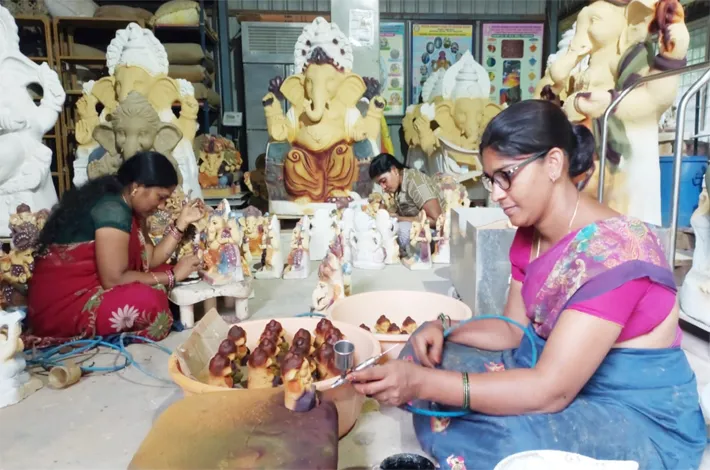
Professor Jayashankar Telangana Agricultural University initiative is giving artisans and devotees a sustainable alternative to chemical-based colours
T P VENU I hyderabad
Women at the Natural Dye Processing and Incubation Centre (NDPIC) at Professor Jayashankar Telangana Agricultural University (PJTAU) are leading a quiet revolution by producing natural dyes and biodegradable paints for colouring Ganesh idols. The centre also offers finished clay Ganesh idols in various sizes at affordable prices.
Speaking to Metro India, Dr Lakshmi Pooja Sanku, Assistant Professor, Department of Apparel and Textiles, and Officer-in-Charge of NDPIC, said, “Every year, the unit produces 18 to 22 tonnes of biodegradable paints. The incubation unit facilitates weavers, artisans and entrepreneurs by providing training, production facilities and opportunities to develop and test new products on a pilot scale.”
The paints made from natural dyes contain natural pigments and gums as their main ingredients. They are easily biodegradable and do not harm aquatic life. In contrast, plaster-of-Paris idols are often painted with metallic colours such as gold and silver that may contain toxic substances, including mercury, cadmium, lead and carbon.
The ingredients used to make the natural dyes include pomegranate, marigold, annatto, indigo, ratanjot, flame of the forest, turmeric and babool gum, among other roots, flowers, seeds and leaves. These natural ingredients produce vibrant shades such as yellow, orange, greenish yellow, golden yellow, blue, black, grey, brown and wheatish brown.
People can purchase biodegradable paints and clay idols from the centre. A six-inch idol costs Rs 140, while a five-foot idol costs Rs 23,000. For orders of 500 idols, an advance payment of 50 per cent is required, with a delivery period of 15 days.
The biodegradable natural-dye surface paints are priced between Rs 150 and Rs 750 and are available in shades of yellow, blue, red, orange, violet, pink, white and black.
The Telangana State Pollution Control Board (TSPCB) sponsored Rs 1 crore in 2016 for the production of biodegradable eco-paints. The centre has also developed eco-friendly Holi colours as part of the NAIP Value Chain in Natural Dyes project, a World Bank-funded ICAR initiative.
PJTAU's natural-dye technologies have had a significant impact on farmers in Telangana by developing value chains around natural dye-producing crops and promoting their cultivation on unused lands. The identification, collection and cultivation of natural dye sources can improve the economic viability of rural communities.
The technology also offers better livelihood opportunities to weavers, handicraft artisans and hobby groups engaged in sustainable product development in Telangana.