22 October, 2026 | 9:26 PM


A collection of scientific theories
22-03-2026 12:00:00 AM
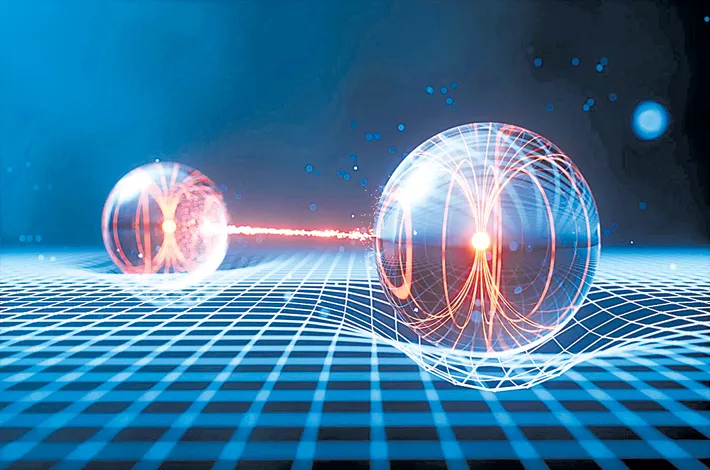
A group of young theorists, led by high school student Arth Shrivastava with contributions from classmates Aayush Tulasi Ethakotha and Parakusham Prince Rohan (all in 9th grade), have published a speculative paper titled "A Collection of Theories" in the March 2026 issue of the Journal of Emerging Technologies and Innovative Research (JETIR). The paper compiles five original conceptual ideas that build on foundational concepts from quantum mechanics, general relativity, thermodynamics, and related fields.
Drawing inspiration from sources like Stephen Hawking's A Brief History of Time and various online scientific resources, the authors aim to bridge gaps between different areas of physics while addressing longstanding puzzles and proposing hypothetical scenarios. The first theory tackles the famous black hole information paradox, which questions whether information about matter falling into a black hole is permanently lost—potentially violating quantum conservation laws—or preserved somehow.
Shrivastava proposes that quantum gravity fluctuations below the Planck scale introduce uncertainties in spacetime curvature near the singularity. Although classical general relativity predicts infinite density and zero volume at the singularity, the author argues that volume approaches but never reaches zero due to these quantum effects. This uncertainty, he suggests, allows information to "bounce" outward via entangled virtual particle pairs near the event horizon, aligning with Hawking radiation while preserving the singularity's structure.
The mechanism relies on asymmetries in the universe's "arrows of time" (psychological, thermodynamic, and cosmological) inside black holes, enabling gradual decay without outright information destruction. A more dramatic second hypothesis explores a sci-fi-inspired "Quantum Gravity Apocalyptical" scenario. It imagines a future device amplifying quantum spacetime fluctuations from sub-Planck scales into the classical realm. As these fluctuations grow in amplitude, the author envisions the emergence of positive and negative energy densities, potentially forming transient wormholes, unpredictable time warps, and dimensional instabilities.
Over time, this could cascade into universal-scale disruption, though the paper stresses the idea remains purely speculative and impossible with foreseeable technology. It draws analogies to gravitational waves and cosmic expansion to underscore how seemingly minor quantum effects might scale catastrophically if unnaturally forced into macroscopic influence. The third proposal examines Bose-Einstein Condensates (BECs)—a state of matter where bosonic particles cool near absolute zero and occupy a single quantum state with superfluid properties.
Shrivastava hypothesizes that in a BEC, uniform thermal energy distribution and quantum entanglement eliminate a central gravitational curvature point. Spacetime around such a condensate would remain largely flat, with minimal stretching or light-bending effects, as all points exhibit equal "depth" in curvature. The author links this to optical density measurements from BEC experiments, suggesting reduced quantum uncertainties at near-absolute-zero conditions could stabilize spacetime in novel ways, though limited to bosonic systems.
In the fourth theory, on "Wormhole Decay Tunnel," the paper reinterprets Einstein-Rosen bridges (wormholes) as arising from quantum uncertainties connecting singularities of black holes (or a black hole and hypothetical white hole). The fragile "throat" connecting the ends makes wormholes inherently unstable and short-lived. Upon decay, the author speculates that separating singularities trigger Higgs field interactions, producing virtual particle-antiparticle pairs that become real matter and antimatter.
A collision between black and white hole singularities might average out extreme time dilations to near-zero, potentially annihilating surrounding matter while allowing information to escape via uncertainties—though paradoxes involving time travel remain unresolved. Finally, the "Tachyonic Space-time" section discusses hypothetical tachyons—particles with imaginary mass theorized to always exceed light speed. Their unusual energy-momentum relations (reversing classical proportionality) allow faster-than-light travel without violating relativity in abstract mathematical terms, though they break causality.
The author speculates that harnessing tachyons could enable effective time travel or teleportation, dramatically altering perceptions of classical reality, but emphasizes their purely theoretical status. The paper, while enthusiastic and wide-ranging, combines established physics concepts with highly speculative extensions and personal interpretations. Published in JETIR—an open-access journal that has faced criticism for rapid publication timelines and questions about its peer-review rigor—the work reflects youthful curiosity in tackling frontier problems. The authors invite experts and readers to engage with the ideas, positioning the collection as a thought-provoking gateway to interdisciplinary scientific exploration rather than definitive conclusions.