9 October, 2026 | 12:30 AM


25 Years: A Story Beyond the Goal
09-10-2026 12:00:00 AM
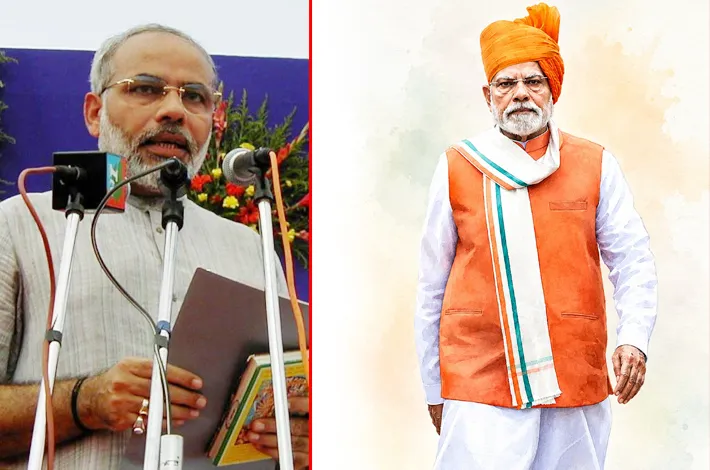
In India’s political history, there have been certain personalities whose journeys have extended far beyond the corridors of power. They have shaped their political identities through a long process of organisational work, ideological commitment, public service and nation-building.
Narendra Modi’s political journey can also be viewed through this broader perspective. It is the journey of a volunteer who imbibed the values of public service through the shakha of the Rashtriya Swayamsevak Sangh (RSS), built his identity through organisational work in the Bharatiya Janata Party, led Gujarat, and eventually established himself at the centre of national politics as the Prime Minister of India.
On 7 October 2001, Narendra Modi took oath as the Chief Minister of Gujarat. In 2026, he is completing 25 years as the head of a government. During this period, he has continuously worked and contributed towards improving people’s quality of life and advancing the country’s progress. However, Narendra Modi’s story did not begin in 2001. Behind this long journey lie decades of organisational experience, discipline and ideological training.
From an RSS Volunteer to a Servant of the Nation
Narendra Modi’s public life has been deeply connected with the Rashtriya Swayamsevak Sangh. His organisational journey began in Ahmedabad. He later took on responsibilities as a pracharak. To understand the background of Narendra Modi’s personality, it is important to understand his role as an RSS volunteer. The life of a volunteer places emphasis on organisation, discipline, commitment to the nation and continuous engagement with society.
He subsequently became active in the organisation of the Bharatiya Janata Party. By taking on organisational responsibilities at various levels, he gradually advanced in national politics. Thus, an important foundation of Narendra Modi’s political journey has been organisation-building and a worker-centric political culture.
When Narendra Modi assumed the office of Chief Minister of Gujarat on 7 October 2001, the state was going through a difficult phase. In 2001, a devastating earthquake affected large parts of Gujarat, including Kutch. Before that, the state had also been affected by natural disasters such as droughts and cyclones. Modi has referred to these challenges in several of his speeches and statements. Subsequently, he sought to develop a model of governance in Gujarat that placed infrastructure development, investment, electricity, agriculture, administrative reforms and overall development among its priorities.
Narendra Modi served as the Chief Minister of Gujarat for 13 years. This became an important foundation of his administrative experience and later shaped his role in national politics.
From BJP Leader to Prime Minister
The 2014 Lok Sabha election marked a decisive turning point in Indian politics. Under Narendra Modi’s leadership, the BJP secured a full majority in the Lok Sabha. On 26 May 2014, he took oath as Prime Minister. In 2019, the BJP secured a full majority once again. In 2024, Narendra Modi took oath as Prime Minister for the third time.
One particularly noteworthy aspect of this journey is that an ordinary organisational worker rose to the country’s highest elected executive office.
After 2014, Narendra Modi associated himself with the concept of the Pradhan Sevak. For his supporters, the term became a symbol of his political style. At its core is the idea that power is not a privilege but a responsibility.
From ‘Sabka Saath, Sabka Vikas’ to ‘Viksit Bharat’
As Prime Minister, Narendra Modi’s governance has been widely associated with large-scale welfare and development-oriented programmes. These include the Jan Dhan Yojana, Swachh Bharat Abhiyan, Ujjwala Yojana, Pradhan Mantri Awas Yojana, Ayushman Bharat and Direct Benefit Transfer, through which efforts have been made to reach millions of beneficiaries.
The welfare of the poor has remained a key priority of the government. Schemes have been designed around basic needs such as housing, sanitation, banking, cooking gas, healthcare and food security. The fundamental objective of these programmes has been to provide basic facilities and economic opportunities to the poor and vulnerable sections of society.
The political concept of Sabka Saath, Sabka Vikas evolved further through Sabka Prayas and eventually towards the broader national goal of Viksit Bharat.
Digital India: A Changing Face of Governance
One of the defining features of the Narendra Modi era has been the rapid digitalisation of India’s public life. Digital payments, UPI, Aadhaar-based services, Direct Benefit Transfers and digital public infrastructure have transformed the nature of interaction between citizens and the government.
India’s digital capabilities have also received international recognition. During India’s G20 Presidency in 2023, particular emphasis was placed on digital public infrastructure, the Global South and inclusive development. This was not merely a technological transformation. It was accompanied by a broader effort to make governance more direct, efficient and citizen-centric.
Leadership Through Decisive Decisions
During Narendra Modi’s tenure as Prime Minister, several major decisions were taken that had far-reaching consequences for Indian politics and the economy. These included demonetisation in 2016, the introduction of GST in 2017, constitutional changes related to Jammu and Kashmir in 2019, the Citizenship Amendment Act, and changes to the country’s railway and criminal laws.
These decisions received support as well as criticism. This is natural in a democratic process. The true test of any major decision lies in its long-term impact, citizens’ experiences and its institutional consequences.
A New India on the Global Stage
Over the past decade, India’s role on the global stage has become an important feature of Narendra Modi’s leadership. India has played significant roles in platforms and initiatives such as the Quad, G20, the Global South and the International Solar Alliance, among others.
India’s G20 Presidency in 2023 was particularly significant. At the G20 Summit in New Delhi, the African Union was admitted as a permanent member. This was an important indication of India’s diplomatic priorities and its efforts to give greater prominence to the voice of the Global South on the international stage.
A key message of Modi’s foreign policy has been that India will not remain merely a participant in the global order, but will seek to play the role of a strong nation capable of shaping global outcomes.
The Values of a Volunteer and the Responsibility of a Prime Minister
To understand the journey of the Prime Minister, it is also important to understand his life as a volunteer. The Sangh Parivar gave him organisational values. His long experience as a BJP worker and his experience of administrative leadership, together, these three levels shaped his political personality.
This is why organisation, party workers and public participation have held a special place in his politics. Even after becoming Prime Minister, he has often described himself as a servant of the people.
After completing 25 years in public administration in 2025, he stated that serving the nation is the greatest honour and responsibility. He expressed his resolve to work harder, guided by the values of the Constitution, to achieve the collective national goal of Viksit Bharat.
Narendra Modi’s Contribution as Prime Minister of Independent India
There is little doubt that Narendra Modi holds an important place among the most influential and transformative Prime Ministers of India since Independence. His contribution cannot be assessed solely on the basis of electoral success. His government has developed its own distinct style of governance, marked by decisiveness in decision-making, expansion of welfare programmes, digital transformation, global diplomacy and the setting of long-term national goals.
The true contribution of any leadership is ultimately judged by the test of time. It is measured through the lasting consequences of its decisions, its impact on institutions, the changes it brings to citizens’ lives and its influence on future gene- rations. In this sense, Narendra Modi’s 25 years in public life represent an important chapter in the history of independent India.
From Service to Resolve
The journey that began in an RSS shakha travelled through the Chief Minister’s Office in Gujarat and eventually reached the office of the Prime Minister of India.
It is the journey of a worker in an organisation becoming a leader of the nation, and then a Prime Minister calling upon the country to achieve important national goals.
If this 25-year journey were to be summed up in a single sentence, it could be said: This is a journey of responsibility more than power. A journey of service more than position. It is not merely the journey of an individual, but the journey of an idea and of India’s resolve to achieve the vision that he describes as ‘Viksit Bharat’.
From BJP Leader to Prime Minister
The 2014 Lok Sabha election marked a decisive turning point in Indian politics. Under Narendra Modi’s leadership, the BJP secured a full majority in the Lok Sabha. On 26 May 2014, he took oath as Prime Minister. In 2019, the BJP secured a full majority once again. In 2024, Narendra Modi took oath as Prime Minister for the third time.
Modi @25
Twenty-five years in public life is a significant period for any individual. In Narendra Modi’s case, this period spans three distinct roles, the RSS volunteer, the BJP organiser and leader, and the Chief Minister of Gujarat and Prime Minister of India.
During these 25 years, India too has witnessed significant changes. There have been transformations in the economy, technology, infrastructure, digital payments, social security schemes, foreign policy and political thought. The country views many of these changes as achievements associated with his leadership.
Sunil Bansal