14 September, 2026 | 1:51 PM


BJP reboots poll machine
29-05-2026 12:00:00 AM
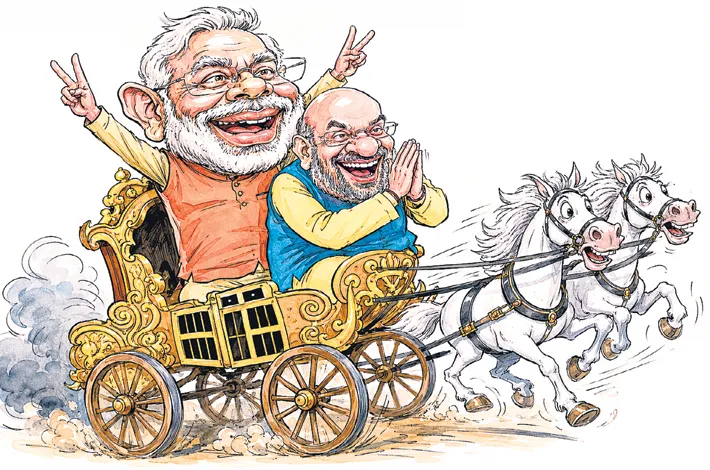
- Ministers take charge of state units amid looming leadership shifts
- BJP accelerates organisational overhaul
BJP is shifting ministers into organisational roles to strengthen its election machinery ahead of crucial state polls and 2027.
Union Ministers of State like Harsh Malhotra and Pankaj Chaudhary have been tasked with reviving key state units.
The reshuffle signals a larger churn in which Chief Ministers, Deputy CMs, and ministers could be moved into party posts to make way for new faces in government.
BJP’s strategy reflects its long-standing model of rotating leaders between governance and organisation to maintain electoral agility and cadre control.
With battles looming in states like Bihar, West Bengal, and Punjab, the party is focusing on booth-level expansion and tighter coordin-ation between got and organisation.
metro india news I New Delhi
In a significant move signalling the Bharatiya Janata Party’s (BJP) renewed focus on strengthening its organisational machinery ahead of key state polls and the broader 2027 electoral cycle, the party has appointed sitting Union Ministers of State to head crucial state units. This latest round of appointments underscores a fluid interplay between government and party roles, with indications that several Chief Ministers, Deputy Chief Ministers, Union Ministers, and state ministers could soon transition to organisational posts, freeing up berths for fresh faces in the executive.
The most notable development came on May 29 (effective immediately, announced May 28), when Union Minister of State Harsh Malhotra was appointed president of the BJP’s Delhi unit, replacing Virendra Sachdeva. Malhotra, a first-time Lok Sabha MP from East Delhi and Minister of State for Corporate Affairs and Road Transport & Highways, brings extensive grassroots experience as a former councillor and Mayor of the East Delhi Municipal Corporation. Party insiders view his elevation as a strategic bid to energise the Delhi unit, which has faced challenges in the national capital.
Simultaneously, Dr. Archana Gupta was named Haryana BJP president (the second woman in the role in recent decades), Kewal Singh Dhillon (a 76-year-old former Congress leader known for his business background) took charge in Punjab to bolster outreach in Sikh and rural pockets, and young MLA Abhishek Debroy was appointed in Tripura. These changes represent National President Nitin Nabin’s first major organisational reshuffle since assuming the top post earlier in 2026.
This pattern is not new. Union Minister of State for Finance Pankaj Chaudhary was appointed Uttar Pradesh BJP president in December 2025. Earlier precedents include leaders like Bandi Sanjay Kumar, who served as Telangana BJP president before becoming MoS in the Ministry of Home Affairs, and G. Kishan Reddy, a Union minister who has shouldered state organisational responsibilities.
According to the BJP’s internal constitution, the national president appoints state unit chiefs, a process that has intensified since mid-2025 as the party completed organisational elections in a phased manner to pave the way for leadership transitions, including Nabin’s own formal election. : P.V.N. Madhav in Andhra Pradesh (July 2025), Sanjay Saraogi in Bihar (December 2025), Ravindra Chavan in Maharashtra (July 2025), and others in Telangana, Mizoram, and more.
Sources indicate that in the coming months, the party may formalise further shifts. Several sitting Chief Ministers and Deputy CMs in BJP-ruled states, along with Union and state ministers, could be moved to key party posts at the national or state levels. This would create vacancies for new ministerial inductees, allowing the party to inject fresh blood while retaining experienced hands in organisational roles critical for booth-level management and electioneering.
Such rotations are a hallmark of BJP’s cadre-based approach, honed under leaders like Prime Minister Narendra Modi, Amit Shah, and previous national presidents. Historically, the party has seamlessly moved leaders between government and organisation. For instance, after the 2023 assembly wins in Rajasthan, Madhya Pradesh, and Chhattisgarh, surprise CM picks like Mohan Yadav in MP sidelined some veterans, who were accommodated elsewhere. Similar dynamics played out in earlier terms with leaders like Vijay Rupani and Biplab Deb transitioning post-CM tenures.
Strategic imperative
Analysts see these moves as preparation for upcoming battles. Key states like Bihar, West Bengal (where BJP recently made gains leading to government formation under Suvendu Adhikari), Punjab (2027 polls), and others require robust ground-level leadership. By placing ministers like Malhotra in Delhi and Chaudhary in UP—both electorally vital—the party aims to leverage governmental experience for organisational revival and better coordination between governance delivery and political outreach.
A senior BJP leader, speaking anonymously, told reporters: “The party believes in constant churning. Leaders in government gain administrative insight, which they can deploy in organisation-building, while organisational veterans ensure ideological sharpness in governance. This two-way traffic keeps the party agile.”
Critics, however, point to an increasing reliance on defectors or late entrants in some roles, arguing it dilutes traditional cadre loyalty. Defectors-turned-CMs in eastern states have raised eyebrows, though the party maintains that performance and winnability are paramount.
Broader context and numbers
BJP currently governs or shares power in over a dozen states, with 18 Chief Ministers or equivalents from the party or NDA allies in recent counts. The organisational structure spans 37+ state/UT units, each with presidents overseeing district and mandal levels. Internal elections involve thousands of delegates, culminating in the national president’s selection once sufficient state units are in place. Nitin Nabin’s election process in early 2026 followed this template.
With Lok Sabha strength solid and state elections on the horizon, the party is also eyeing cabinet resets at the Centre. Speculation swirls around inducting new faces while shifting some ministers to party roles, aligning with the “one family, one post” ethos in spirit if not always in letter.
Party General Secretary (Organisation) B.L. Santhosh and other core leaders are overseeing these transitions, ensuring alignment with RSS-inspired discipline. As one observer noted, “BJP doesn’t see government and party as separate silos; they are complementary arms of the same mission.”
As these changes unfold, they promise to reshape the contours of BJP’s leadership for the next phase of its dominance in Indian politics. Whether this leads to smoother governance or sharper electoral machines remains to be seen, but the intent for renewal is unmistakable. The coming weeks are likely to bring more announcements, keeping both party workers and political watchers on their toes.