21 September, 2026 | 3:39 AM


India’s Longest Irrigation Tunnel Nears Completion in MP
18-07-2026 12:00:00 AM
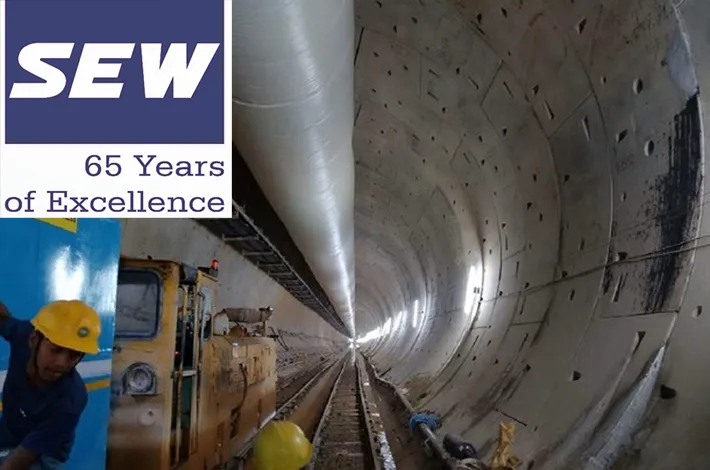
SEW Creates History
metro india news I bhopal
In a landmark achievement for Indian infrastructure, the Hyderabad-based SEW Infrastructure Ltd, through its Patel-SEW Joint Venture, has steered one of the country’s most formidable engineering challenges to near completion. The 11.952-km Sleemanabad Tunnel, part of the Bargi Diversion Project under the Narmada Valley Development Authority (NVDA), stands as India’s longest irrigation tunnel. After nearly 17 years of relentless effort against daunting geological obstacles, the project is in its final stages, with excavation largely finished and only minor cut-and-cover sections remaining.
This milestone represents far more than a technical triumph. It is a feather in the cap for the Madhya Pradesh Government, which has prioritized water security and agricultural transformation in the state’s drought-prone regions. Chief Minister Mohan Yadav is scheduled to visit the Katni district site, underscoring the project’s significance for the Vindhya and Mahakaushal regions. The tunnel promises to rewrite local legends by uniting the waters of the Narmada with the Son River basin through human ingenuity.
SEW’s engineering prowess shines through adversity
Awarded in 2008 to the SEW Joint Venture SEW-Patel on a turnkey basis, the project initially carried an estimated cost of ₹799 crore. SEW, a company with decades of expertise in heavy civil engineering, irrigation, dams, and pipelines since its founding in 1959, brought specialized knowledge to the table. The venture tackled what many considered one of India’s most technically demanding irrigation endeavors. The tunnel, with a 10.14-metre diameter, bores through the Vindhya mountain range at depths of nearly 30 metres. It will enable gravity-fed transport of Narmada water, eliminating energy-intensive pumping. Once fully operational, the right bank main canal will boast a discharge capacity of 227 cumecs — the highest for any canal in Madhya Pradesh.
SEW’s achievement is particularly noteworthy given the extreme challenges. Engineers navigated hard marble, limestone, dolomite, and slate formations interspersed with massive underground caverns and weak zones. Water seepage reached staggering rates of up to 25,000 litres per minute, triggering frequent soil collapses and halting progress. The American Robbins Tunnel Boring Machine (TBM) deployed initially proved inadequate and became inoperable amid the harsh geology.
Demonstrating resilience and innovation, the joint venture imported a advanced German-made Herrenknecht TBM and adopted specialised TAM grouting technology to stabilize formations. Excavation proceeded from both ends, passing safely beneath inhabited areas, a national highway, and railway tracks without surface damage. Over 300 engineers and labourers worked in shifts, showcasing the human element behind SEW’s success.
Tragically, some workers lost their lives, highlighting the risks involved in such projects. SEW’s track record in irrigation and tunnelling — including contributions to major dams like Nagarjuna Sagar and others across states — equipped it to persist where others might have faltered. The company’s commitment turned a project stalled for years into a history-making endeavor. By mid-2026, physical progress under the contract reached approximately 96.66%, with the main tunnel and much of the associated 12.135-km open canal completed.
Transformative impact on Madhya Pradesh
For the Madhya Pradesh Government, this project symbolizes decisive action on water management and rural development. The tunnel will irrigate around 2.45 lakh hectares across nearly 1,450 villages in six districts: Jabalpur, Katni, Maihar, Satna, Rewa, and Panna. Satna is poised to receive the largest share, followed by Maihar and Katni, with benefits extending to Rewa and Panna. It will also supply drinking water to Katni city and surrounding areas, boosting agricultural productivity, strengthening the regional economy, and enhancing water security in historically drought-prone zones.
Irrigation potential for over 44,160 hectares has already been created. The government targets 87,433 hectares by December 2026 and 154,693 hectares by December 2027, scaling up to full capacity thereafter. This phased rollout underscores a strategic approach to maximizing benefits swiftly. The project’s cost has risen to approximately ₹1,610 crore due to geological realities, extensions, advanced technologies, and dewatering efforts. While cost overruns are common in such complex undertakings, the long-term returns in terms of agricultural output, employment, and regional development are expected to far outweigh the investment. Critics have raised questions about delays and payments, but the completion phase highlights effective recent momentum under the current administration.
A broader legacy for Indian infrastructure
SEW’s success at Sleemanabad adds to India’s growing expertise in large-scale tunnelling for water security. As climate variability increases pressure on water resources, projects like this demonstrate how engineering excellence can bridge river basins and revive arid lands. The gravity-flow design is environmentally efficient, reducing the carbon footprint compared to pumped systems.The tunnel’s completion also debunks mythological notions of estranged rivers, symbolizing unity and progress. Inauguration is anticipated soon, possibly by Prime Minister Narendra Modi alongside CM Mohan Yadav, marking a proud moment for national infrastructure.
For SEW Infrastructure, this is a crowning achievement that validates its core competencies in tunnelling and irrigation. It reinforces the company’s reputation for delivering in the face of extreme adversity, paving the way for future ambitious projects. Madhya Pradesh’s government, too, earns acclaim for sustaining vision through challenges, delivering a water lifeline to lakhs of farmers.As water begins to flow through the Sleemanabad Tunnel, it will not only quench parched fields but also irrigate hope across vast stretches of central India.
This engineering marvel stands as testimony to what persistent collaboration between government and industry can accomplish — turning formidable mountains into conduits of prosperity.