21 November, 2026 | 2:12 AM


Chukka Ramaiah: As I Knew Him
21-11-2026 12:00:00 AM
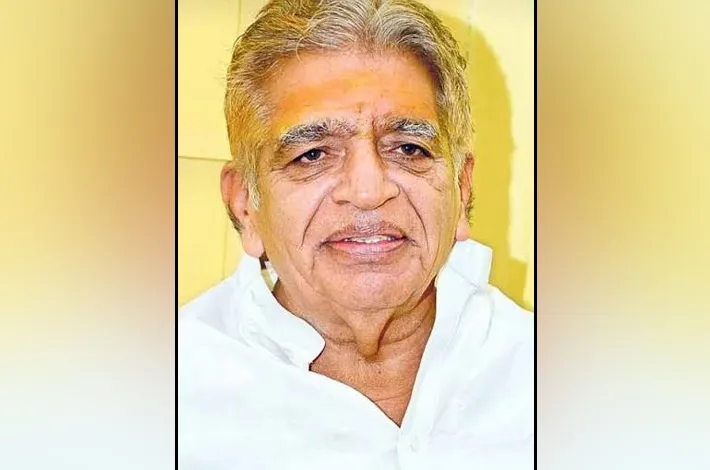
In the competitive world of Indian engineering education, few names carry the weight of Chukka Ramaiah. Popularly known as “IIT Ramaiah,” he prioritised conceptual clarity over rote learning
VJM Divakar I hyderabad
Soon after obtaining my Master’s degree in English Literature, I joined the then-prestigious Andhra Pradesh Residential Junior College at Nagarjuna Sagar in undivided Andhra Pradesh as a lecturer in 1981. Two years later, the AP Residential Degree College was also established there.
All my seniors from the junior colleges were promoted and posted to the Degree College. I continued teaching for some time until the new faculty was appointed. It was then that Chukka Ramaiah Sir joined the Degree College as Head of the Mathematics Department. Incidentally, he was allotted the quarters next to mine. That is how our association began.
Ramaiah Sir took the initiative to establish the AP Residential Educational Institutions Teachers’ Union with the support of veteran leaders such as C. Raghavachari, A. Somasundar and M.J. Manikya Rao. I was closely associated with him in the Union’s activities, and he helped me become one of its office-bearers. Our journey continued until I left the job in 1986.
Along with other teachers, Ramaiah Sir would go for long evening walks on the Nagarjuna Sagar Dam. During those walks he taught me a great deal about teaching and the values of the profession. He encouraged me to conduct special classes after college hours for slow learners. Incidentally, his daughter Rajeswari became my student at the Junior College. When I faced a difficult conflict with my Principal, M. Sreenivas Reddy, it was Ramaiah Sir who stood firmly by me.
Few people know that Ramaiah Sir regularly invited students to his home and taught them for several hours after college. Because the students would miss dinner, he provided meals for them. His deep commitment to teaching never prevented him from working for the welfare of the teaching community.
After I left teaching and joined the Indian Express as a reporter, my Chief of Bureau, Sri P.S. Sundaram, assigned me the education beat in addition to political reporting. This once again brought me into close contact with Ramaiah Sir. He helped me file several exclusive reports on education. Through him, I also became closely associated with Prof. M. Malla Reddy, Prof. Navneeth Rao and many other academic scholars. When he started a residential junior college in Nalgonda, he invited me as the chief guest. At a personal level, he arranged coaching for my daughter for the EAMCET. She performed well and secured a free seat in a prestigious engineering college.
More than his academic accomplishments, Ramaiah Sir is a kind soul, a compassionate human being, a reformer, and a gentleman to the core. I wish my guide, friend and philosopher a very happy 100th birthday.
In the competitive world of Indian engineering education, few names carry the weight of Chukka Ramaiah. Popularly known as “IIT Ramaiah,” he prioritised conceptual clarity over rote learning.
Born on 20 November 1925 in Gudur village (now in Jangaon district of Telangana), Ramaiah grew up in a traditional Brahmin family. His early years were shaped by the social inequalities of the time. He actively opposed feudal practices and untouchability in his village, drawing inspiration from Mahatma Gandhi’s movement for social reform. During the turbulent period of the Telangana armed struggle against the Nizam’s rule and the Razakars, he joined the rebellion and spent several years in jail.
After his release, Ramaiah chose teaching as his path. He began as a mathematics teacher in schools across the Telangana region and later rose to become Principal of the Andhra Pradesh Residential Degree College at Nagarjuna Sagar. He took voluntary retirement around 1983 and moved to Hyderabad. Financial pressures after retirement played a part in his next chapter, but a deeper motivation emerged when his daughter gained admission to an IIT. At the campus he observed how few students from Andhra Pradesh and Telangana had secured seats compared with those from other states. This disparity spurred him to act.
In 1985, Ramaiah established the IIT Study Circle in Nallakunta, Hyderabad. What began with a handful of students seeking mathematics coaching grew rapidly through word of mouth. Classes often started as early as 4 a.m.—a discipline that students and parents accepted with determination. Ramaiah emphasised understanding the underlying concepts of mathematics rather than memorising formulae. He believed original thinking came from fresh minds and often credited his own students with teaching him new approaches.
The institute developed a rigorous selection process of its own. Thousands of aspirants applied each year; around 125 to 175 students were chosen through an entrance test. Demand became so high that other coaching centres began preparing students specifically for admission into Ramaiah’s programme. Early batches produced dramatic results. In 1986, eight of the fifteen students cleared the IIT entrance examination.
Over the decades the centre consistently achieved a high success rate, with many first-generation learners from rural areas and social-welfare institutions among the successful candidates. Estimates place the number of students who entered the IITs under his guidance at well over two thousand.
Ramaiah’s approach remained focused on accessibility. The coaching operated with modest fees relative to commercial alternatives and extended support to students from economically weaker sections. He also mentored groups from Andhra Pradesh Social Welfare Residential Junior Colleges, helping a significant number of first-generation learners secure places in the premier institutes.
Beyond the classroom, Ramaiah contributed as a public figure. In 2007 he was elected to the Legislative Council from the Teachers’ Constituency covering Warangal, Khammam and Nalgonda, serving for six years. He advocated the establishment of an IIT in the Telangana region and spoke consistently about educational opportunities and the region’s development needs. A strong supporter of Telangana statehood, he highlighted issues of poverty and backwardness. He authored more than sixteen books in Telugu, primarily on education, including works that examined teaching methods and the broader landscape of learning.