18 October, 2026 | 6:44 PM


CM sets reform agenda at collectors meet
04-03-2026 12:00:00 AM
■ Revanth's strong Solar push and emphasis on Welfare Transparency
■ 99 Day Action Plan to kick-off from March 6
Collectors prepare for Landmark Digital Census
In the morning session, Chief Secretary K Ramakrishna Rao, along with Director of Census Operations, Telangana Bharathi Hollikeri, reviewed preparations with District Collectors for the first phase of Census 2027 beginning May 11. He said the exercise will be India’s first fully digital Census, conducted through a dedicated mobile application to ensure real time, accurate and transparent data collection.
Self Enumeration will begin 15 days before House Listing Operations. Collectors were directed to ensure complete coverage of all households, including remote and vulnerable areas, and to provide structured training for enumerators and supervisors. Officials were asked to maintain timelines, data quality and technological readiness. Senior officials including Jayesh Ranjan, Rahul Bojja and Sandeep Kumar Sultania attended.
metro india news I hyderabad
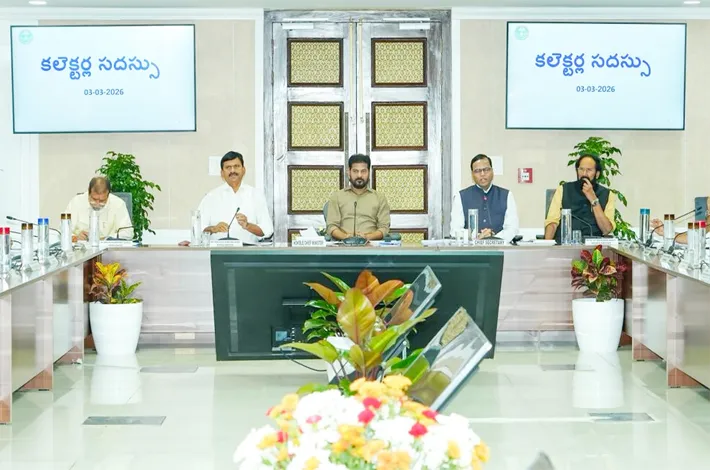
The Telangana Chief Minister A Revanth Reddy outlined an ambitious governance roadmap centered on accountability, technology driven transparency and grassroots participation at a high level review meeting of District Collectors held at the State Secretariat. Several Cabinet Ministers, senior advisors, the Chief Secretary, DGP and district collectors from across the State attended the conference.
The Chief Minister directed officials to ensure active involvement of ward members, sarpanches, municipal ward members, chairpersons, corporators and mayors in the 99 Day Action Plan. He instructed that one day structured training programmes be conducted at district headquarters to clearly explain their roles and responsibilities, supported with printed reference material.
A strong push for solar energy adoption formed a key part of the agenda. Farmers are to be encouraged to shift from conventional pump sets to solar pump sets, with awareness campaigns highlighting long term benefits. Households should also be educated on installing rooftop solar plants, using solar power and connecting to the grid for additional income generation.
Collectors were asked to present details of beneficiaries of major welfare schemes in village and ward meetings, including new ration cards, fine rice distribution, Indiramma housing, free electricity up to 200 units, loan waivers, free bus travel and subsidised LPG cylinders.
The cumulative impact of these initiatives at village, mandal, constituency and district levels must be transparently shared with the public.
Emphasising healthcare access, the Chief Minister directed that services of 35 government medical colleges be fully utilised, with PHCs and CHCs referring patients appropriately to ensure advanced care. In welfare delivery, facial recognition technology must be implemented to ensure benefits reach only eligible persons. He noted that similar verification in pension schemes helped remove three lakh ineligible beneficiaries.
Road safety and public infrastructure also received focus. The Transport Department was instructed to complete digitisation of its data, conduct fitness checks for school buses and commercial vehicles and organise eye screening camps for drivers. A dedicated WhatsApp number will be introduced to report dangerous road conditions and potholes for swift action. Strict measures were ordered to prevent dumping of waste along the Outer Ring Road and service roads.
Attention was also given to timely payment of midday meal bills, regulation of hostels in urban areas, prevention of drug use in educational institutions and appointment of psychologists in private and corporate schools.
In agriculture, soil testing, crop diversification, market aligned cultivation and effective coordination between Agriculture and Civil Supplies departments were stressed. Issues in the urea app must be resolved and nano urea demonstrations conducted at field level.
The 99 Day Action Plan will run from March 6 to June 12 under the banner Praja Palana Pragati Pranalika, implemented in five phases from village to State level, culminating in State Formation Day celebrations.
Ten thematic areas including sanitation, health, welfare, agriculture, education, youth, women and environment will guide the programme. A dedicated mobile app will monitor progress, while foundation stones and inaugurations of development works will be taken up across departments during this period.