7 October, 2026 | 12:40 AM


Confusion Over BC CM Claim
07-10-2026 12:00:00 AM
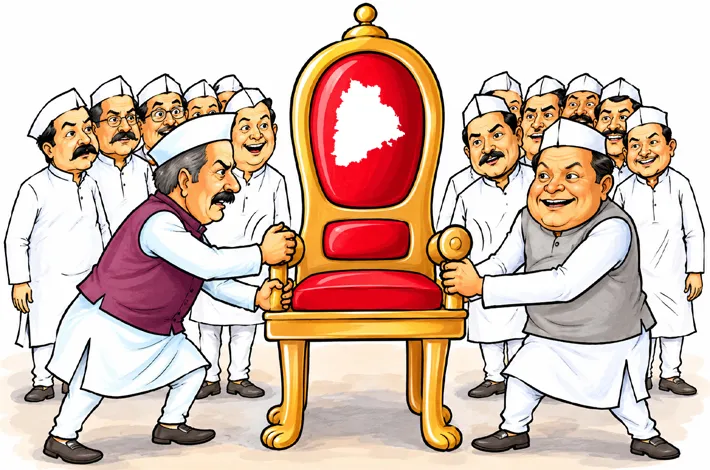
The Claim Deepens Caste Fault Lines in Telangana
metro india news I hyderabad : Conflicting statements from senior Congress leaders have triggered fresh uncertainty among Backward Classes in Telangana, raising questions about the party’s commitment to social justice and its internal power equations. Telangana Pradesh Congress Committee president Mahesh Kumar Goud’s recent assertion that a BC leader will soon become chief minister stands in sharp contrast to Chief Minister A. Revanth Reddy’s repeated claims that he will remain in office for another decade, creating a perception of deliberate ambiguity.
At an OBC meeting in Shamshabad a few days ago, Mahesh Kumar Goud declared that a BC leader would become the state’s chief minister in the coming days. He claimed the assurance rested on the support of national leaders Rahul Gandhi and Mallikarjun Kharge. “We will take the constitutionally due share of BCs with dignity. If necessary, we will fight and secure it. Rahul Gandhi is the true protector of OBCs. He will become prime minister soon. Congress will remain in power in Telangana till 2039. We will return to office with 100 seats in the next Assembly elections,” he said.
Revanth Reddy, however, has struck a different note. At a meeting in Kollapur on July 18 and on other occasions, the chief minister stated that he would continue as chief minister for the next ten years and for another term as well, remaining in the post until 2034. “There is no doubt about it,” he asserted.
These parallel claims have left BC communities confused. While Mahesh’s remarks generated initial enthusiasm, the absence of any timeline has drawn sharp criticism from BC groups. Political observers note that the statements have reopened a Reddy-versus-BC leadership contest within the party. The situation is further complicated by the existing friction between the “old Congress” and the “green Congress” factions already visible in the state unit.
Singer Epuri Somanna’s satirical comments and songs targeting upper castes at the recent OBC gathering have added another layer of tension. Analysts argue that such rhetoric risks polarising upper-caste and BC communities at a time when the party needs broader social consolidation.
Political promises come easily; the real test lies in the seriousness of implementation. Mahesh’s declaration, made in the presence of other senior leaders, has opened a new debate. On the surface it appears as an expression of affinity for BCs. A closer reading, however, reflects the deep confusion inside the Congress and the ongoing struggle for leadership between Reddy and BC groups. There is a growing suspicion that the party is once again seeking to place its hand on the BC community, which has long served as a reliable vote bank.
The contradiction is stark. One side speaks of a BC chief minister in the near future; the other insists on a ten-year tenure for the current chief minister. What does “soon” actually mean—within two years, after 2029, or much later? The lack of precision has become a subject of widespread discussion.
A look at recent political history adds context. In the united Andhra Pradesh, the Telugu Desam Party held power for ten years from 1994, followed by ten years of Congress rule from 2004. After statehood, the BRS governed for ten years from 2014. Congress leaders now speak of another decade in office. If Revanth Reddy’s timeline is accepted and a BC leader is considered only after that, the prospect of a BC chief minister could stretch towards 2044.
Open-ended statements without clear deadlines risk being seen as an attempt to mislead a community that constitutes more than half the state’s population. BCs form over 50 per cent of Telangana’s population. During elections the Congress speaks of caste census, social justice and proportional representation. Once in power, however, the priority given to BCs in key appointments appears to diminish. Past “BC declarations” have not translated into the top executive post. The gap between rhetoric and action has already produced significant dissatisfaction within the community.
Internal party dynamics further weaken the credibility of the BC chief minister claim. The meeting at which Mahesh made the announcement reportedly saw limited participation from other Reddy leaders and prominent BC figures. This absence underscores the factionalism and lack of cohesion inside the state Congress. In practical terms, the state treasury, fund allocation, decision-making and administrative control rest with Revanth Reddy. The government functions according to his priorities. In such circumstances, the capacity of any other leader to force a change at the top remains open to doubt.
With no Congress government at the Centre, the national leadership has limited leverage over a strong state chief minister on whom the party depends politically and financially. Whether the high command can push a BC chief minister against Revanth’s wishes, and whether the party can win the 2029 elections without his leadership, remain unanswered questions.
The current approach also reveals strategic weaknesses. Anxiety over the possible erosion of the BC vote bank and the rising BJP challenge appears to be driving the rhetoric. Relying on old-style songs and attacks on upper castes is unlikely to prove an effective strategy. In a democracy, justice for one community is essential, but so is the ability to build coalitions across castes. A BC chief minister needs support beyond BC votes—upper castes, Scheduled Castes, Scheduled Tribes and minorities are equally necessary. Polarising speeches may increase division and ultimately harm the very community they claim to represent.
For the promise to gain public trust, it must be practical and credible. Vague future projections are insufficient. If the Congress is serious about a BC chief minister, it needs concrete steps. A large public meeting attended by Rahul Gandhi and Mallikarjun Kharge, with an official announcement of a clear post-2029 timeline, would carry weight.