27 September, 2026 | 12:34 AM


CPI invites Jagan for joint protests
27-09-2026 12:00:00 AM
kiranmai tutika I amaravati
The Communist Party of India’s (CPI) decision to reach out to YSR Congress Party (YSRCP) president Y.S. Jagan Mohan Reddy and seek his participation in a joint political campaign on public issues has opened a fresh debate over the shape of opposition politics in Andhra Pradesh. The immediate issue is drought and farmers’ distress, but the political implications of the CPI-YSRCP interaction have already extended beyond the September 26 round-table in Vijayawada.
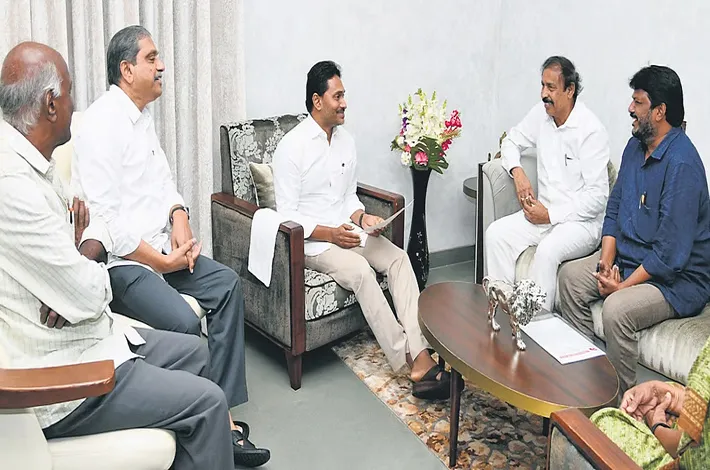
A senior CPI delegation comprising State secretary G. Eswaraiah, national executive member K. Ramakrishna, Akkineni Vanaja and P. Harinath Reddy met Jagan at the YSRCP central office in Tadepalli on Thursday. YSRCP State coordinator Sajjala Ramakrishna Reddy was also present. The CPI leaders invited Jagan to the round-table and said he had responded positively to the proposal for joint struggles on people’s issues. Eswaraiah said the CPI was seeking a broader opposition mobilisation over the drought situation, arguing that while the government had claimed cultivation over 65 lakh acres, actual sowing was around 50 lakh acres.
The development immediately drew criticism from former YSRCP leader and former Rajya Sabha member V. Vijayasai Reddy. Reacting on X, Vijayasai questioned the wisdom of the YSRCP working with CPI, pointing out that CPI is associated with the INDIA bloc. He wrote that a report had appeared in the YSRCP’s own publication about the party deciding to undertake joint struggles with CPI and asked YSRCP workers to consider the consequences of such an arrangement.
His reference to a leader sitting in an elevated chair was widely interpreted in political circles as a veiled reference to Sajjala Ramakrishna Reddy, who was present during the CPI-Jagan meeting. YSRCP leaders mentioned that YSRCP is prepared to join issue-based struggles concerning the people and farmers of Andhra Pradesh. Participation in such a platform should be seen in the context of fighting for public causes and does not, by itself, amount to an electoral alliance or political tie-up with the Congress-led INDIA bloc, they said.
Jagan’s political history with the Congress is fundamentally adversarial. He left the Congress in 2011 and subsequently built the YSRCP as a separate political force. In May 2012, Jagan was arrested by the CBI in the disproportionate-assets case and was subsequently remanded to judicial custody. At the time, Jagan’s family and YSRCP supporters alleged that the Congress-led UPA government was politically targeting him; Congress leaders denied involvement and maintained that the CBI investigation was court-directed.
That history remains politically significant because the Congress is now headed in Andhra Pradesh by Y.S. Sharmila, Jagan’s sister and former political associate. Sharmila has continued to maintain a separate political line from her brother. As recently as September 22, amid speculation following family interactions, she rejected suggestions that she was engaged in any political rapprochement with Jagan. She said meetings connected with her daughter’s wedding should not be interpreted as political developments and described reports suggesting otherwise as baseless.
There is nevertheless evidence of opposition parties working together on individual issues. On September 15, the YSRCP, Congress, CPI and CPI(M) participated in a CPI-organised round-table concerning alleged deletions and notices issued during the electoral-roll revision process. What about a Congress-YSRCP rapprochement? For now, that remains an open political question rather than an established development.
For the moment, the CPI-Jagan meeting has done something more immediate, it has brought the long-separated strands of Andhra Pradesh’s opposition politics into the same conversation, while leaving the much larger question of Jagan, Congress and Sharmila unresolved.