26 November, 2026 | 7:51 AM


Farmer questions media priorities
26-11-2026 01:39:32 AM
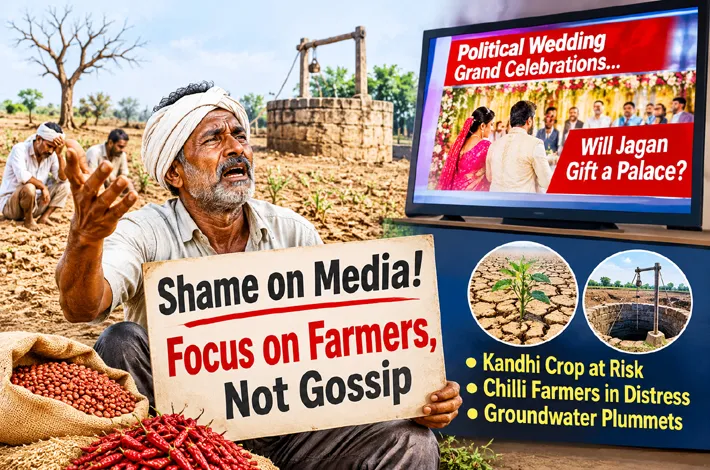
Media under fire as activist calls out focus on celebrity wedding over farmers’ crisis
metro india news I Amaravati : A sharp critique of television news priorities has drawn attention across Andhra Pradesh after Jakkula Veera Swamy, a concerned citizen from the state, shared a video on social media highlighting what he described as a steady decline in the quality and relevance of media coverage. After spending an hour watching television channels one recent evening, Swamy expressed deep disappointment at the direction news programming had taken, arguing that channels were drifting further from the issues that shape the daily lives of ordinary people.
The immediate trigger for his remarks was a prime-time debate that centred on the marriage of the daughter of Y.S. Sharmila, the president of the Andhra Pradesh Congress Committee. Instead of examining policy, governance or public welfare, the discussion revolved around speculation over whether Y.S. Jagan Mohan Reddy would gift a palace to the newly married couple. Swamy found the scale of attention given to this personal matter both puzzling and troubling. He questioned why the private affairs of political families commanded such extensive airtime while the hardships of five crore people in Andhra Pradesh received little notice. His frustration culminated in a blunt assessment: “Shame on media.”
Swamy used the moment to draw a clear contrast between the subjects dominating screens and the crises unfolding in rural areas. He pointed first to farmers growing kandhi, or red gram, a crop that depends heavily on timely rainfall. With agricultural borewells drying up across many regions, cultivators who have already invested significant sums in seeds, labour and inputs now face the grim prospect of watching their crops wither. The uncertainty over how to protect these fields has left farming families anxious and financially strained. Swamy asked why television channels had not organised sustained debates on this pressing agricultural emergency.
He extended the same concern to chilli farmers, another major community in the state whose produce forms a vital part of both local livelihoods and the broader economy. These growers, he noted, are confronting their own set of difficulties, from input costs to market uncertainties and water shortages. Despite the scale of their challenges, their struggles rarely feature in the high-decibel discussions that fill evening slots. Village groundwater levels continue to drop and traditional water bodies are drying up, further compounding the vulnerability of rural households. Swamy observed that these developments, which threaten the basic viability of farming and drinking water security, have failed to prompt the kind of continuous, serious coverage that personal stories of political families routinely receive.
The video reflects a wider unease about how both mainstream television and social media platforms in the Telugu states often amplify sensational or personality-driven stories at the expense of structural problems. In Andhra Pradesh and Telangana alike, audiences frequently encounter detailed coverage of political weddings, internal party speculation and lifestyle details of prominent families, while the slow-moving crises of agriculture, groundwater depletion and rural distress struggle for consistent attention. Social media, which could serve as an alternative space for highlighting ground-level realities, frequently mirrors the same patterns, circulating celebrity-linked content far more vigorously than reports on crop failures or drying wells. The result is a public conversation that feels increasingly disconnected from the everyday pressures faced by farmers and village communities.
The concerns he raised touch on long-standing patterns in the media ecosystems of both Telugu states. Channels compete intensely for viewership, and stories involving political families or dramatic personal developments often deliver higher engagement than reports on agricultural stress or environmental decline. Social media algorithms reinforce this tendency by rewarding emotionally charged or celebrity-adjacent posts. In this environment, the voices of kandhi and chilli farmers, the evidence of falling water tables, and the quiet desperation of villages watching their traditional sources of water disappear struggle to break through. Swamy’s video serves as a reminder that the cumulative effect of such choices is a public sphere less equipped to confront the real vulnerabilities of rural Telugu society.
Farmers in Andhra Pradesh have repeatedly spoken of the dual pressures of climate variability and depleting groundwater. Red gram cultivation, dependent on the monsoon, becomes particularly precarious when borewells fail and surface water sources shrink. Chilli growers face parallel risks that threaten both household incomes and the state’s agricultural output. These are not abstract policy questions; they determine whether families can repay loans, keep children in school, and remain on their land. When television debates and social media trends overlook these realities in favour of speculation about palaces and weddings, the gap between media narratives and lived experience widens.
Swamy’s intervention does not claim that personal events should never be reported. His argument centres on proportion and priority. When an hour of prime-time programming is devoted to a political family’s wedding arrangements while the distress of large numbers of cultivators remains largely unexamined, the selection of news itself becomes a statement about what society values. He called for a change in the way television channels choose and present stories, insisting that issues with direct consequences for people’s survival and dignity must reclaim their place at the centre of public discussion.
As the video circulates, it adds to a growing body of public comment questioning whether the media landscape in the Telugu states adequately reflects the scale of agricultural and water-related challenges. The appeal directed at the Chief Minister and TDP leaders underscores the expectation that political authority, too, must respond to these ground-level pressures rather than allow attention to remain fixed on peripheral narratives.
For many viewers who shared Swamy’s sense of frustration, the central question remains straightforward: when will the difficulties of farmers cultivating kandhi and chilli, the drying of borewells, and the shrinking of village water bodies receive the sustained examination they require? The answer, according to the video, begins with a conscious decision by media organisations, political leaders and the wider public to treat these subjects as urgent rather than optional.
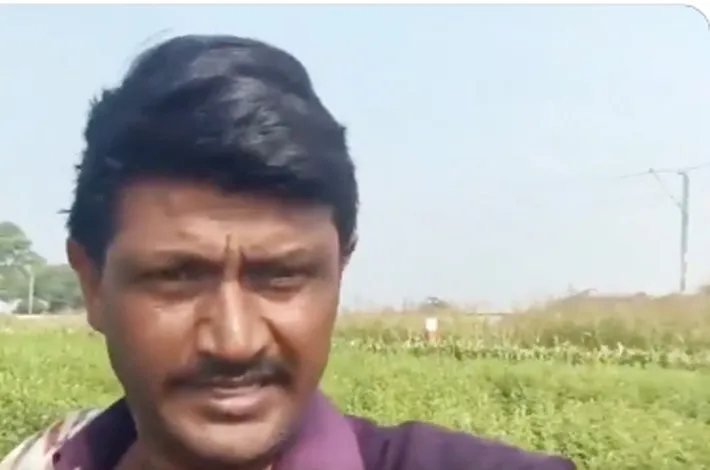
Urges media to stop gossip, focus on farmers
Swamy’s critique went beyond diagnosis. He issued a direct appeal to Andhra Pradesh Chief Minister Nara Chandrababu Naidu, urging him to examine the water and farming difficulties with seriousness and to initiate practical measures. He also called on TDP leaders and the media itself to redirect their time and platforms toward subjects that affect people’s lives in tangible ways. Discussions about farmers’ problems, the scarcity of water for irrigation and domestic use, and the broader condition of rural livelihoods, he argued, deserve far greater priority than gossip surrounding marriages and gifts. By framing the issue as one of collective responsibility, Swamy positioned the media, the government and political leadership as stakeholders who must recalibrate their focus.