8 October, 2026 | 12:18 PM


High Court Shields KCR
23-04-2026 12:00:00 AM
metro india news I hyderabad
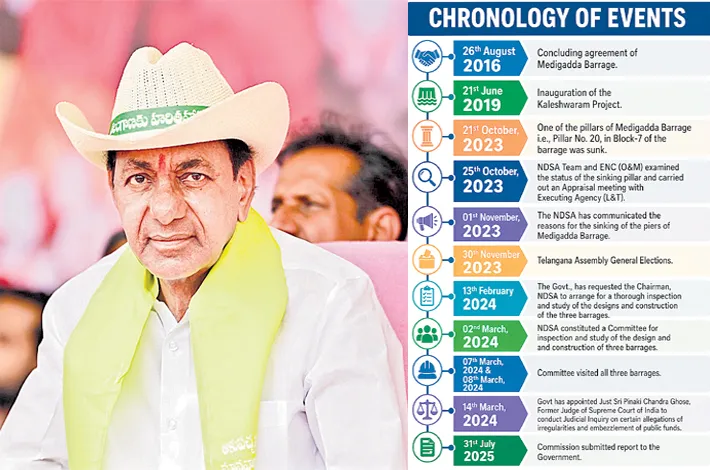
In a significant development with far-reaching political and legal implications, the Telangana High Court has restrained the State government from initiating any action against former Chief Minister K. Chandrasekhar Rao, former Irrigation Minister T. Harish Rao, and other senior officials based on the findings of the Justice P. C. Ghose Commission. The Division Bench comprising Chief Justice Aparesh Kumar Singh and Justice G. M. Mohiuddin delivered the verdict on a batch of petitions challenging the Commission’s report on alleged irregularities in the Kaleshwaram Lift Irrigation Project.
The Court made a crucial distinction between the legality of the Commission’s constitution and the validity of its findings. While upholding the formation of the Commission as lawful and within constitutional bounds, it declared that the adverse findings against the petitioners were legally unsustainable. The Bench held that such findings were rendered in violation of principles of natural justice and statutory safeguards under Section 8B of the Commissions of Inquiry Act, 1952. Consequently, all observations deemed “prejudicial” to the petitioners were declared inoperative.
This effectively means the Commission's conclusions against KCR, Harish Rao, IAS officer Smita Sabharwal, and former Chief Secretary S. K. Joshi cannot be used as the basis for any punitive or investigative action. The Court emphasized that individuals whose conduct is under scrutiny must be given a fair opportunity to present their case, including the right to cross examine evidence and defend their reputation. The failure to adhere to these safeguards rendered the Commission’s adverse findings legally untenable.
The verdict comes in the backdrop of the Commission’s report, which had earlier held KCR and others accountable for alleged irregularities in the construction and maintenance of key barrages under the Kaleshwaram project, including Medigadda, Annaram, and Sundilla. The report had been tabled in the State Assembly, following which Chief Minister A. Revanth Reddy announced a CBI probe into the matter.
By staying action on the report, the High Court has significantly altered the trajectory of the case, at least in the immediate term. Legal experts interpret the judgment as a strong case of procedural fairness and due process, particularly in inquiries that carry reputational consequences. At the same time, the Court stopped short of quashing the Commission itself, leaving room for further legal and administrative developments.
At the heart of the High Court’s ruling lies a detailed examination of procedural lapses in the functioning of the Ghose Commission. The Bench observed that any inquiry body must strictly adhere to statutory provisions, especially when its findings could harm the reputation of individuals.
Section 8B of the Commissions of Inquiry Act mandates that if a Commission intends to make findings that may adversely affect a person, it must provide that individual with a reasonable opportunity to be heard and to present evidence in their defence. The Court found that this requirement was not adequately fulfilled in the present case.
The judgment clarified the meaning of “prejudicial findings,” noting that any observation that attributes guilt, alleges corruption, or holds individuals responsible for financial loss falls within this category. Since such findings were made without following due process, they were declared legally void. Importantly, the Court rejected the petitioners’ argument that the Commission itself was unconstitutionally constituted. It held that the State government acted within its powers in setting up the inquiry panel. This nuanced position ensures that while procedural violations are corrected, the broader framework of accountability mechanisms remains intact.
Government’s next course of action
The Telangana Government has responded cautiously but firmly to the verdict. Irrigation Minister Uttam Kumar Reddy clarified that the High Court has not given a “clean chit” to any individual involved in the Kaleshwaram project. According to the government, the ruling is limited to procedural aspects and does not invalidate the concerns raised in the Commission’s report.
The Minister emphasized that the Commission’s identification of faults in key barrages, particularly Medigadda, remains relevant. He reiterated that multiple investigations, including those by the CBI, Vigilance authorities, and the National Dam Safety Authority, will continue independently of the Commission’s findings.
The State Cabinet, which is meeting on April 23, is expected to deliberate on the judgment, with a key focus on whether to challenge it before the Supreme Court of India. Government sources indicate that an appeal is being actively considered, particularly on the issue of whether the Commission’s findings can still inform ongoing investigations.
The government has also sought to reassure the public that its commitment to transparency and accountability remains unchanged. Officials have stressed that the Kaleshwaram project, given its scale and significance, will continue to be subject to rigorous scrutiny.
Judgement a ‘slap’
Leaders of the Bharat Rashtra Samithi have welcomed the High Court verdict, describing it as a major vindication of their long-standing position. BRS Working President K. T. Rama Rao termed the judgment a “slap” on what he alleged were politically motivated actions by the Congress government.
KTR argued that the verdict exposes the misuse of institutions for political vendetta and reinforces the supremacy of constitutional safeguards. He reiterated the party’s claim that the Ghose Commission report was flawed from the outset and driven by political considerations.
In strong remarks, he demanded that Chief Minister Revanth Reddy apologize to farmers for allegedly neglecting the Kaleshwaram project over the past two and a half years. He also called for immediate repairs to the Medigadda barrage, asserting that even minor damages should be addressed promptly to restore irrigation benefits to lakhs of farmers.
Echoing similar sentiments, T. Harish Rao stated that the judgment reaffirms the principle that “truth ultimately prevails.” He accused the Congress government of engaging in vindictive politics and urged it to shift focus towards completing pending repair works.
The High Court’s verdict has set the stage for a renewed political and legal battle over the Kaleshwaram project. While it provides immediate relief to key BRS leaders, it does not close the case. Instead, it introduces a new phase where the focus shifts to alternative investigative mechanisms and potential appellate proceedings.
The possibility of the State approaching the Supreme Court adds another layer of uncertainty. An appeal could potentially reopen questions about the admissibility of the Commission’s findings, prolonging the legal battle.