15 October, 2026 | 11:52 AM


Is Congress' protests justified at AI Summit?
22-02-2026 12:00:00 AM
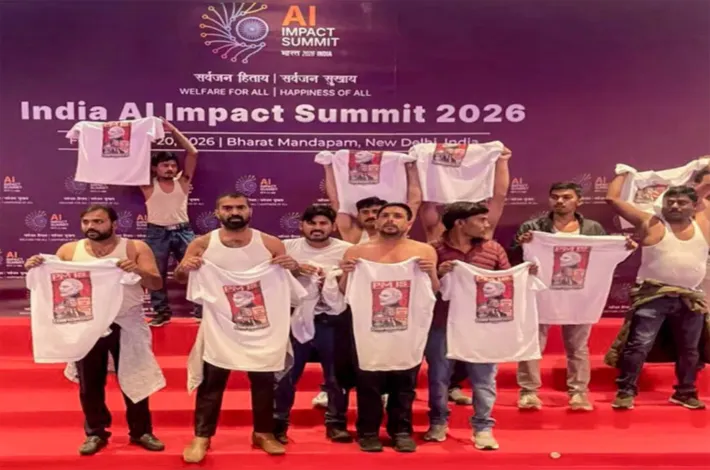
In a bizarre turn of events at India's Global AI Summit, Congress workers staged a shirtless protest, disrupting what was meant to be a showcase of national pride. The incident, captured on video and widely circulated, has ignited a firestorm of criticism, with many labeling it as a deliberate attempt to embarrass the country on an international stage. The summit, organized by the Government of India, brought together global leaders to discuss India's rising stature in artificial intelligence. However, the protest transformed the event into a spectacle of anarchy, drawing sharp contrasts from commentators who juxtaposed it against timeless works of art that symbolize human creativity and discipline.
A BJP leader lambasted the protest, humorously suggesting Rahul Gandhi has a "contract" with Narendra Modi to divert attention from BJP missteps. He compared the act to the 2021 Republic Day violence by Khalistani elements, questioning how Congress could bring shame to a national event akin to hosting foreign heads of state. "This isn't a BJP convention," he emphasized, applauding the innovation if done at a party event but condemning it as national disgrace. He highlighted institutions like ISRO, IIT, and AIIMS built under Nehru, asking if they were meant for such (indecent display.
In defense of the act , Congress spokespersons maintained that the protest reflected the anger of 1.4 billion Indians amid institutional capture by the BJP, suppression of dissent, and economic woes like unemployment and paper leaks. They criticized the summit for being reduced to a "PR exercise" for Prime Minister Narendra Modi, pointing to administrative lapses, thefts, and disorganized arrangements, including founders unable to access their booths and the showcasing of Chinese robots by IT Minister Ashwini Vaishnaw. One leader stressed that protesting was necessary when parliamentary avenues were stifled, invoking the Unlawful Activities (Prevention) Act (UAPA) against dissenters and media bias.
The incident ignited a broader debate on the balance between democratic protest and national responsibility. In a televised panel discussion, participants grappled with whether the Congress had scored a self-goal by choosing poor timing and tactics. One participant argued that while issues like the trade deal were valid, the manner—disrupting a summit with startups, entrepreneurs, and foreign delegates—was unacceptable and violated decorum, likening it to removing one's shirt in court. He cited Supreme Court precedents on protest restrictions under Article 19, emphasizing law and order. The Congress participant countered by highlighting extraordinary circumstances where dissent is criminalized, positioning the protest as an expression of youth frustration over joblessness and governance failures.
A political analyst acknowledged the constitutional right to peaceful protest but noted a fine line between it and incitement. He criticized the manner as unpalatable and potentially heat-of-the-moment, yet attributed it to opacity in the India-US trade negotiations, calling for more transparency on tariffs, incentives, and impacts on citizens. He also pointed out India's lag in AI development compared to global leaders like China's DeepSeek or Google's Gemini, urging constructive steps. He emphasized tolerance in democracy, arguing that even disagreeable voices must be endured, though he disagreed with the protest's execution and suggested alternative venues.
Another analyst viewed the protest as tactically misjudged, accusing the Congress of prioritizing nuisance over narrative-building. She argued it wouldn't aid the party in elections or alliances, such as in Tamil Nadu or West Bengal, and stemmed from an obsession with opposing Modi, even at the cost of political survival. She lamented that the incident overshadowed the summit's achievements, including participation from 110 countries, 500 AI delegates, 45 global ministers, and $200 billion in deals over 24 months. She highlighted internal Congress contradictions, with Karnataka (a Congress-ruled state) contributing 60% of startups and Telangana's CM proposing an AI war room in Hyderabad.
Ultimately, the episode underscores the tensions in India's vibrant democracy. While protests are essential for accountability, the host noted that national positioning on the global stage demands maturity from all sides. The AI Summit, despite initial glitches, impressed with high-level attendance and a focus on societal AI impacts, as praised by international figures. Yet, the protest diverted attention from these gains, raising questions about whether political rivalries are sacrificing collective progress. As reactions continue, the incident serves as a reminder that in matters of national interest, unity often trumps division.