19 September, 2026 | 9:53 AM


Is Telangana under Andhra’s grip?
19-05-2026 12:00:00 AM
metro india news I hyderabad
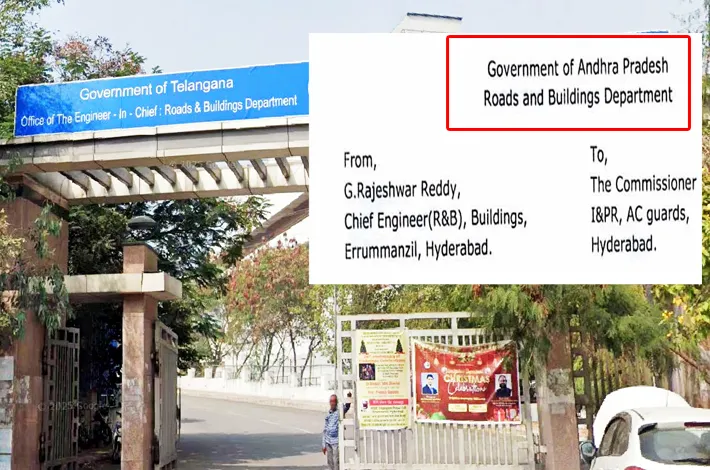
In a development that has raised eyebrows across political and administrative circles in both Telugu states, a rejoinder issued in response to an investigative report on alleged irregularities in the new Telangana High Court building complex at Rajendranagar has arrived on the official letterhead of the Government of Andhra Pradesh’s Roads and Buildings (R&B) Department.
The incident, occurring just days after Metro India published its May 14, 2026, exposé titled “HC Project Under Cloud,” has triggered serious questions about administrative autonomy, inter-state bureaucratic overlaps, and the real locus of decision-making in Telangana’s key infrastructure projects.
The original article detailed multiple concerns surrounding the ambitious Rs 2,583 crore project, which includes a sprawling High Court complex, judges’ residences, and supporting infrastructure on about 100 acres in Rajendranagar. Key allegations included manipulation of soil bearing capacity (SBC) reports—showing lower values (40-70 tonnes per sq m) compared to nearby areas (around 115 tonnes)—to justify deeper excavations, additional foundations, and cost escalations nearing Rs 200 crore.
Questions were also raised about structural quality, discrepancies in reported versus actual manpower at the site, deviations from approved designs, and the alleged sidelining of the consultant, Team One India Pvt Ltd, after it flagged these issues in a December 2025 letter.
On May 17, a rejoinder from Mr. G. Rajeshwar Reddy, Chief Engineer (R&B) Buildings, Errummanjil, Hyderabad, was forwarded through Telangana’s Commissioner (I&PR). Shockingly, it bore the letterhead of the Andhra Pradesh government’s R&B department.
Questions of Dual Control
At the heart of the controversy lies a fundamental query: Why would an official response concerning a flagship Telangana project come on Andhra Pradesh stationery? Mr. Rajeshwar Reddy is identified in Telangana government records as Chief Engineer (R&B) Buildings for the state, with an office at Errummanjil. His involvement in Telangana’s R&B matters is well-documented in official directories and professional interactions. Still, the letterhead suggests either a shared bureaucratic apparatus, an outdated template, or something more systemic.
This is not merely an embarrassing typo. In the post-bifurcation era, both states have worked to establish distinct administrative identities, though they continue to share certain resources, personnel, and sometimes even assets in Hyderabad. Critics argue that persistent overlaps in key departments like R&B could indicate that Telangana’s infrastructure execution remains indirectly influenced or monitored by Andhra Pradesh structures. Is the Chief Engineer’s office operating with dual reporting? Are major projects in Telangana being vetted through residual Andhra administrative channels?
Need for Clarity and Reform
This incident underscores the urgency for both states to complete administrative bifurcation in letter and spirit. Clear delineation of cadres, assets, and departmental structures is long overdue. For Telangana, asserting control over its R&B and infrastructure wings is critical for executing flagship projects without external shadows.
The High Court complex is more than bricks and mortar; it represents justice delivery for a young state. Any cloud of irregularity or external influence tarnishes its foundational legitimacy.
However, in the absence of a prompt and transparent explanation, it fuels legitimate doubts about who truly steers Telangana’s development agenda. As the project progresses toward 2027, restoring public confidence requires not just rebuttals but demonstrable adherence to highest standards of probity, quality, and state autonomy. The people of Telangana deserve a High Court complex built on firm ground—both literally and figuratively.
If the lapse is deliberate, action should be taken immediately. If it is an act of omission, may be they are doing this for other projects’ execution including the new High Court Building Complex. In such a situation strict action to be initiated against the culprits.
Metro India Clarifies
At Metro India Newspaper, we uphold the highest standards of journalism. As a responsible media organisation, we are committed to ethical reporting in both letter and spirit. In keeping with this commitment to transparency and accountability, we are publishing the rejoinder received from the Chief Engineer of the Public Works Department (PWD).
We strongly deny any allegation suggesting that we published the report with malicious intent. Our organisation maintains the highest levels of professional integrity and has no malafide intentions whatsoever. We also categorically state that we have no reason or motive to defame the PWD or any of its officials. Our sole objective remains to serve the public interest by sharing verified information that affects citizens and governance.
The news report in question was prepared and published based on the information and relevant data available to us at the time. Like any responsible media house, we rely on credible sources and documented details before bringing matters to public attention. Journalism plays a vital role in highlighting issues that impact infrastructure development, public resources, and service delivery. When potential concerns arise regarding government departments entrusted with significant public funds and responsibilities, it becomes our duty to examine and report them factually.
We believe in constructive journalism that not only informs but also encourages improvement. It is in this spirit that we urge the PWD to treat the published report seriously. The department should conduct a thorough verification of the facts presented. If any lapses or shortcomings are identified during this process, appropriate corrective measures should be taken promptly. Such an approach would strengthen the department’s functioning and restore full public confidence in its operations.
Metro India has always prioritised accuracy, fairness, and balance in its coverage. We maintain open channels for responses and clarifications from all stakeholders, which is why we are featuring the Chief Engineer’s rejoinder prominently. This practice reflects our dedication to presenting all sides of an issue so that readers can form informed opinions.
Responsible media organisations serve as a bridge between the public and governing institutions. By highlighting matters of public importance, we contribute to greater accountability and improved service delivery. At the same time, we recognise the challenges faced by departments like the PWD in executing large-scale projects under various constraints. Our reporting aims to support systemic improvements rather than target individuals or institutions unfairly.
Metro India remains dedicated to its role as a vigilant and responsible media platform. We will continue to report on matters of public importance while upholding the highest journalistic standards. We trust that the PWD will utilise this opportunity to review its processes, implement necessary corrections where required, and reinforce its commitment to excellence in public service.
- Editor