14 September, 2026 | 11:01 PM


Let’s Listen to Ratan Tata
12-06-2026 12:00:00 AM
From Hyderabad to Boston to Bombay House
A personal reflection of Dr Vaman Rao on a two-decade connection with Mr Ratan N. Tata
In the months since Mr. Ratan Tata’s passing in October 2024, the institutions he spent a lifetime building have been navigating questions of governance, direction, and succession that he will not be present to guide. I have no standing to comment on those deliberations, and this is not the place for it. What I can offer is a witness account — drawn from twenty-one years of private conversations, boardroom encounters, and an institutional partnership that began in late 2003 — of the principles by which Mr. Tata himself led. I believe those principles are the only inheritance that truly matters, and they are more relevant now than at any time since his passing.
I grew up shaped by Hyderabad: its layered history, its particular blend of intellectual rigour and cultural warmth, its conviction — not always spoken aloud, but always present — that India carries a civilisational depth that the world has not yet fully absorbed. Hyderabad formed my sense of who I was and what science was for.
London and Boston formed my sense of how science was done. The laboratory, the regulatory pathway, the capital markets, and the negotiating table across four continents — these became my working environment for three decades. I built Indigene Pharmaceuticals out of a molecular medicine thesis, moved it across geographies, and arrived, in late 2003, at the fourth floor of Bombay House with a biopharma proposition and the particular confidence of someone who has survived a few years of global entrepreneurship.
I did not expect Bombay House to change me. But it did. Because the man on the fourth floor asked a different kind of question than anyone I had met in Boston, Washington, London, Kyoto, or Toronto. And the two and a half hours that followed altered the compass by which I have navigated every room since.
I. The Introduction That Changed Everything
The meeting in late 2003 had been scheduled for thirty minutes. I had been introduced to Mr. Ratan Tata by Mr. F.C. Kohli — the founding Chief Executive of Tata Consultancy Services, widely regarded as the father of the Indian information technology industry.
Atul Nishar — Chairman of Hexaware Technologies and then President of NASSCOM India — was a fellow board member at Hexaware. He introduced me to Mr. Kohli, and that connection proved to be one of the most consequential of my career. Mr. Kohli was extraordinary. He was in his seventies, but his curiosity operated at a speed that put men half his age to shame. We became close not through business necessity but through intellectual kinship — a shared belief that technology and science, applied with rigour and purpose, could transform lives in ways that government and capital alone never could. The friendship extended to our families.
When Mr. Kohli said he wanted to introduce me to Mr. Ratan Tata, he did not present it as a networking opportunity. He presented it as something closer to a responsibility — as if he had decided that two people with a particular kind of purpose simply ought to know each other, and that it was his job to make sure they did. That is how the late Mr. F.C. Kohli operated. He did not broker transactions. He recognised resonance.
“The late Mr. F.C. Kohli did not broker transactions. He recognised resonance — and he believed certain people, with a particular kind of purpose, simply ought to know each other.”
II. The First Lesson: Start With the Human Being
I came to Bombay House prepared, as any scientist-entrepreneur would, with everything the situation seemed to call for: the molecular rationale for the Multiceutics platform, the regulatory pathway, the market opportunity, and the strategic case for a Tata partnership. I was ready to present.
Mr. Tata disarmed that preparation almost immediately — not by dismissing it, but by asking a question I had not anticipated. He wanted to know about the patients. Not the market size. Not the revenue projections. The patients. Who were they? What were they living with? What would actually change for them if the science worked?
I have spent my career in rooms with powerful people — Prime Ministers, presidents, and boards of global corporations, in government advisory councils in Washington and London, and across negotiating tables in Kyoto and Toronto. I can count on one hand the number of those people who opened a first strategic meeting by asking about the human beings at the end of the value chain. Mr. Tata always did. It was not a rhetorical device or a performance of conscience. It was his actual orientation. His compass pointed at a different true north than most.
That question — but who is this actually for? — is one I now ask first in every room I enter. It has changed the nature of every conversation I have had since.
“He wanted to know about the patients — not the market size, not the projections. The patients. Who were they? What would change for them if the science worked?”
III. The Meeting I Refused to Cancel
Of all the encounters across twenty-one years, one has stayed with me with particular force: February 21, 2006.
Eight days earlier, on February 13 — I had travelled to Mumbai from Boston for a series of meetings — I was involved in an accident outside the Intercontinental Hotel. I suffered a triple fracture of my right shoulder. A procedure was carried out the same day; my arm was placed in plaster and a cast, completely immobilised. I then flew to Hyderabad to recover.
I had a scheduled meeting with Mr. Tata on February 21. It did not occur to me to cancel it. I flew back to Mumbai, arrived at Bombay House with my shoulder in a cast and my jacket sleeve on the right side hanging empty — there was simply no way to put my arm through it. We met as planned.
Mr. Tata was visibly surprised that I had not asked to reschedule. He said so directly. In that conversation, we planned what would become the joint press conference of June 30, 2006, at the Taj Hotel in Mumbai. And it was in that meeting that he said the words I have carried with me ever since. I believe he said them in part because of what he was looking at: a man who had flown across India with a broken shoulder and a hanging sleeve rather than send an apologetic message asking to move the date. He had seen something. And he named it.
“Your purpose combined with passion and perseverance will lead your journey.”
— Ratan N. Tata, to Dr. M. Vaman Rao • Bombay House, Mumbai • February 21, 2006
Three words. Purpose. Passion. Perseverance. He did not mean them as corporate values or motivational material. He meant them as a diagnosis — an observation about what separated ventures that endured from those that did not, and people who built things of lasting worth from those who merely accumulated.
Those words also carry an echo that both of us recognised. The Brihadaranyaka Upanishad, one of the oldest Upanishadic texts, says: ‘You are what your deep, driving desire is. As your desire is, so is your will. As your will is, so is your deed. As your deed is, so is your destiny.’ The Sanskrit philosophical tradition and Mr. Tata’s modern formulation are saying the same thing: that the quality of what we build is determined not by strategy or resources or market timing, but by the depth and authenticity of the desire from which it springs. Mr. Tata lived that principle with a consistency I have rarely witnessed in a life of working alongside remarkable people.
IV. The Day Purpose Became Public
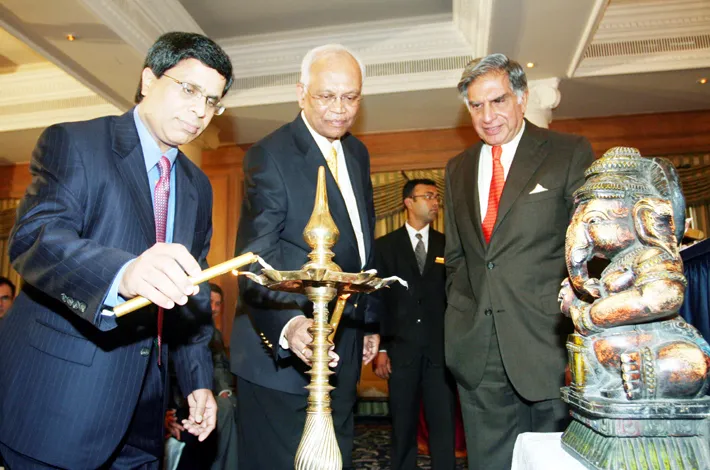
On June 30, 2006, we stood together at the Taj Hotel in Mumbai for a joint press conference — one of the very few Mr. Tata gave in his career. The event marked not one announcement but two: the strategic alliance between Indigene Pharmaceuticals and the Tata Group — in which Tata Industries took a significant equity stake in Indigene — and, simultaneously, a strategic alliance between Indigene and the Council of Scientific and Industrial Research.
Dr. R.A. Mashelkar, then Director-General of CSIR and Secretary to the Government of India, joined us on stage. The three of us — Mr. Tata, Dr. Mashelkar, and I — lit the ceremonial lamp together to inaugurate the occasion. The Hindu Business Line reported the event on its front page the following morning.
VI. The Boardroom Lesson: Intellectual Honesty Is an Institutional Architecture
One boardroom encounter remains especially vivid. It was June 2007. I was alone in the room with the full Board of Directors of Tata Sons, presenting the marketing strategy for Indigene’s consumer healthcare products across Walgreens and CVS pharmacy stores throughout the United States.
Midway through my presentation, R. Gopalakrishnan — then Executive Director of Tata Sons and formerly Managing Director of Hindustan Lever — challenged me directly. He said I was underestimating the marketing investment required to sustain the growth trajectory we had already established. Alan Rosling, another Board member, joined the discussion. Mr. Tata weighed in. I held my ground in the room.
By 2008, I had learned that Mr. Gopalakrishnan was right. I had indeed underestimated the marketing spend.
What stayed with me was not the fact that I was wrong — anyone building under uncertainty will be wrong. What stayed with me was the culture in which it happened. Challenge in that boardroom was not personal. Being wrong was not shameful. The standard was always the outcome for the business, not the comfort of the presenter. Mr. Tata created that culture. You felt it the moment you walked in.
He made intellectual honesty safe without making it soft. That balance is extraordinarily difficult to achieve and extraordinarily rare. It is also one of the principal reasons institutions endure.
VII. The Third Lesson: Philanthropy Is an Orientation, Not an Activity
Over the years, our conversations ranged well beyond the commercial. Mr. Tata spoke often about the Tata Trusts — the philanthropic holding entities through which the Tata Group has, for generations, channelled significant resources back into Indian society. But what struck me was not the scale of that philanthropy, which is well documented. It was the philosophy underneath it.
For Mr. Tata, giving was not a separate activity from building. It was the same activity, motivated by the same question: what kind of society are we creating? He was deeply sceptical of philanthropy that was performative — that built institutions with names on them rather than systems that made those institutions unnecessary. He was interested in the conditions under which human beings could flourish. Not the gestures that made donors feel good. The conditions.
Philanthropy as an activity asks: how much did we give? Philanthropy as an orientation asks: what kind of society are we helping create? One is episodic. The other is architectural. Mr. Tata practised the second.
“Would anyone notice if this stopped existing? And if they would — who? And why?” — The simplest possible test for whether a venture has done something real.
He once put a question to me that I have thought about every year since: ‘Would anyone notice if this stopped existing? And if they would — who? And why?’ It is the most efficient possible test for whether a venture has embedded genuine purpose or merely described it. Not whether it raised capital. Not whether it generated applause. Whether it would be missed. And by whom.
I think about that question every time I make a design decision in the work I am now building — infrastructure to make personalised health and longevity accessible to individuals regardless of geography or income. It is Mr. Tata’s question, applied to a new problem. And it is still the right question.
VIII. What I Carry Forward
Ratan Tata died on October 9, 2024. He was eighty-six. The world’s response was a measure of the man: not the performative grief of celebrity mourning, but something quieter and more durable — the recognition by millions of people, in India and far beyond, that someone who had genuinely tried to do right by the world had left it.
I was fortunate. I knew him not only through his public record but through those private hours at Bombay House, through the boardrooms of Tata Sons, through a friendship that began with a two-and-a-half-hour conversation on a Friday evening in 2003 and continued, in one form or another, until the October of his passing. I knew his curiosity, his directness, his rare capacity for listening without performing, and his even rarer ability to build an institution of extraordinary scale without losing sight of the individual human beings that institutions exist to serve.
I carry several things from those years: the discipline of asking who something is actually for; the understanding that institutional trust is built in private; the conviction that philanthropy is an orientation toward the world, not an activity you add to a balance sheet. And above all, the words he gave me — purpose, passion, perseverance — which echo an ancient Indian wisdom that both of us, in our different ways, had already found to be true.
From Hyderabad to Boston to Bombay House: the arc of my journey was shaped by science, by entrepreneurship, and by the belief that enterprise must ultimately serve human beings. Mr. Tata sharpened that belief. He gave it a standard.
That is what Ratan Tata taught me. And that is what I am still trying to build.
-Dr. M. Vaman Rao, MS, PhD
Dr. Rao is a scientist, serial entrepreneur, innovator, and global investor based in Boston, Massachusetts, USA. He has built ventures across seven geographies, established more than 50 international strategic alliances, authored more than 20 scientific publications, and is named on 50 patent applications before the USPTO. He served as a strategic partner to the Tata Group through Indigene Pharmaceuticals from 2003 to 2012, presenting to the Tata Sons Board of Directors on multiple occasions. He was introduced to Mr. Ratan Tata by the late Mr. F.C. Kohli. He currently works at the intersection of artificial intelligence, healthcare, life sciences, longevity, and health infrastructure.
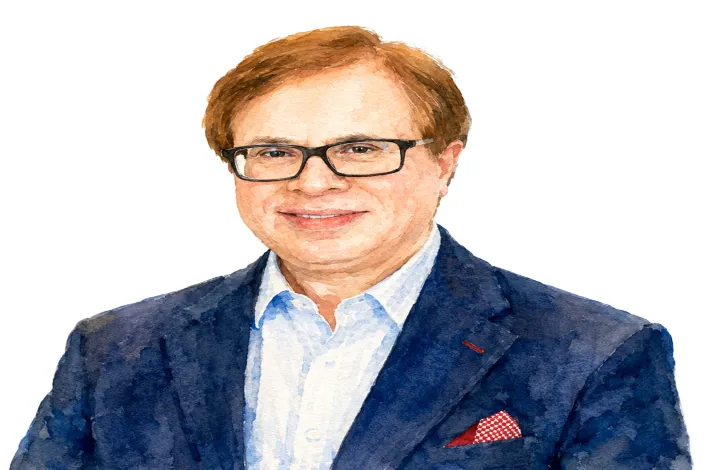
Dr. Vaman Rao can be reached via email at vaman@ vamanrao.com.