11 October, 2026 | 12:34 PM


Love between Spice and Silk
10-10-2025 12:00:00 AM
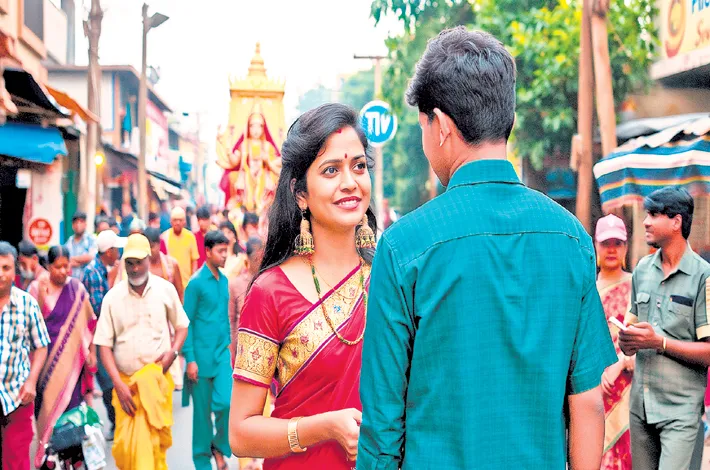
In the heart of Berhampur, where the air hummed with the rhythmic clack of silk looms and the salty whisper of the Bay of Bengal, Priya first glimpsed Arjun. It was during the annual Thakurani Yatra, when the goddess's idol paraded through Rangabali Street, draped in shimmering sarees woven from the city's famed Bomkai silk. Priya, a 22-year-old Telugu girl from a family of spice traders who had settled in Odisha a generation ago, had come to the festival with her cousins. Her dark hair cascaded like the Mahanadi in monsoon, and her eyes, sharp as a weaver's needle, caught the flicker of diyas lining the temple steps.
Arjun, a lanky 24-year-old with sun-kissed skin and a smile that rivaled the golden hour over Gopalpur Beach, was helping his father, a veteran silk merchant, set up a stall of intricate sarees. His Oriya roots ran deep—his family had spun threads of tradition for decades in the narrow lanes of Bada Bazaar. As the crowd surged, Priya's dupatta snagged on a display of shimmering pallus. Arjun's hand steadied her, his fingers brushing hers like a gentle monsoon breeze.
"Careful, akka," he said in halting Telugu, a nod to the multilingual mosaic of Berhampur. She laughed, her voice a melody of Andhra cadence. "Thank you, anna. But it's priya, not akka." In that moment, amid the chants of "Jai Maa Thakurani" and the scent of jasmine garlands, something stirred—a thread pulling two worlds together.
Their meetings became stolen moments. Priya studied literature at Berhampur University, her days filled with dog-eared Tagore volumes and chai from roadside stalls. Arjun managed his family's loom workshop, his evenings sketching designs inspired by temple motifs. They met at the quiet edges of the city: the shaded groves of Budheswari Temple, where peacocks strutted like courtiers, or the sandy stretches of Gopalpur, where waves crashed like unspoken promises. Language was no barrier; they wove a tapestry of broken Hindi, English whispers, and gestures that spoke louder than words.
One twilight, as they sat on the beach with coconut water in hand, Arjun traced patterns in the sand—a blooming lotus, her favorite from Telugu folklore. "Priya, in Oriya, we say 'bhuli' for forget. But I can't forget you." She leaned into him, the horizon bleeding orange. "In Telugu, it's 'mariyu.' But my heart won't let me." Their first kiss tasted of sea salt and unspoken fears, under a sky stitched with stars.
Love, however, was a fragile weave, prone to fraying. When Priya's parents discovered the notes tucked in her books—Arjun's sketches of her face amid silk motifs—they erupted like a storm over the Chilika Lake. Her father, Ramesh, a stern man with callused hands from years grinding turmeric, slammed his fist on the dining table. "A Telugu girl with an Oriya boy? What about our customs, our mangalsutra traditions? They'll demand pitha and jagannath rituals at the wedding!" Her mother, Lakshmi, wept into her nine-yard saree, invoking ancestors from Vijayawada. "Beta, love is sweet, but marriage is a family's loom. One loose thread, and it unravels."
Across town, in the bustling heart of Silk City, Arjun faced his own tempest. His mother, Sita, a widow who commanded the looms with quiet ferocity, crossed her arms over her cotton sari. "Our blood is woven with Odisha's soil. Telugu ways? Their spicy curries and film songs? No, Arjun. Find a girl from our mela, one who knows the Kartika Purnima fairs." His father, though softer, nodded gravely. "Son, we've built this life thread by thread. Don't snap it for a fleeting fancy."
The lovers met in secret at the old clock tower in Berhampur, its chimes mocking their ticking hearts. Priya's eyes brimmed with tears. "They'll never understand, Arjun. My amma says Oriyas are too ritual-bound, like their endless puja bells." He pulled her close, his voice steady as the loom's pedal. "And your nanna thinks Telugus are too fiery, like your mirchi bajji. But we're the bridge, Priya. We'll show them."
The turning point came during Diwali, when Berhampur glowed like a jewel box. Priya's family hosted a modest Deepavali, their home fragrant with pulihora and laddus. Arjun arrived uninvited, not with grand gestures, but with a gift: a custom Bomkai saree, its border embroidered with Telugu motifs—a peacock feather intertwined with an Odia konark wheel. He knelt before Ramesh and Lakshmi, his voice trembling yet resolute. "Uncle, Aunty, I know our worlds differ. But look at this saree—Telugu grace in Oriya silk. That's us. Priya has taught me 'annayya' for brother; I've shown her the dance of ghumura drums. Love isn't division; it's the dye that colors both."
Sita and his father had followed, bearing a silver thali etched with Lakshmi's motifs—a peace offering from their ancestral puja. As the families sat amid flickering lamps, stories flowed like the Rushikulya River. Ramesh shared tales of his grandfather trading spices with Odia merchants in the 1940s, bridging borders long before Partition. Sita recounted how her loom once wove sarees for Telugu brides during the freedom struggle, threads of unity in turbulent times. Laughter mingled with tears as Priya and Arjun performed a duet—her lilting Telugu folk song fused with his rhythmic Odia beat, their hands clasped like intertwined yarns.
By night's end, the barriers crumbled. Ramesh clasped Arjun's shoulder. "Beta, if you can weave my daughter's heart so carefully, you'll weave our family too." Sita embraced Priya. "Child, your fire will warm our hearths, not burn them." The parents' acceptance was no thunderclap, but a quiet dawn—forged in shared rangoli patterns on the floor, where Telugu kolam curves met Odia alpana swirls.
Months later, under the banyan tree of Budheswari Temple, Priya and Arjun married. Her mangalsutra gleamed beside his sacred thread, a pheras circle blending seven Telugu vows with Odia sankalpa chants. The air sang with conch shells and shehnai, guests from both communities toasting with rasagollas and payasam. As they walked hand in hand through Berhampur's lanes, the looms clacked on—a symphony of futures woven together.
In that city of silk and sea, love proved the strongest thread: enduring, vibrant, unbreakable.