26 October, 2026 | 3:31 AM


Man behind robotic heart surgery
16-03-2026 12:00:00 AM
Ranee Kumar
He stands apart in the operating theatre, where precision, courage and responsibility converge. For him, the OT is a lifeline and every patient a life entrusted to his skill. Meet Dr. Satyaki Nambala, the pioneering cardiothoracic surgeon who helped bring robotic heart surgery to India.
His professional journey is a compelling story of determination, discipline and unwavering commitment to a dream. Despite a schedule that leaves little room for pause, he agreed to revisit the milestones that shaped his career and the choices that defined it.
Early inspiration
For Dr. Satyaki, medicine was almost predestined. Growing up in a family of doctors left little room for alternative ambitions.
“My father was an ENT surgeon and my maternal uncle an orthopedist,” he recalls. “In those days many doctors had clinics attached to their homes. As a child, I spent hours in those clinics, handing over instruments to my elders. It felt natural that I too would become a doctor.”
Born and raised in Bengaluru with ancestral roots in Shimoga district, he completed his MBBS in 1982 from JSS Medical College and later pursued a Master’s degree in surgery at St. John's Medical College.
During his postgraduate training, he developed a strong interest in cardiac surgery but hesitated to openly pursue it.
“At that time cardiac surgery in India was still evolving,” he explains. “The mortality rates were high and many senior doctors felt the field had little future. Even my professors advised against it.”
Yet the doubts of others did not diminish his ambition.
Chasing a dream
Determined to pursue cardiac surgery, Dr. Satyaki secured admission to the prestigious Sree Chitra Tirunal Institute for Medical Sciences and Technology in Thiruvananthapuram, where he trained for three years.
A defining moment came when he watched renowned Canadian cardiac surgeon Tirone E. David perform the complex valve-sparing operation known as the David Procedure.
“I was mesmerised,” he recalls. “That day I decided that if I ever had the chance, I wanted to work with him.”
It seemed an ambitious dream at the time. But perseverance played its part. An unexpected vacancy opened in Dr. David’s unit when another trainee could not join. Dr. Satyaki applied and in 2003 travelled to Toronto to train under one of the world’s leading cardiac surgeons.
The experience proved transformative. The rigorous training environment reshaped his confidence and professional outlook.
“At first I was shy in the operating theatre,” he admits. “But the mentors there encouraged independence. I was once left in charge of the operating room and told that every decision had to come from me. It forced me to grow quickly.”
Another moment of trial came under a meticulous Chinese-Canadian surgeon known for his uncompromising standards. For days he was asked simply to observe. Just as frustration set in, the surgeon offered him a chance to perform a single anastomosis.
“If I did it well, I could assist in the full surgery,” he says. “Fortunately I met his expectations.”
The opportunity opened the door to performing multiple surgeries and refining his skills.
Learning across Continents
Though he could have pursued a career abroad, Dr. Satyaki chose to expand his expertise further. He moved to Brigham and Women’s Hospital of Harvard Medical School in the United States, where he trained in minimally invasive cardiac surgery.
The exposure to advanced surgical techniques strengthened his vision of introducing similar innovations in India.
Despite attractive opportunities overseas, he eventually decided to return home.
Building a robotic surgery programme
Back in Bengaluru, he joined Apollo Hospitals in 2009. The early years were demanding. At the time he performed only five or six surgeries a month and began building a programme in minimally invasive valve surgery largely on his own.
“It was difficult in the beginning,” he says. “Some procedures would take eight to ten hours. The pressure was intense and some young surgeons found it hard to continue.”
But persistence paid off. He began demonstrating techniques at medical conferences across the country and gradually built a reputation for expertise in minimally invasive heart surgery.
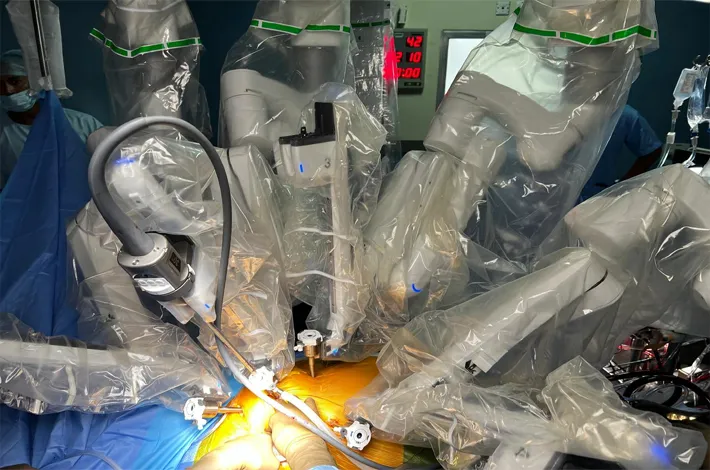
A major turning point came in 2018 when he persuaded the hospital to acquire the da Vinci Surgical System. At that time robotic technology was used in India mainly for harvesting vessels rather than performing complete cardiac procedures.
“We decided to push the boundaries,” he says.
Mastering Robotic Heart Surgery
To perfect the technique, Dr. Satyaki travelled to Asan Medical Center for specialised training. There he practised extensively on cadavers to master the delicate movements required for robotic cardiac surgery.
The training proved invaluable. Over the years he has performed more than 600 robotic heart surgeries, placing his team among a small group worldwide capable of conducting full robotic cardiac procedures.
Despite recognition and accolades, he remains understated about his achievements.
During the conversation he recounts an incident that reflects changing patient perceptions. An elderly woman once insisted on traditional open surgery rather than robotic assistance. After speaking to another patient who had undergone robotic surgery, she returned convinced that robotic surgery was the better option.
Advice for Young Doctors
For aspiring medical professionals, Dr. Satyaki offers candid advice.
“Medicine demands patience. There is no instant success,” he says. “Becoming a cardiac surgeon can take nearly two decades of study and training. Many people do not realise how demanding the journey is.”
He acknowledges that the long path can feel discouraging when peers advance quickly in other professions. Yet he believes the rewards are deeply fulfilling.
“No wealth or material success can equal the satisfaction of saving a life,” he says. “That sense of fulfilment makes every sacrifice worthwhile.”
For Dr. Satyaki Nambala, the operating theatre remains not just a workplace but a stage where passion, precision and perseverance come together to keep the human heart beating.