16 September, 2026 | 1:41 AM


Open AI Models Reshape Classrooms
16-09-2026 12:00:00 AM
Traditional courses face overhaul
metro india news I hyderabad
The surge of openly accessible artificial intelligence systems is transforming India’s education landscape, forcing universities, schools and policymakers to rethink long-standing degree structures. Open-weight models, free foundational tools and multilingual platforms now allow students and teachers across the country to experiment, build and learn without the barriers of proprietary software or high costs. This shift is already visible in enrolment patterns, curriculum redesigns and hiring preferences. 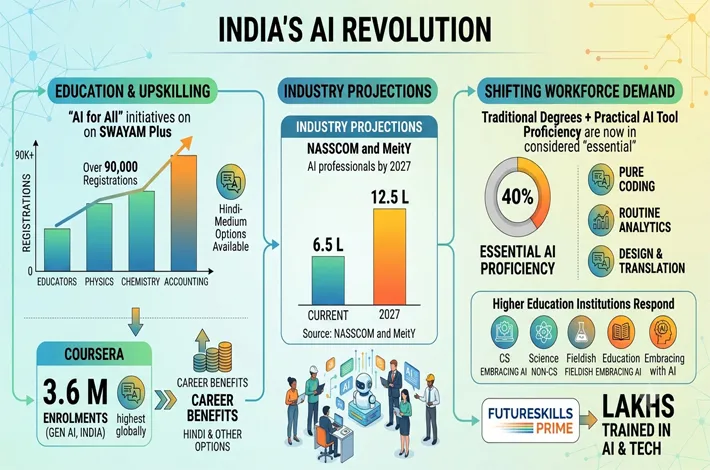
According to data from the All India Council for Technical Education (AICTE), approved engineering seats for 2025-26 reached 15.98 lakh, a 7 per cent year-on-year rise. Growth concentrates heavily in computer science, artificial intelligence, machine learning and data science programmes. More than 920 colleges now offer dedicated B.Tech specialisations in CSE with AI and ML focus. In contrast, mechanical, civil and electrical engineering streams record shrinking demand and lower fill rates. Overall B.Tech enrolment hit a five-year high of 75 per cent in 2024-25, driven largely by these technology-oriented branches.
The National Education Policy 2020 provides the policy backbone. AI and computational thinking become mandatory components for Classes 3 to 8 from the 2026-27 academic session. At the secondary level, nearly 8 lakh CBSE students enrolled in AI courses for 2024-25, with over 50,000 at the senior secondary stage.
Schools across states are installing ICT labs under Samagra Shiksha, with more than 1.79 lakh approved, while platforms such as DIKSHA and SWAYAM expand reach. SWAYAM alone hosts over 110 AI-related courses from IITs and IISc, drawing more than 41 lakh enrolments. Open models accelerate this democratisation. IIT Madras-incubated Bodhan AI, in partnership with NVIDIA and AI4Bharat, released open-weight Indic language models covering speech recognition, text-to-speech, translation and optical character recognition across up to 27 languages. These form part of the Bharat EduAI Stack, designed as digital public infrastructure so that edtech firms, state governments and researchers can build NCERT-aligned student bots and teacher tools without starting from scratch.
The government is overhauling AI curricula to emphasise industry-linked projects from the first semester, raising practical components from 25-30 per cent toward 40-75 per cent in some programmes. Universities increasingly accept credits from online platforms under the Academic Bank of Credits and National Credit Framework, allowing students to blend formal degrees with micro-credentials in generative AI or domain-specific applications. Surveys show more than 70 per cent of Indian teachers already use AI tools for lesson planning and content generation, freeing time for mentoring while highlighting the need for stronger pedagogical training. Traditional arts, commerce, law and humanities programmes lag in formal AI integration at the median institution.
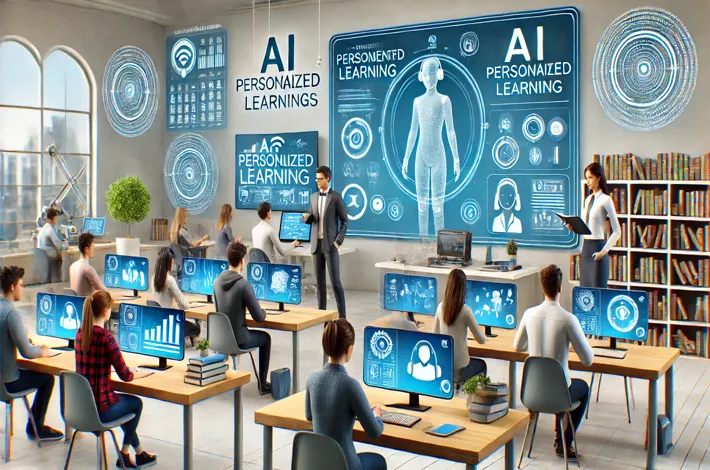
English majors, B.Com students or law graduates gain limited structured exposure beyond optional electives or self-driven MOOCs. Experts note that open models make personalised tutoring, multilingual content and adaptive assessments feasible even in resource-constrained settings. AI-assisted biology classes in pilot schools have lifted average scores from 49 per cent to 70 per cent and improved reasoning confidence. Similar tools support oral reading fluency assessments for millions of students and reduce teacher workload on routine documentation.
The job market reflects these changes. Overall IT hiring shows modest contraction in conventional roles, while AI-specific recruitment rises sharply. Employers prioritise portfolios, project experience and demonstrated ability to collaborate with AI systems over pure institutional pedigree for many positions. Campus recruitment numbers from large IT firms have adjusted downward for generalist freshers even as specialised AI talent commands premium packages. Graduates from mechanical or pure civil streams who add AI literacy – through open tools for design optimisation, predictive maintenance or data analysis – improve employability.
Faculty shortages constrain quality delivery outside elite institutions. Digital infrastructure remains uneven: only about 65 per cent of schools report computer access and internet connectivity. Concerns over academic integrity, over-reliance on generated content and the need for critical evaluation skills prompt institutions to redesign assessments toward higher-order reasoning and verification. The IndiaAI Mission invests in centres of excellence, data labs in Tier-2 and Tier-3 cities, and sovereign compute resources to address these gaps. Policymakers and educators describe the trajectory as one of adaptation rather than disappearance.
Traditional courses evolve by incorporating open AI capabilities: history students analyse large text corpora, commerce students model financial scenarios, and engineering branches outside computer science apply AI to domain problems. Open models lower costs dramatically, enabling a rural student to access sophisticated tutoring in regional languages on modest devices. India’s large youth population and digital public infrastructure position the country to convert this accessibility into widespread capability.
As open AI tools proliferate, the value of education shifts toward teaching students how to question, verify, create and collaborate with intelligent systems. Degrees that remain static risk declining relevance; those that integrate practical AI fluency, multidisciplinary thinking and continuous upskilling stand to prepare graduates for an economy where human judgement and machine assistance operate together. India’s scale – over 250 million school students and millions in higher education – makes the transition both a national imperative and a global test case for equitable, open AI-driven learning.
Changing educational landscape
Parallel initiatives under AI for All on SWAYAM Plus have drawn over 90,000 registrations for beginner-friendly courses in AI for educators, physics, chemistry and accounting, including Hindi-medium options. NASSCOM and MeitY projections underscore the urgency. India’s AI professional base stands at roughly 6 to 6.5 lakh and is expected to exceed 12.5 lakh by 2027. Coursera reported 3.6 million Generative AI enrolments from India in 2025 – the highest globally – with learners citing career progression and salary gains.
FutureSkills PRIME has enrolled or trained lakhs more in AI, big data and related technologies. Industry demand for hybrid skills is rising: around 40 per cent of companies now treat a traditional degree plus practical AI tool proficiency as essential for entry-level roles. Traditional pure coding or routine analytical jobs face pressure as AI tools handle drafting, basic coding, translation and design tasks faster. Higher education institutions respond by embedding AI across programmes rather than confining it to computer science silos.