20 September, 2026 | 12:36 AM


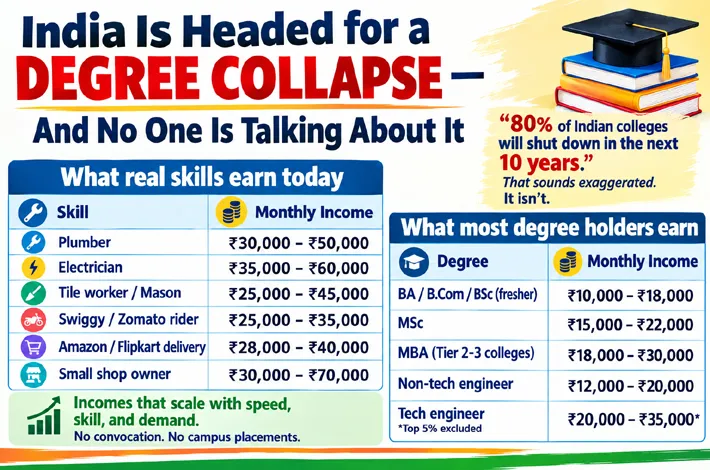
Plumbers Earn More than Degree Holders
20-09-2026 12:00:00 AM
metro india news I hyderabad : What Gen Z Expects from Higher Education in IndiaIndia’s higher education landscape is expanding rapidly in numbers of institutions and enrolments. Yet for Generation Z, the central question is no longer simply “Will I get a degree?” but “Will this degree prepare me for a world that keeps changing?” The mismatch between academic credentials and workplace requirements has become one of the defining tensions of contemporary Indian education.
Traditional pathways—engineering, medicine, civil services, management—still attract large numbers. The prestige attached to these fields remains powerful. However, Gen Z is more pragmatic than previous cohorts about outcomes. They see seniors struggling with underemployment, delayed placements and jobs that demand skills never taught in college.
Reports of graduates working in roles unrelated to their degrees are common, breeding scepticism about the automatic value of a university education.The skills gap is widely acknowledged. Employers repeatedly cite shortages in communication, problem-solving, digital fluency and domain-specific practical knowledge. Universities, constrained by rigid curricula, outdated syllabi and limited industry linkages in many cases, struggle to respond at scale.
While elite institutions and a handful of private universities have built strong placement records and industry partnerships, the majority of colleges still operate in relative isolation from the economy they are meant to serve.
Gen Z is responding in characteristic fashion: by supplementing formal education with parallel learning.
Coding bootcamps, online certifications, freelancing platforms and short-term skill courses have become integral to student life. Many treat the degree as a necessary credential while investing personal time and money in building a portfolio that actually demonstrates competence. Entrepreneurship is no longer a distant aspiration; campus startups and side hustles are increasingly visible.Policy has begun to catch up.
The National Education Policy 2020 encourages multidisciplinary education, multiple entry-exit options, academic bank of credits and greater autonomy for institutions. The push towards vocational education and integration of skills into mainstream degrees is significant. Implementation, however, requires sustained funding, faculty development and genuine collaboration with industry.
Without these, reforms risk remaining aspirational.Parents and students also need clearer information. The proliferation of private institutions of varying quality makes informed choice difficult. Transparent data on learning outcomes, placement statistics and alumni trajectories would help Gen Z families make better decisions. Career counselling that goes beyond “secure a government job or multinational package” is still rare in most schools and colleges.
Gen Z’s expectations are realistic rather than rebellious. They want education that is relevant, flexible and connected to opportunity. They value critical thinking and creativity alongside technical competence. They are willing to work hard, but they resist systems that demand endless examination preparation without corresponding returns in capability or employability. For India to convert its youth population into a genuine demographic dividend, higher education must move beyond expansion of seats to transformation of purpose. Degrees should signal readiness for a complex world, not merely completion of a prescribed syllabus. Gen Z is already adapting. The question is whether institutions and policymakers will adapt with equal urgency.