8 November, 2026 | 12:01 AM


Qualification Congesion?
08-11-2026 12:00:00 AM
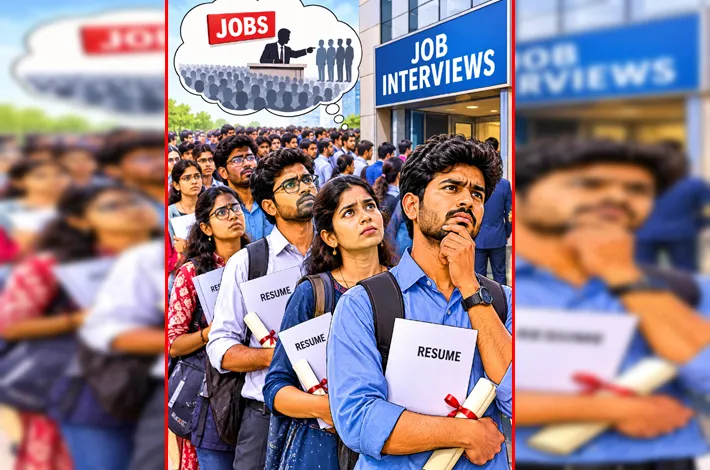
■ A degree that was once seen as a reliable path to financial security no longer guarantees stable employment or career growth.
■ Many graduates are being forced to change career paths, explore different sectors or pursue additional qualifications to stay competitive.
■ Educational institutions must take greater responsibility for ensuring that their courses meet actual industry requirements.
■ The growing gap between academic qualifications and employment opportunities also raises questions about the relevance of existing education systems.
■ The focus should gradually shift from producing more degree holders to creating a workforce that can find meaningful employment and contribute productively to the economy.
metro india news I hyderabad : The phenomenon of qualification congestion has emerged as one of the most pressing structural challenges in country’s socio-economic landscape. Millions of young Indians invest years and significant family resources into acquiring degrees, diplomas and professional certifications, only to confront a job market that absorbs a fraction of them. This mismatch between the volume of credentialed individuals and the limited number of suitable openings creates a persistent bottleneck that shapes education choices, family strategies and national productivity.
At the heart of the problem lies the rapid expansion of higher education. Enrolment in colleges and universities has grown dramatically over the past two decades. Private institutions have proliferated, many offering courses that prioritise quantity of graduates over quality of skills. As a result, large cohorts of degree holders enter the labour force each year with credentials that signal formal education but often lack the practical competencies employers seek. The outcome is a swelling pool of applicants for every vacancy in government services, public sector undertakings and the more desirable segments of the private sector.
Competitive examinations amplify the congestion. Entrance tests for engineering, medicine, civil services and banking attract numbers that dwarf available seats and posts. Coaching centres have become a parallel industry, drawing students into multi-year preparation cycles that delay entry into productive work. Families treat these examinations as high-stakes lotteries, pouring savings into tuition and relocation. Success rates remain extremely low, leaving the majority to recycle through subsequent attempts or settle for underemployment. The psychological toll is visible in rising reports of stress, delayed marriages and prolonged financial dependence on parents.
The labour market itself reinforces the squeeze. Formal sector job creation has not kept pace with the output of the education system. Manufacturing and high-skill services generate opportunities, yet the bulk of employment continues to reside in informal or low-productivity activities. Graduates frequently accept positions far below their stated qualifications, accepting salary levels that fail to recover the cost of education. This underutilisation of human capital represents a quiet drain on national potential. At the same time, employers complain of skill gaps, pointing to curricula that remain theoretical and disconnected from workplace requirements.
Regional and social dimensions add further layers. Urban centres attract the bulk of qualified job seekers, intensifying competition in metros while leaving smaller towns with both shortages of certain professionals and surpluses of general graduates. Reservation policies and category-based relaxations in eligibility criteria for government posts introduce additional complexity. While intended to broaden access, these measures sometimes concentrate large numbers of candidates into specific recruitment streams, heightening the sense of congestion for all groups.
Policy responses have so far proved partial. Skill development missions and apprenticeship schemes aim to bridge the gap between classroom learning and employability, yet coverage remains uneven and industry participation limited. Efforts to regulate higher education quality face resistance from institutions that prioritise enrolment numbers. Digital platforms and remote work have opened new avenues, particularly in technology and services, but they absorb only a modest share of the annual graduate outflow. Demographic momentum ensures that the pipeline of new entrants will remain full for years to come.
The broader economic consequences are significant. When large numbers of educated youth remain outside meaningful employment, consumption patterns, savings rates and social stability come under pressure. Households that stretched finances for education experience prolonged repayment burdens. Innovation and entrepreneurship suffer when talent is locked into prolonged job searches rather than productive activity. International comparisons highlight the contrast with economies that better align education systems with industrial demand.
Addressing qualification congestion requires coordinated action across education, industry and labour policy. Curricula must incorporate stronger ractical components and regular industry input.
Vocational pathways need elevation in social status so that not every student funnels into general degree programmes. Recruitment processes in the public sector can be streamlined and made more frequent to reduce multi-year waiting cycles. Private employers require clearer incentives to invest in structured training rather than relying solely on ready-made credentials. Data systems that track graduate outcomes by institution and discipline would help students make more informed choices and expose programmes that consistently underperform.
The current situation reflects both the success of expanded access to education and the incomplete transition to a skills-oriented economy. Qualification congestion is not merely an inconvenience for individual job seekers. It is a systemic friction that slows the conversion of demographic advantage into sustained growth. Until the volume of credentials is matched by corresponding opportunities and relevant competencies, the pressure on India’s young workforce will continue to define daily realities for millions of households.