11 September, 2026 | 1:24 AM


Ramappa in Danger?
11-09-2026 12:00:00 AM
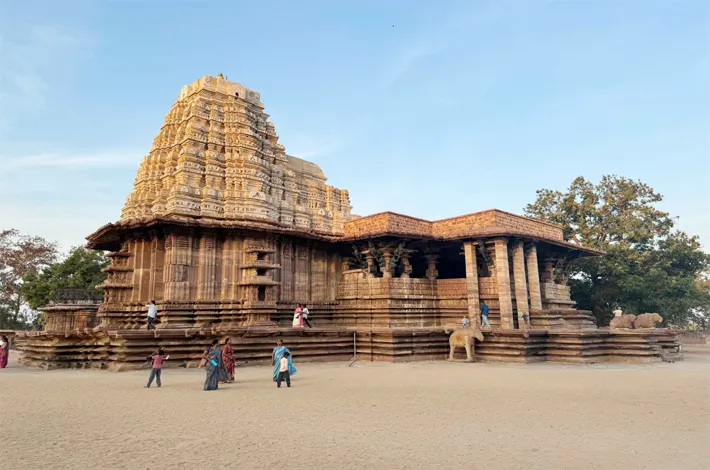
The UNESCO declared world heritage temple faces existential threat from proposed coal mine
metro india news I Mulugu/Hyderabad:
The 13th-century Kakatiya Rudreshwara Temple, popularly known as Ramappa Temple and Telangana’s sole UNESCO World Heritage Site, stands at risk from a proposed deep opencast coal mining project by Singareni Collieries Company Limited (SCCL).
Heritage experts, the Kakatiya Heritage Trust, and local stakeholders warn that the PVNR Opencast Mine at Venkatapur village, roughly 5 km downstream, could destabilize the monument, its accompanying Ramappa Lake, and surrounding communities.
Inscribed by UNESCO on July 25, 2021, the temple was built around 1213 CE under the Kakatiya dynasty by Recherla Rudra, a general of Ganapati Deva. Named after its master sculptor Ramappa, the structure is celebrated for its exquisite carvings in hard dolerite and sandstone, lightweight “floating bricks” in the vimana, and an innovative confined sandbox foundation.
The sand-filled base, compacted to optimal density, has historically absorbed seismic shocks, helping the temple endure earthquakes and the passage of more than eight centuries. The temple complex sits near the earthen-bunded Ramappa Lake (or Tank), a Kakatiya-era irrigation work with about 3 TMC storage capacity that supports roughly 30,000 acres of farmland and remains a vital water source for drinking and agriculture in the region.
In a detailed representation addressed to Union Minister of Coal and Mines G. Kishan Reddy, the Kakatiya Heritage Trust—whose trustees include retired IAS officers and academic Prof. M Pandu Ranga Rao—urged immediate intervention to halt the project.
The Trust, which played a central role in preparing the UNESCO nomination dossier and demonstrating the floating bricks before international evaluators, has consistently opposed the grant of a No Objection Certificate by the Palampet Special Development Authority (PSDA). Meetings of the PSDA in March 2023 and December 2024, chaired by the Mulugu Collector, recorded strong objections from the Trust, Archaeological Survey of India representatives, and heritage officials.
The structure already shows signs of distress, including fracturing and differential settlement of large floor beams in the Ranga Mandapam, attributed partly to past earthquakes and natural ground-water changes; the western side exhibits a canopy-like dip.
Although some technical studies commissioned by SCCL, including work involving IITs and other agencies, have concluded that controlled blasting would produce vibrations well below the temple’s tolerance thresholds (reported peak frequencies far lower than the structure’s capacity), the Trust maintains that cumulative, periodic and cyclical vibrations over the mine’s multi-decade life could induce fatigue. Combined with altered hydrogeology, these stresses risk progressive failure.
In the most severe scenario outlined by the Trust, massive water release through fractures could breach the lake, inundate downstream villages, cause loss of life and property, and potentially undermine or collapse sections of the temple—likened by the authors to a local tsunami. Beyond structural risks, the project raises concerns over biodiversity loss,
socio-economic disruption for farming communities dependent on the lake, and erosion of the deep cultural and religious attachment of local populations to the temple and its waterscape. The mine is planned to extract an estimated 40.4 million tonnes of coal over approximately 19 years across forest, agricultural and assigned lands.
SCCL has obtained certain clearances and paid compensation in parts of the area, still operations have faced repeated delays since the UNESCO inscription sparked the “Save Ramappa” movement. Recent developments underscore the continuing tension. In early September 2026, a PSDA meeting chaired by Mulugu Collector Borkhade Hemant Sahadevarao heard objections from the Kakatiya Heritage Trust and other members.
The Collector assured that conservation of the World Heritage Site remains the highest priority and that no decision on mining would be taken without comprehensive scientific studies, environmental safeguards, continuous monitoring and compliance with heritage norms. Officials from archaeology, irrigation, forests, tourism, ASI and SCCL participated. The Trust has circulated a lineament map showing the spatial relationship between the lake, temple and proposed pit to substantiate its geological arguments.
Supporters of the project emphasise India’s energy needs, the economic value of coal extraction, and technical mitigations such as controlled blasting. Opponents, including the Trust and political voices in the past, counter that the unique Outstanding Universal Value of the only World Heritage monument in the Telugu-speaking states, secured after more than a decade of collaborative effort by the Trust, ASI and Telangana’s heritage department, must not be jeopardised for temporary mineral gains.
They call for a wider protective buffer and permanent withdrawal of the mining proposal. As the PSDA and higher authorities deliberate further assessments, the fate of Ramappa Temple—an enduring testament to Kakatiya engineering genius, artistic brilliance and hydraulic wisdom—hangs in the balance between heritage preservation and resource development.
The coming scientific evaluations and administrative decisions will determine whether this 800-year-old marvel continues to stand resilient or faces irreversible risk from modern industrial activity only a short distance downstream.
It is high time that the government should immediately order a thorough inquiry by the experts, scholars and specialists in the field, conduct a in-depth study and take immediate measures to save Ramappa before it is too late.
How the mine could damage Ramappa temple
The proposed mine would excavate to a depth of 300 metres in an area encompassing parts of the Pranhita-Godavari graben basin. The geology features multiple cycles of sedimentation (Pakhal, Sullavai, Lower and Upper Gondwana formations) with sandstones, shales, conglomerates and coal seams, heavily disturbed by major and minor faults, joints and lineaments trending primarily WNW-ESE, E-W and NE-SW. Strata dip northeast.
The Trust’s report, titled “Impact of Opencast Mining of Singareni Collieries on UNESCO Inscribed Ramappa Temple & the Great Heritage of Ramappa Lake,” cites Geological Survey of India observations that the water level of Ramappa Lake influences the hydraulic gradient of groundwater flowing through these fractures toward the proposed deep pit.
Critically, the lake’s earthen bund connecting two hillocks lacks a cut-off trench (COT). Experts argue that the steep hydraulic gradient created by a 300-metre excavation could accelerate seepage and trigger piping phenomena along interconnected lineaments that traverse both the lake and the temple site. The confined sandbox foundation of the temple, while resilient under normal conditions, could be compromised if groundwater fluctuations or piping remove supporting material.