16 October, 2026 | 1:38 PM


You talk of the past well talk of the present
30-07-2025 12:00:00 AM
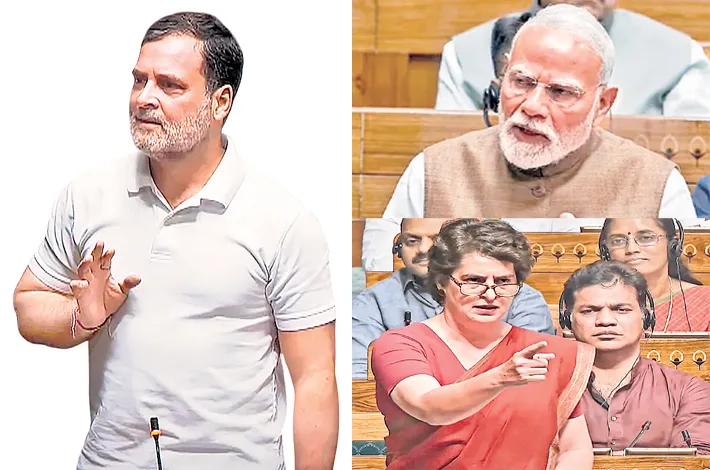
They Came, They Spoke, They Conqured
Priyanka Gandhi Vadra’s speech in the Lok Sabha on July 29 was a powerful and empathetic intervention during the discussion on the Pahalgam terror attack and Operation Sindoor, a military operation aimed at countering terrorism in Jammu and Kashmir. As a relatively new parliamentarian, having taken oath as the Wayanad MP in November 2024, Priyanka used this platform to hold the government accountable, question its security lapses, and highlight the human cost of the Pahalgam attack, which claimed 26 lives. Her speech was marked by a blend of personal reflection, sharp political critique, and a call for transparency, delivered with the composure and clarity that have drawn comparisons to her grandmother, former Prime Minister Indira Gandhi.
Priyanka began her speech by grounding her remarks in personal experience, emphasizing her understanding of the pain caused by terrorism. She referenced the assassination of her father, former Prime Minister Rajiv Gandhi, who was killed by a terrorist attack when her mother, Sonia Gandhi, was 44 years old. “I lost my father to terrorism when my mother was just 44. That pain shaped me, and it’s why I deeply feel the sorrow of the 26 lives lost in Pahalgam,” she said.
This personal anecdote was not merely rhetorical; it served to humanize the tragedy and underscore her emotional connection to the victims, particularly those in Pahalgam, where she had met affected families, including a woman widowed just six days after her wedding.
This encounter, she noted, was unforgettable and fuelled her demand for answers.
She questioned how such a brutal attack on civilians in the Baisaran valley of Pahalgam could occur despite the heavy deployment of security forces in Jammu and Kashmir. “Why was there no soldier present when tourists flocked the Baisaran valley in Kashmir’s Pahalgam? How was there no intelligence agency which could detect that a brutal terror attack on civilians was being planned?” she asked, as reported by The Indian Express. These pointed questions highlighted what she described as a systemic failure of intelligence and security apparatus under the current government. She further pressed whether the chief of the Intelligence Bureau or Home Minister Amit Shah had taken responsibility or resigned for these lapses, a direct challenge to the ruling Bharatiya Janata Party (BJP).
Priyanka called Sindoor, a “tamasha” (spectacle) in the media, echoing sentiments expressed by Congress MP Praniti Shinde. “No one is telling us what was achieved in this Operation. How many terrorists were caught? How many fighter jets did we lose? Who is responsible, and whose mistake is this?” Her remarks reflected skepticism about the government’s narrative of success, particularly in light of the ceasefire announced during the operation. Priyanka noted that while Jaishankar clarified Prime Minister Narendra Modi had not spoken to Trump during the operation, he failed to categorically deny US involvement, leaving critical questions unanswered.
The Congress MP broadened her critique to encompass other instances of violence under the BJP’s tenure, including the Delhi riots and ethnic clashes in Manipur. “Pathankot attack, Manipur clashes, Delhi riots—all these events took place under their tenure. Why are they still not taking responsibility?” she asked. She accused the government of abandoning the people of Pahalgam, stating, “There was no arrangement—no security, no first aid in Pahalgam. People went trusting the government, and the government left them to God’s mercy.”
She remarked, “After Operation Sindoor, the Pak General was having lunch with the US President—this is a failure of our diplomacy.” She expressed frustration at the unprecedented halting of a war, questioning, “For the first time in India, a war was stopped while it was still going on. The Prime Minister invoked Nehru and my mother’s tears, but still didn’t answer—why was the war stopped?” These statements underscored her belief that the government prioritized optics over substantive action, failing to deliver justice or clarity to the public.
In her speech, Priyanka adopted a combative yet measured tone, avoiding the theatrical style sometimes associated with her brother, Rahul Gandhi. She spoke primarily in Hindi, using strategic pauses to emphasize her points and engage with interruptions from BJP MPs, particularly female members, with poise. Her ability to remain calm under pressure was noted by Congress leaders, with MP Karti Chidambaram praising her for “thinking on her feet” and humanizing tragedies through personal anecdotes. Her fluency in Hindi and command over language were seen as assets, enhancing her ability to connect with the audience and convey the opposition’s message effectively.
Priyanka’s speech also touched on broader political themes, aligning with the Congress party’s stance on accountability and transparency. She challenged the government to focus on present failures rather than deflecting blame to historical figures like Jawaharlal Nehru, a frequent target of BJP criticism. “You talk of the past, we’ll talk of the present,” she asserted, urging the government to take responsibility for recent security lapses. Her call for accountability resonated with the opposition’s broader narrative, as evidenced by Leader of the Opposition Rahul Gandhi and Congress president Mallikarjun Kharge’s similar demands during the debate.
Priyanka Gandhi Vadra’s speech in the Lok Sabha on July 29 was a significant moment in her nascent parliamentary career. It showcased her ability to blend personal empathy with sharp political critique, holding the government accountable for security failures in Pahalgam and questioning the efficacy and transparency of Operation Sindoor. Her remarks underscored the human toll of terrorism, criticized the government’s diplomatic and security lapses, and positioned her as a formidable voice for the Congress party. While the speech was rooted in the specific context of the Pahalgam attack, it also reflected her broader commitment to advocating for justice and accountability, setting the stage for her growing influence in Indian politics.
Priyanka Gandhi Vadra Wayanad MP
‘Declare trump a lier’
Leader of Opposition Rahul Gandhi on Tuesday in Lok Sabha questioned the leadership during the Sindoor Operation. Mr. Gandhi claimed that the loss of Indian aircraft during the operation was due to political constraints, not military shortcomings.
"The aircraft were lost because the political leadership had tied the hands of the armed forces by deciding not to attack military and air defence infrastructure in Pakistan," he said.
Rahul Gandhi accused the government of undermining the morale and effectiveness of the armed forces by imposing limitations and lacking the political will to support the Indian armed forces and claimed it revealed sensitive details about Operation Sindoor to Pakistan.
He sharply criticised the government's military response to the attack, raising questions about Defence Minister Rajnath Singh's statements on the floor of the House.
"Rajnath Singh said Operation Sindoor began at 1:05 AM and that by 1:35 AM, India had already called Pakistan to inform them that we had hit non-military targets and that we did not want escalation," Mr. Gandhi said.
"These are not my words. These are the words of India's Defence Minister," he said.
Mr. Gandhi also accused the government of undermining the morale and effectiveness of the armed forces by imposing limitations.
If you want to use the Indian armed forces, you must have 100% political will.
You must give them full freedom of operation," he asserted. The Congress leader claimed that the Indian Director General of Military Operations (DGMO) was instructed by the government to seek a ceasefire just 30 minutes after the lunch of the operation. "At 1:35 in the night, you told Pakistan exactly what you were going to do — that we will not hit military targets, that we don't want escalation," Mr. Gandhi said.
"You directly told Pakistan your political will, that you do not want to fight," he alleged.
“You attacked Pakistan and simultaneously told them we are not going to hit your army or air defence systems. That is not freedom of manoeuvre; that is surrender.”
Mr. Gandhi quoted India's defence attache in Indonesia to attack the government, saying you told pilots not to attack their air defence system.
‘pak on its knees’
Prime Minister Narendra Modi once again launched a scathing attack on the former Prime Minister of India stating that it was Congress government’s decision under Jawaharlal Nehru to approach the World Bank to mediate the Indus Waters Treaty was a betrayal.
“Our water, our rivers but who decides? The World Bank? Nehru ji agreed to give 80 percent of the water to Pakistan," he said. “The Indus Waters Treaty was a big betrayal."
He said that whenever he speaks about Nehru or the Congress, their supporters and ecosystem “get agitated," but insisted the criticism was rooted in facts. “The decisions you took, we are still suffering because of those".
The Prime Minister’s sharp rebuttal came shortly after Leader of Opposition Rahul Gandhi accused the government of lacking the political will to let the armed forces act freely. Gandhi alleged that the Centre revealed operational details to Pakistan after the April 22 terror attack and failed to give the military full freedom of action. His speech triggered strong protests from BJP MPs and led to a fiery response from Modi in the House.
Prime Minister Narendra Modi accused the Congress party of repeatedly compromising India’s national security during a fiery speech in Lok Sabha.
In a series of sharp remarks, PM Modi said historic decisions taken by the Congress leadership had long-term consequences,
including missed opportunities to reclaim Pakistan-occupied Kashmir (PoK) and the surrender of India’s water rights under the Indus Waters Treaty.
He said that during the 1971 war, India had captured thousands of Pakistani soldiers and large areas of Pakistani territory.
“With more vision, PoK could have been reclaimed then," he said, adding that “it was all laid out on the table" and even the Kartarpur corridor could have been brought back under India’s control. The Prime Minister blamed the then Congress leadership for lacking the political will to take decisive action.
“Before asking why PoK wasn’t reclaimed, they should answer who let Pakistan take it in the first place. The answer is clear," PM Modi said. He said that Congress leaders in the early 1960s were ready to abandon areas like Poonch, Uri, Neelam Valley and the Kishanganga region, all in the name of a so-called ‘Line of Peace’.