18 October, 2026 | 8:59 AM


Vande-Mataram Row Strong on Rhetoric, Weak on Facts
15-02-2026 12:00:00 AM
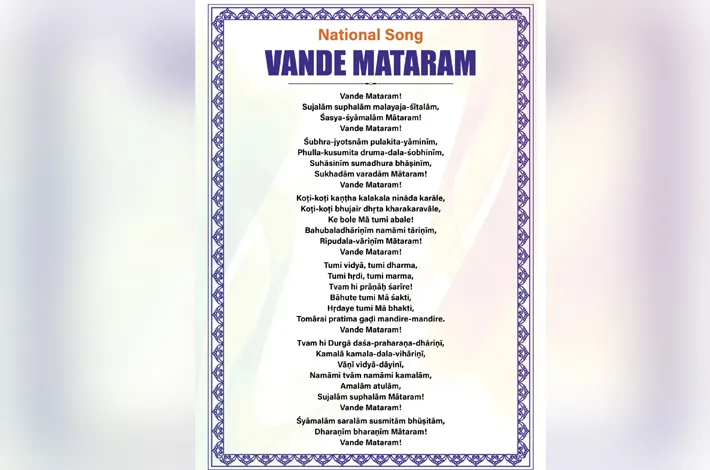
Priyanka Gandhi was fielded by the Congress to open the debate from the principal Opposition party in the Lok Sabha, after Prime Minister Narendra Modi initiated the debate to mark 150 years (1875-2025) of Vande-Mataram. Alongside the debate in Parliament on Vande-Mataram, the Ministry of Home Affairs came up with a detailed, 10-page guidelines on Vande-Mataram. Among other things, it specifies playing Vande-Mataram after unfurling National Flag; on the arrival and before departure of the President at Government functions; and making it mandatory for all schools to begin the day with community singing of Vande-Mataram. These are all reserved for the National Anthem.
This is taking a long, circuitous route to change the National Anthem, without replacing it with the National Song. A simpler, more direct way could have been to replace the National Anthem, Jana Gana Mana, with Vande-Mataram. For the first time, there appears to be an official shift away from National Anthem, by according the National Song the pride of place normally occupied by the National Anthem. This is tantamount to officially downgrading the National Anthem.
The National Anthem is governed by the Prevention of Insults to National Honour Act, 1971, enacted by Prime Minister Indira Gandhi on December 23, 1971. In this Act, Section 2 deals with National Tricolour and the Constitution, while Section 3 wholly deals with the National Anthem. During Constitution 42nd Amendment in 1976, Indira Gandhi inserted Article 51-A. Alongside Fundamental Rights, she included Fundamental Duties which entail respecting Constitution, National Tricolour and National Anthem.
Priyanka Gandhi's arguments assume significance in the present-day political context. Without pulling political punches, Priyanka Gandhi presented a set of facts. This was clearly aimed at dispelling the misinformation clouding the entire issue that the Congress was responsible for editing and cutting short Vande-Mataram, as part of a larger plan of Muslims appeasement.
Recounting how Vande-Mataram was a settled issue, Priyanka Gandhi reminded that 76-years ago, Constituent Assembly on January 24, 1950, adopted Jana Gana Mana as the National Anthem, besides Saare Jahaan se Achha along with Vande-Mataram in the original form of two stanzas, as National Songs. Present on the occasion were stalwarts like Pandit Jawaharlal Nehru, Sardar Patel, Maulana Azad and the likes of Dr B R Ambedkar and Hindu Mahasabha leader who later went on to launch Jan Sangh, precursor to BJP, Shyama Prasad Mookerjee. It was unanimously adopted and no one raised objections then. Why is the controversy now?
Going straight to the chronology of events relating to Vande-Mataram, Priyanka Gandhi marked out three milestones of 1875, 1882 and 1896, which makes it so easy to understand. It is crystal clear, without scope for any confusion. In 1875, Bankim Chandra Chatterjee composed Vande-Mataram, comprising all of two stanzas, which went on to inspire the freedom-fighters. In 1882, seven years later, Bankim Chandra set out to write his magnum-opus, Anand Math, based on Sanyasi Rebellion during the Great Bengal Famine in 1770. Vande-Mataram became its centerpiece. Seven years after Vande-Mataram was originally composed, Bankim Chandra added four additional stanzas, in the totally different context of his novel, Anand Math. As novelist, Bankim Chandra set his Anand Math in a certain historical context; now, it being played up as an electoral trump card.
The issue figured again in 1937, when at the AICC Session in Kolkata, Dr Rajendra Prasad moved the Resolution seconded by Sardar Patel that defined Vande-Mataram as consisting of 2 stanzas and Nehru had no role to play, as popular narrative goes. Ahead of the AICC Session, Netaji Subhash Chandra Bose wrote to Pandit Jawaharlal Nehru on October 17, 1937, asking him to meet Gurudev Rabindranath Tagore during AICC Session in Kolkata, to sort out the controversy over Vande-Mataram.
In his reply to Netaji on October 20, 1937, Jawaharlal Nehru says, "There is no doubt that the present outcry against Vande-Mataram is, to a large extent, a manufactured one, by the communalists... Whatever we do cannot be to pander to communalists’ feelings but to meet real grievances, where they exist. I have decided now to reach Calcutta on the 25th morning. This will give me time to see Dr Tagore as well as other friends." The sequence shows there is no confusion over Vande-Mataram comprising of just two stanzas. The additional four stanzas never formed part of the original version and the later four stanzas belonged to the cinematic version in Anand Math.
The original version of two stanzas of Vande-Mataram was sung by Rabindranath Tagore at the AICC Session in 1896. Eversince, the same version of two stanzas of Vande-Mataram is sung at the beginning of every AICC Session for 130 years now. Besides, Vande-Mataram is sung at the flag-hoisting on Republic Day on January 26, Independence Day on August 15 and on Congress Foundation Day on December 28 -- all in the AICC headquarters in the Capital and in the different PCCs in the States. Sixty-years after RSS Second Chief and Sangh Ideologue Madhav Sadashiv Golwalkar, in his Bunch of Thoughts, published in 1966, signalled the rift over the National Anthem, Jana Gana Mana, instead preferring Vande-Mataram.
Vande-Mataram and Jana Gana Mana are compositions in Bengali, by Bengalis. Gurudev Rabindranath Tagore's Jana Gana Mana is a stirring invocation to the Dispenser of India's destiny, Bharata Bbhagya Vidhata. The National Anthem celebrates India’s geographical spread, cultural diversity and spiritual unity by invoking the names of regions, rivers and mountains. The National Anthem stands not merely as a song but as a symbol of unity, diversity, national identity and respect for democracy. Eye on West Bengal Assembly elections, there is an escalation in the controversy over the National Song, Vande-Mataram, and by inference the National Anthem, Jana Gana Mana. Potentially this could be turned into a polarizing issue. Or, it could be the first step to replace the National Anthem.
- Venkat Parsa
The author is a senior journalist