24 September, 2026 | 3:05 AM


Wake up Hyderabad!
10-01-2026 12:00:00 AM
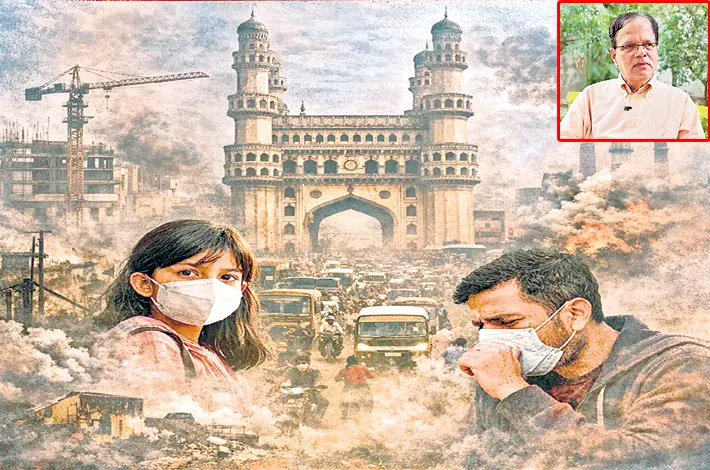
- City’s worsening pollution raises concerns, are we going the Delhi way?
- Pollution may not be choking, but the warning signs are clear
As Delhi gasps under hazardous air, Hyderabad’s worsening pollution raises a question, are we heading down the same road?
Delhi’s real-time Air Quality Index (AQI) has crossed 400, entering the “hazardous” category. According to the Central Pollution Control Board (CPCB), Delhi’s AQI stood at 411, a level that poses serious health risks. While Hyderabad is not yet at that extreme, experts warn that the city’s steadily declining air quality is a red flag that cannot be ignored as it would lead to the same situation.
The current air quality of Hyderabad is being reported in the “poor” to “unhealthy” range. With comparatively fewer heavy industries than northern metros, Hyderabad’s pollution behaves differently, it stays closer to the ground. Particulate matter, especially PM10 and PM2.5, dominates the city’s air highlighting a harsh reality, Hyderabad’s biggest enemy is not smokestacks alone, but its own soil turned airborne dust.
Globally, India’s Pollution on High Level
According to Telangana State Pollution Control Board (TGPCB) data, Hyderabad has recorded pollution levels exceeding permissible limits repeatedly over the past few months. Despite this, pollution governance remains fragmented and reactive.
Globally, as of early 2026, India continues to rank among the most polluted countries, largely due to northern India’s air quality crisis. In contrast, China has demonstrated that rapid improvement is possible. Its “war on pollution” resulted in a 64% reduction in PM2.5 levels in Beijing within a decade. China linked bureaucratic promotions to air quality targets, shifted away from coal, relocated polluting industries, mandated 100% electric public transport in major cities, enforced construction dust control, and used real-time satellite surveillance treating pollution as a matter of national security.
Industries, Vehicles and Vanishing Green Cover
Hyderabad today has industries scattered across the city, violating principles of organized industrial zoning. Scientific analysis and citizen consultation were largely absent during expansion. The city once had numerous lakes and gardens like the historic “baghs” such as Moosarambagh, but their disappearance has directly affected air quality.
Public transport remains unreliable and inaccessible, forcing citizens to depend on private vehicles, which is another major factor. “Hyderabad now has one of the highest densities of two-wheelers and four-wheelers, with lakhs of vehicles added every year, significantly increasing emissions”, he added.
Unplanned industrialization, particularly chemical and pharmaceutical industries, adds to the pollution load, making Hyderabad’s air more chemically toxic.
“Garbage, Dust and Civic Failure”
Another major contributor to pollution is Hyderabad’s lack of scientific urban solid waste management. “Garbage is often burned or dumped along roadsides. Massive garbage mountains have formed, turning areas like Jawaharlal Nagar into dumping grounds a failure shared by both citizens and GHMC”, he explained.
The final and most critical issue, Prof. Reddy stressed, is civic sense. Microplastics are now present in both air and water. Despite Article 51A(g) of the Constitution, which mandates environmental protection, citizens continue practices that damage the ecosystem.
He called for a dedicated State Environmental Development Commission to ensure sustainable planning and demanded stronger municipal accountability.
Pollution Control Board Offers a Cautious View However, Sharath Kumar, environmental scientist from the Telangana Pollution Control Board, acknowledged pollution in Hyderabad but said it would not worsen to Delhi’s levels.
“AQI interpretation often causes confusion. For us, 50–100 is good, 100–200 satisfactory. Delhi’s AQI figures are national averages and often misunderstood,” he explained.
Hyderabad’s AQI varies widely between areas like Sanathnagar and Jubilee Hills due to local conditions. Meteorology plays a crucial role, sometimes worsening pollution temporarily. A source apportionment study conducted with IIT Kanpur, costing nearly ₹1 crore, traced pollution sources. Road dust accounts for 27–30%, vehicles for another 20–30%, and industries around 15%.
An action plan is currently being implemented, covering nearly 500 connected industries. Measures include surprise inspections, vehicle monitoring, promotion of electric vehicles, expansion of charging infrastructure, plantation drives, and real-time air quality monitoring.
“Our awareness and actions matter. Citizen participation is key to stopping violations,” Sharath Kumar said.
Is Hyderabad going the Delhi way?
Prof. K. Purushotham Reddy, an eminent environmentalist issues a sharp warning, Hyderabad is indeed moving in the direction of Delhi.
He explains that Delhi’s geography worsens its pollution. The Himalayas and northern mountain ranges act like a wall, trapping air as winds move toward Delhi. Dust from multiple regions accumulates and mixes with sand from the Thar Desert, increasing particulate matter and making the air extremely toxic.
“The Ministry of Environment should have considered ecosystem limits much earlier while planning Delhi’s development,” he added.
He pointed out that the Government of India has only occasionally appointed National Commissions on Urbanization. “They gave three or four recommendations, but the limits of nature were never taken seriously,” he added.
“Unplanned Industrialization and Failure of Municipal Corporations are Major Factors” Unlike Delhi, Hyderabad does not face a geographical barrier that traps pollution. During the 1990s, the city had large open spaces, agricultural land, and better natural ventilation. However, rapid urbanization changed that. Push-and-pull factors such as the expansion of hospitals, industries, electricity production, migration, and land development without adequate water resources transformed Hyderabad into a dense, busy metropolis. Urbanization surged without scientific planning. Prof. Reddy blamed repeated failures of the municipal corporation. “Reports are always prepared, but proper plans are either never implemented or constantly altered. Too many interferences lead to unscientific decisions,” he said.