13 October, 2026 | 7:08 PM


BJP gains may disrupt UDF-LDF electoral balance in Kerala polls
03-04-2026 12:00:00 AM
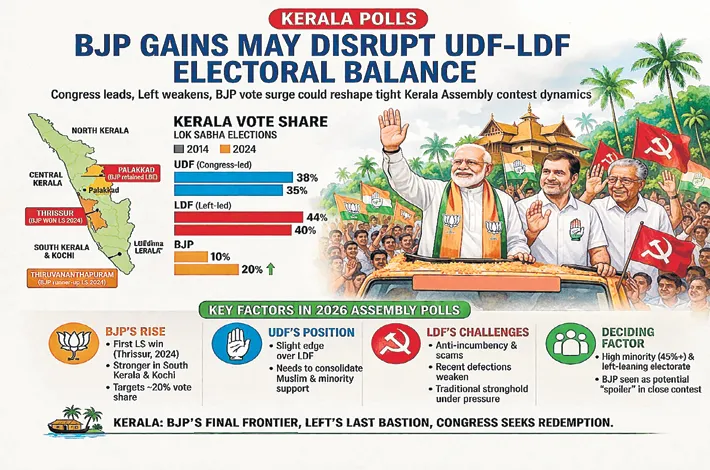
Congress leads, Left weakens, BJP vote surge could significantly reshape Kerala’s tight Assembly contest dynamics and alignments
Kerala is regarded as the “final frontier” for the BJP and the last bastion of the Left. For the Congress, the state offers redemption after a long streak of electoral losses. The Congress-led United Democratic Front (UDF) has an advantage vis-à-vis the Left Democratic Front (LDF) in the 2026 Assembly polls, but an increase in the BJP’s vote share could upset calculations.
Prime Minister Narendra Modi’s roadshow in Thrissur this week evoked conspicuous public enthusiasm, but one should not read too much into it. Kerala’s “city of gold” is, after all, a BJP seat, wrested from the Congress in 2024 by the party’s lone MP in the state, Suresh Gopi, who is the Minister of State for Petroleum and Natural Gas.
Despite eight decades of RSS activism and over 5,000 shakhas in the state, the BJP has made little electoral headway. Its inability to crack Kerala is rightly attributed to the state’s unique socio-religious set-up. A high proportion of minorities and a history of progressive reforms that secularised state politics have engendered distrust of right-wing parties.
A little over 45 per cent of Kerala’s population comprises minorities, with Muslims at around 27 per cent and Christians at 18 per cent, according to the 2011 Census. The share of the Hindu population is the lowest in any state outside the Northeast and Punjab, and the Union Territories of Jammu & Kashmir, Ladakh and Lakshadweep.
Currently, the BJP does not have a single MLA in Kerala. It opened its account with the Nemom Assembly seat in 2016 but lost it subsequently. Hitherto, it has been a marginal player in Kerala’s politics—but is that about to change?
It won Thrissur and was the runner-up in Thiruvananthapuram in 2024, boosting the NDA’s vote share to 20 per cent from 10 per cent in 2014. It won only one Lok Sabha seat, but in terms of Assembly segments, it led in 11, including six in Thrissur and three in Thiruvananthapuram, and was the runner-up in six. It is on these seats in south Kerala and the Kochi region that the BJP is strategically focusing its attention.
The fact that it won the local body elections in Thiruvananthapuram last year and retained Palakkad, besides securing five gram panchayats, is a morale booster. The defection of C.C. Mukundan, CPI MLA from Nattika in Thrissur, to the BJP is also a promising sign.
But above all, the party needs a fresh political narrative in Kerala, as the leadership is well aware. Polarisation does not work, and the electorate’s overall ideology is left-oriented. Even the Congress-led UDF includes socialist and Marxist parties.
The roots of Kerala’s contemporary politics go as far back as the early 19th century. As casteism took its most monstrous form in Kerala, the backlash was the fiercest. While social reformers in the rest of India were primarily concerned with the miserable condition of women, in Kerala the primary fault line was caste.
A paradox, as the pushback against caste began with the Channar revolt, asserting the right of lower-caste women to cover their upper bodies. The late colonial period saw the Malabar Rebellion and the successful temple entry movement, which fuelled the rise of class consciousness.
As social scientist M.R. Manmathan argued in a 2013 paper, an environment favouring social equality created fertile ground for left ideology and a concomitant aversion to religious idioms in politics.
Against this historical backdrop, political messaging must be secular, pro-development and anti-corruption. This is precisely what Modi did in Thrissur. He also emphasised the Centre’s efforts to ensure the safety of Indians in the war-torn West Asia region, where over three million Keralites live and work.
However, the positive effect of development rhetoric will be weighed against the negative impact of the anti-Christian stance adopted by RSS-linked organisations in other states. The BJP’s outreach to the Syrian Christian community, which appeared to be progressing, imploded after a series of attacks last year on Christmas celebrations in Odisha, Chhattisgarh and Assam.
Going forward, reining in hooligan elements in organisations such as the Bajrang Dal will be critical for the party.
The BJP’s main problem in Kerala is the limited scope for alliances. Unlike in the Northeast, it does not have strong regional partners. Another handicap is the lack of a strong, charismatic face in the state.
For all parties, opportunity lies in the women’s vote. In 2024, more women than men exercised their franchise, yet the state suffers from a significant gender gap in representation. Only 39 women candidates have been fielded overall.
The combatants in Kerala face differing challenges. The ruling LDF is on the back foot due to anti-incumbency, scams and defections. The UDF must consolidate the Muslim vote to renew minority confidence. The BJP must secure at least a fifth of the popular vote.
It has little chance of winning more than a handful of seats but can play spoiler. If the LDF is disproportionately affected, it benefits the Congress—and vice versa.

Bhavdeep Kang is a senior journalist with 35 years of experience in working with major newspapers and magazines. She is now an independent writer and author