13 October, 2026 | 8:13 PM


Graduate unemployment trap leaves millions waiting years for stable jobs
03-04-2026 12:00:00 AM
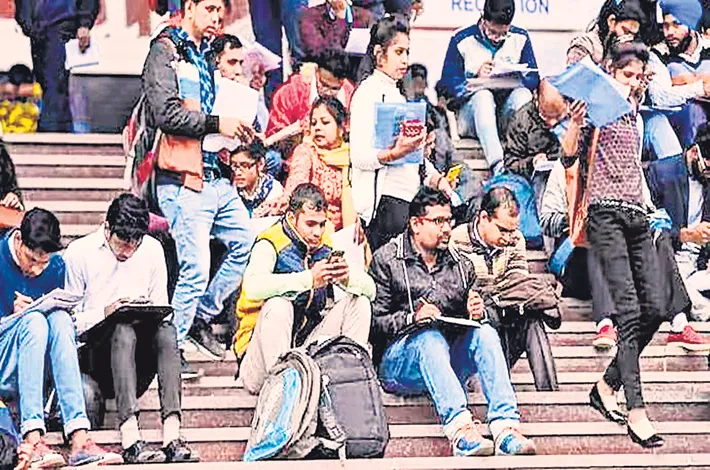
Low private wages and scarce government jobs trap educated youth in prolonged exam-preparation limbo cycle prevalent across India today
Imagine spending the best years of your life, from age 22 to 29, in a waiting room. You are educated, ambitious and capable. But the job you are waiting for has odds worse than a lottery. So you study harder, attempt again and wait once more.
This is the lived reality for an estimated 11 million young graduates in India today. The fifth edition of the State of Working India report, published this month by Azim Premji University, reveals a startling statistic: 67% of all unemployed youth aged 20–29 are graduates—1.1 crore people.
In 2004, graduates constituted just 32% of the unemployed youth cohort. Their share in the youth population has risen from 10% to 28% over two decades. But employment has not kept pace.
Between 2004 and 2023, India produced roughly 50 lakh graduates every year. Only 28 lakh found employment annually, and a mere 17 lakh entered salaried work. The arithmetic of national waste is stark.
The unemployment rate among graduates aged 22–29 is as high as 33%. Yet this falls below 4% after age 30. What changes is not success—it is resignation.
Young men eventually accept whatever work is available, however dead-end. Young women often exit the labour force altogether, retreating into unpaid domestic care work. Male unemployment falls because men take jobs; female unemployment falls because women stop looking.
Why do millions of graduates spend their prime years in this limbo? The answer lies in a rational but socially damaging calculation. Private sector salaries have stagnated.
In 2011, a young male graduate earned about ₹21,800 a month. By 2023, this had fallen to ₹19,573. Adjusted for inflation, this decline is severe. Unsurprisingly, graduates avoid entry-level private sector jobs.
Government jobs, by contrast, offer far higher pay, job security, pensions and social prestige. Naturally, aspirants choose to wait.
This wait manifests as endless preparation for competitive exams. A study of Tamil Nadu Public Service Commission data found that a single TNPSC Group 4 recruitment drew 13.7 million applicants. Around 80% of unemployed individuals in Tamil Nadu were preparing for such exams.
The private sector offers a treadmill, not a career. Only 8.25% of graduates work in roles aligned with their qualifications. Nearly half are in low-skill jobs with little progression.
The gender dimension is stark. Educated women in their early 20s actively seek jobs, but many exit the workforce by their late 20s due to marriage and caregiving expectations.
The policy response has created a paradox. Governments subsidise coaching and provide cash transfers, but this tightens fiscal constraints and limits hiring. Vacancies in Central government jobs more than doubled between 2014–15 and 2021–22.
Reservation policies also suffer. When hiring slows, reserved posts remain unfilled, weakening representation for marginalised communities.
The solution lies in reducing dependence on government jobs, improving labour market information, aligning skills with industry needs, and supporting women’s workforce participation.
Millions of educated Indians are wasting their most productive years in a lottery they are unlikely to win. This is not just a personal tragedy—it is a national failure.