24 October, 2026 | 12:46 PM


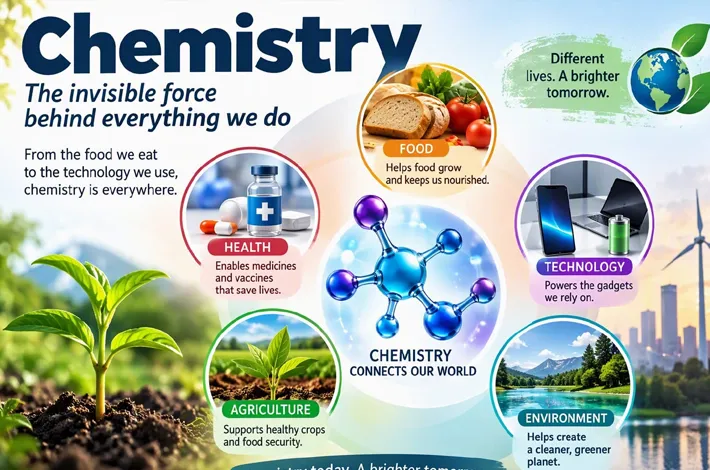
Chemistry: The invisible force behind everything we do
24-10-2026 12:00:00 AM
Science Corner
The greatest strength is its ability to connect different branches of science. Biologists use chemistry to understand living cells
Have you ever wondered what makes bread rise, medicines heal, batteries power our gadgets, or plants grow? The answer lies in a science working quietly around us every day: chemistry.
For many people, chemistry brings to mind laboratories, colourful liquids, test tubes and complicated formulas. In reality, chemistry reaches far beyond the laboratory. It is present in our homes, our bodies, our food, our medicines and almost every technology we use.
It is often called the “central science” because it connects with biology, medicine, physics, agriculture, environmental science and engineering. Putting it simply, chemistry helps us understand what things are made of, how different substances interact and how matter can be transformed.
From the moment we wake up, it is already at work. The toothpaste we use, the soap that cleans our hands, the coffee we drink, the fuel in our vehicles and the food on our plates all involve chemistry. Even breathing depends upon a continuous series of chemical and biochemical reactions inside our bodies.
One of the chemistry’s greatest contributions is to human health such as medicines, antibiotics, vaccines, diagnostic reagents and medical materials which are the products of scientific research involving chemistry. Scientists study molecules and their interactions to discover and develop treatments that can prevent disease, relieve suffering and improve human health. Much of modern healthcare would simply not exist without advances in chemical science.
It is important in agriculture and food security as well. Farmers face the enormous challenge of feeding a growing population while working with limited land, water and natural resources. Fertilizers, plant nutrients, soil analysis and crop-protection products have contributed significantly to agricultural productivity. Today, scientists are also developing more sustainable solutions that aim to protect crops while reducing environmental impact. The future of agriculture will depend not only on producing more food, but also on using science responsibly.
Our environment presents another major challenge. Pollution, climate change, waste management and water quality are complex problems in which chemistry has an essential role. Chemical science helps us identify pollutants, monitor air and water quality, develop biodegradable materials and design cleaner technologies. Advances in solar energy, batteries, fuel cells and other energy technologies also rely heavily on chemistry.
Modern technology itself has chemistry at its core. The smartphone in our hand contains carefully engineered materials used in its battery, screen and electronic components. Computers, electric vehicles, medical devices, aircraft and communication technologies similarly depend on materials created and improved through chemical research.
The greatest strength is its ability to connect different branches of science. Biologists use chemistry to understand living cells. Medical scientist’s study chemical processes involved in disease. Agricultural scientists apply chemistry to soils and crops, while engineers use it to develop materials and technologies.
It teaches us something more beyond formulas and reactions: “how to think”. It encourages curiosity, observation, experimentation and evidence-based decision-making. It teaches us to ask not only what happened, but also why it happened, and what evidence supports our conclusions.
As humanity confronts challenges in health, food, energy and environmental sustainability, chemistry will remain an essential foundation for progress. So, the next time you take a medicine, charge your phone, drink clean water or enjoy a meal, remember the science quietly working behind the scenes.
Chemistry may be invisible in our daily lives, but modern civilization bears its fingerprints everywhere.

(Dr Swarnabala Ganti is a seasoned chemist, regulatory affairs specialist and R&D scientist across India, Iran, Japan, and Taiwan. A Consultant at Swaram Biochem, Agrilife India & Som Phytopharma.)