24 October, 2026 | 1:55 PM


STARTUPS, ON SATURDAY
24-10-2026 12:00:00 AM
Every startup hub needs its Fairchild
William Shockley had co-invented the transistor, won a Nobel Prize, but even he could not stop eight engineers from quitting his lab in September 1957. Shockley came up with the phrase "the Traitorous Eight" to describe them. These engineers won the backing of an industrialist named Sherman Fairchild and they started Fairchild Semiconductor. And, just like that, one day in September a seed was planted, that germinated into the Silicon Valley.
Startup ecosystems are not born from master plans. They are seeded by one breakout company. Policy can set the right conditions – the soil, the water and the temperature. It cannot plant the seed. So, how exactly does a breakout company, create an ecosystem?
Well there is three things:
First, Money i.e. Liquidity. When the company wins, through an acquisition, an IPO or a buyback, its early employees have money. Money they can afford them to take risk on their own idea, or on someone else's.
Second, Playbook. These employees have lived through hypergrowth. They have hired hundreds of people in a year, fixed systems that broke at midnight, and learnt what no business school teaches. In other words, they have walked the path. Their know-how is not theoretical.
Third, Network. They have built together, fought together, and they trust each other. Former colleagues become co-founders, angel investors and first customers.
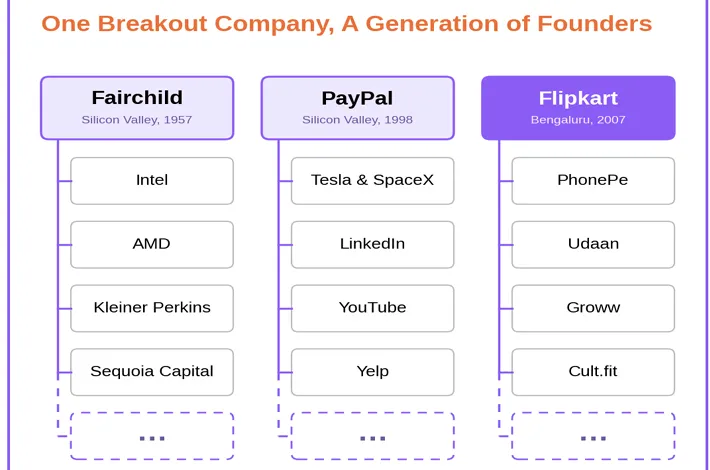
Fairchild is the textbook case. Its alumni, nicknamed the "Fairchildren", went on to found Intel and AMD. Eugene Kleiner co-founded the leading VC, Kleiner Perkins. Don Valentine, a Fairchild sales executive, founded Sequoia Capital. An estimated ninety public companies from the Bay Area trace their roots back to Fairchild. Four decades later, PayPal repeated this phenomenon. Its alumni built Tesla, LinkedIn, YouTube and Yelp, and wrote the first outside cheque into Facebook.
India has its own version of Fairchild in Bengaluru, Flipkart. Founded in 2007, it had to build Indian e-commerce from scratch. Cash on delivery. Payments. Warehouses. Deliveries to small towns. That crucible produced a remarkable diaspora. Former Flipkart executives founded PhonePe, Udaan and Groww. Mukesh Bansal, who ran Myntra inside Flipkart, co-founded Cult Fit. Co-founder Binny Bansal became one of India's most active angel investors. By some counts, Flipkart alumni have started over two hundred companies.
As the CEO of a company that helps people manage cap tables and employee equity, I see successful entrepreneurs being frequent occurrences on startup cap tables. The flywheel is visible in the datasets. Ownership shared in one generation becomes capital for the next.
If you are a student or a young professional, where you work first may matter more than what you earn first. Join a company with a real chance of breaking out, and you collect all three, risk appetite, playbook and network, often without realising it. For any startup hub, the model is clear. Make it easy for your breakout companies to win, to share ownership with their people, and then to let those people go. That is how one company becomes an ecosystem.
With so many successful startups going for IPOs, India now has the potential to create many more Fairchild and many more Fairchildren.
Why it matters: Startup Ecosystems are not built by decree. They are seeded by one company that wins, and nurtured by the people who worked there. Every startup hub needs its Fairchild.
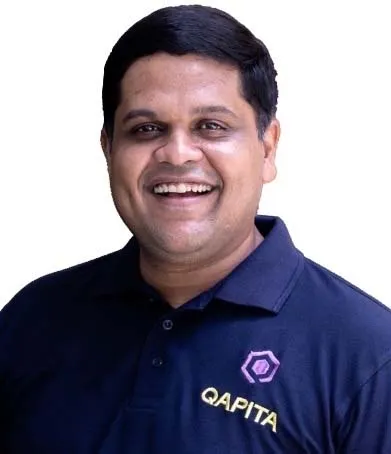
(Ravi Ravulaparthi is the CEO & Cofounder of Qapita.)