26 October, 2026 | 9:46 PM


China calls India’s FDI easing ‘partial’
13-03-2026 12:00:00 AM
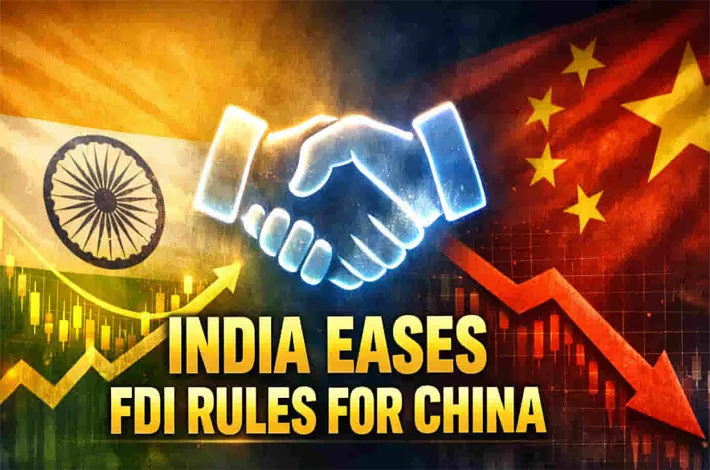
China’s Foreign Ministry declined to comment on the policy shift, saying the matter should be addressed by relevant authorities. However, Chinese business groups and experts reacted cautiously, saying the policy adjustment still leaves several restrictions in place
metro india news I beijing
China has maintained silence on India’s decision to ease foreign direct investment (FDI) rules for companies with limited shareholding from countries sharing land borders with India, while Chinese businesses described the move as only a “partial” opening of the Indian market.
India recently relaxed FDI norms by allowing overseas firms with up to 10 per cent shareholding from neighbouring countries, including China, to invest without mandatory government approval. Earlier, even a single share held by investors from such countries required approval before investment in India.
Despite the change, India clarified that the relaxation does not apply directly to entities or investors from land-bordering countries. Officials said the exemption is only for companies based in other countries that have non-controlling stakes below 10 per cent from investors in these nations.
China’s Foreign Ministry declined to comment on the policy shift, saying the matter should be addressed by relevant authorities. However, Chinese business groups and experts reacted cautiously, saying the policy adjustment still leaves several restrictions in place.
The Chamber of Chinese Enterprises in India described the step as a “partial optimisation” rather than a full liberalisation. It noted that large-scale investments or projects involving control by Chinese firms will still require approval and face strict scrutiny. Chinese investors also said that the proposed fast-track approval process of 60 days currently applies only to limited sectors such as electronic components and polysilicon.
Chinese experts believe the easing could encourage investments in sectors like solar energy and electronics, which may benefit India’s industrial growth. At the same time, they argued that India continues to balance its need for Chinese technology with concerns over foreign influence.
Economic ties between the two countries remain complex. Bilateral relations deteriorated after the Galwan Valley clash in 2020, prompting India to tighten investment rules and ban more than 200 Chinese mobile applications.
Despite political tensions, trade between the two nations continues to grow. In 2024-25, India’s exports to China stood at USD 14.25 billion, while imports rose to USD 113.45 billion, widening the trade deficit to USD 99.2 billion.