6 October, 2026 | 12:00 PM


Sleeping with enemy!
30-04-2026 12:00:00 AM
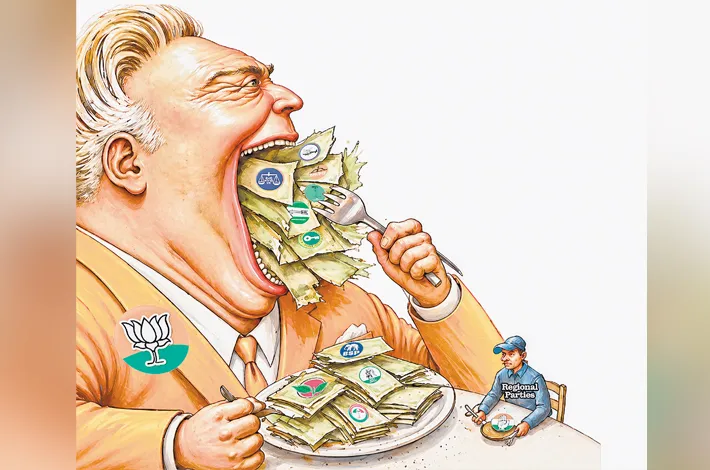
HOW BJP DEVOURS REGIONAL PARTNERS, WHILE CONGRESS GETS CONSUMED BY THEM
vjm divakar
In politics, alliances are often marriages of convenience, but their outcomes reveal stark asymmetries in power dynamics. A pattern has emerged in recent elections: regional parties aligning with the Bharatiya Janata Party (BJP) frequently suffer erosion of their independent
base, reduced to junior partners or shadows of their former selves. In contrast, the Indian National Congress often finds itself eclipsed or subordinated by stronger regional allies in states where it partners with them. The BJP expands its organizational footprint and absorbs voter segments, while Congress cedes ground, becoming a secondary player. One pithy observation captures this: "BJP eats the regional parties it allies with; Congress gets eaten by the regional parties it allies with."
This dynamic stems from the BJP's centralized national appeal, disciplined cadre, and ability to consolidate Hindu-majority or issue-based votes under its ideological umbrella. Regional allies provide initial footholds in caste- or community-specific pockets but often face "alliance fatigue," anti-incumbency spillover, and direct competition as BJP strengthens locally. Congress, weakened nationally since 2014, frequently plays a supporting role, allowing assertive regional partners like DMK, TMC, or NCP factions to dominate narratives and resource allocation.
Punjab: SAD's Decline
The Shiromani Akali Dal (SAD) exemplifies the cost of proximity to BJP. A long-time NDA partner, it broke ranks over the 2020 farm laws. In the 2024 Lok Sabha polls in Punjab, SAD won just 1 seat (Bathinda, Harsimrat Kaur Badal) out of 13, with its vote share plunging to around 13.42%—down sharply from 27.45% in 2019 when allied with BJP. In the 2022 Punjab assembly, it managed only 3 seats with 18.38% votes. While it showed minor recoveries in some local bypolls by late 2025, SAD has been squeezed between Congress (7 LS seats in 2024), AAP (3), and BJP's rising footprint (doubling its vote share to ~18.5% despite no seats). Once the dominant Sikh-centric force, SAD now struggles with internal factionalism and loss of core Panthic support.
Bihar: JD(U) and LJP – Dependence Over Dominance
In Bihar's 2025 assembly elections, the NDA secured a landslide with over 200 of 243 seats. Janata Dal (United) under Nitish Kumar performed creditably, winning around 84-85 seats—its best since 2010—and Nitish briefly continued as CM before a BJP leader succeeded him. BJP emerged as the single largest party with ~89-91 seats. JD(U)'s relevance remains tied to the NDA umbrella amid fierce RJD competition. Lok Janshakti Party (Ram Vilas) under Chirag Paswan showed strength within the alliance (winning ~19 seats), but past splits underscore its limited standalone heft. The alliance delivered for NDA, yet smaller partners operate under BJP's expanding shadow.
Maharashtra: Shiv Sena Split and UBT's Struggle
The 2022 Shiv Sena split highlighted the risks. The Uddhav Balasaheb Thackeray faction (SS(UBT)) opposed BJP and joined the Maha Vikas Aghadi (MVA). In the November 2024 Maharashtra assembly polls, SS(UBT) won only 20 seats out of 288 (vote share ~9.96%), while the pro-BJP Eknath Shinde faction secured 57 seats as part of the victorious Mahayuti alliance (over 230 seats total). BJP itself won 132 seats. UBT retained some Mumbai pockets but lost the broader "Shiv Sena" narrative and Marathi pride mobilization to the ruling splinter. The anti-BJP stance proved costly as the pro-BJP faction thrived.
Haryana: JJP's Wipeout
The Jannayak Janata Party (JJP), a post-2019 BJP ally and junior partner in government (with Dushyant Chautala as Deputy CM), suffered a dramatic collapse in the 2024 Haryana assembly elections. It won 0 seats, with vote share crashing to under 1% (from 14.8% and 10 seats in 2019). Most candidates, including Dushyant, lost deposits. The Indian National Lok Dal (INLD) also fared poorly (~2 seats). BJP and Congress consolidated Jat and other belts, absorbing or marginalizing the smaller players.
Uttar Pradesh and Beyond: BSP, RLD, PDP, JD(S)
In Uttar Pradesh, the Bahujan Samaj Party (BSP) under Mayawati, which has had tactical or neutral stances vis-à-vis BJP at times, won 0 Lok Sabha seats in 2024 (vote share 9.39% in UP) and just 1 assembly seat in 2022 (down from 19 in 2017 and 80 in 2012). It retains a Dalit core (6-8%) but faces fragmentation to BJP and SP's PDA outreach. The Rashtriya Lok Dal (RLD) saw limited gains in NDA phases before declining. In Jammu & Kashmir, the Peoples Democratic Party (PDP), a former BJP alliance partner (2015-18), won only 3 seats in the 2024 assembly polls (vote share 8.87%, down from 28 seats in 2014). Mehbooba Mufti's family faced defeats as National Conference-Congress formed government and BJP polled strongly (25%) in Jammu.
In Karnataka, Janata Dal (Secular), a past BJP ally, won fewer seats in 2023 assembly polls and showed modest performance in 2024 Lok Sabha (2 seats in alliance), losing ground in Vokkaliga areas to Congress and BJP consolidation.
The Contrasting Congress Dynamic
While BJP often "eats" allies by expanding into their social bases—leveraging welfare schemes, Hindutva mobilization, and organizational muscle—Congress frequently gets subordinated. In Tamil Nadu, DMK dominates the INDIA alliance, reducing Congress to a marginal player. In West Bengal, Trinamool Congress (TMC) calls the shots, with Congress a distant third. In Maharashtra's MVA, Congress won just 16 seats in 2024 assembly polls compared to Shiv Sena factions and NCP groups. Punjab's Congress resurgence occurred partly at SAD's expense, but AAP's rise shows national/regional pressures. This reflects Congress's organizational erosion; regional parties with stronger local caste or linguistic anchors extract more from the partnership.
Hope Chandrababu Naidu, Lokesh and Pawan Kalyan are reading this!