27 October, 2026 | 1:40 AM


Creating Shared Value: The next evolution of capitalism
21-07-2026 12:00:00 AM
Shailesh Haribhakti :
In the age of agentic AI, companies embracing shared value as core strategy will drive the next wave of innovation, growth, and legitimacy
In January 2011, Michael E. Porter and Mark R. Kramer published a landmark Harvard Business Review article diagnosing capitalism’s legitimacy crisis. Businesses were viewed as prospering at society’s expense, trapped in narrow, short-term profit models that ignored customer well-being, resource depletion, supplier fragility, and community distress. Their solution was not more CSR or philanthropy but creating shared value (CSV): policies and practices that enhance competitiveness while advancing economic and social conditions in the communities where companies operate.
Fifteen years later, in mid-2026, the diagnosis holds, yet the tools have transformed. Autonomous agentic AI systems plan and execute tasks with minimal oversight. Carbon-conversion technologies turn CO₂ into fuels, chemicals, and materials at scale. Waste-to-energy has advanced from incineration to precision gasification and microbial platforms. The renewables-to-fusion journey has reached grid-pilot demonstrations, with private funding surpassing $4.5 billion. Green mobility now includes fully autonomous, vehicle-to-grid fleets. Full-scale circularity—closed-loop design, AI-tracked material passports, and regenerative manufacturing—is becoming industry standard.
These breakthroughs do not replace CSV; they supercharge it.
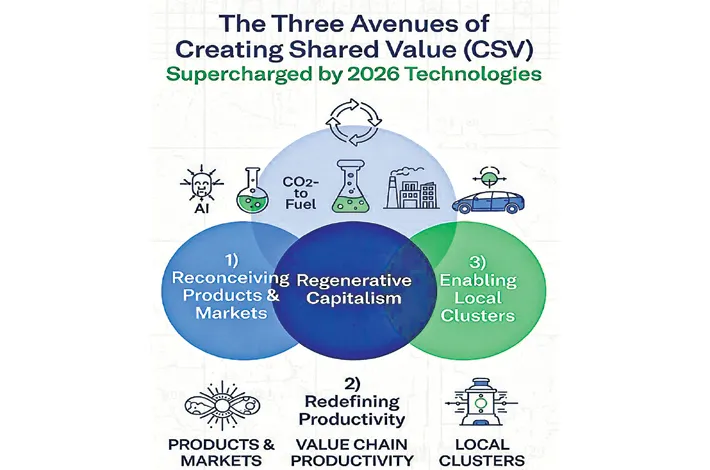
Reconceiving Products and Markets: The first avenue—meeting unmet societal needs—has exploded. In 2011, mobile banking and nutritious foods were breakthroughs. Today, agentic AI agents themselves are a new product category, delivering personalised tutoring, healthcare diagnostics, or micro-insurance in underserved regions at near-zero marginal costs while creating local data economies.
Carbon conversion turns a planetary liability into feedstock: CO₂ becomes ethylene, jet fuel, or concrete. Waste-to-energy converts municipal and industrial waste into syngas, hydrogen, and biochar, while recovering rare-earth metals. Fusion promises baseload power denser than fission. These are bundled with green-mobility-as-a-service: autonomous electric or hydrogen fleets charged by fusion micro-reactors near logistics hubs.
Full-scale circularity shifts markets from ownership to access. Products are designed for infinite reuse, tracked by agentic AI material passports. Smartphones are leased; components are autonomously rerouted through reverse-logistics networks powered by waste-to-energy. Profits rise as material costs collapse; society gains as landfills empty and virgin extraction plummets.
Redefining Productivity in the Value Chain: The second avenue—addressing societal issues inside the value chain—has become turbocharged. Agentic AI orchestrates supply chains in real time: predictive analytics reroute autonomous vehicles, optimise robots for energy use, and schedule waste-to-energy conversion to match factory demand. Internal costs once seen as external—emissions, water scarcity, and health absenteeism—are minimised simultaneously.
Carbon conversion and circularity deliver the clearest gains. Plant feed captured CO₂ into on-site reactors, producing saleable methanol while slashing compliance costs. Waste-to-energy units embedded in factories turn residues into steam and electricity. Fusion pilots co-located with data centres eliminate intermittency taxes. Green mobility fleets with vehicle-to-grid capability act as distributed batteries, stabilising grids and earning revenue.
Employee wellness is now managed by agentic AI coaches, integrating biometrics and scheduling, driving measurable reductions in turnover.
Enabling Local Cluster Development: The third avenue—building supportive clusters—benefits most from the new toolkit. Productivity depends on local business environments, now deliberately engineered with agentic AI, fusion-ready infrastructure, and circular flows. In former coal regions, fusion developers partner with governments and universities for small modular reactors. Agentic AI optimises land, water, and nutrient loops for vertical farming. Waste streams become biogas and biochar. Green-mobility corridors connect clusters to markets. The result: higher farmer incomes, restored soil, reduced migration, and a skilled AI-maintenance workforce.
Urban mobility clusters deploy agentic AI traffic systems integrating autonomous vehicles and waste-to-energy fleets. Material recovery facilities become neighbourhood “urban mines”. Carbon-conversion hubs capture city emissions for local construction. These clusters are intentionally designed, with transparent data platforms enabling pre-competitive collaboration.
Implications for Government, Civil Society, and Leaders: Governments and NGOs must shift from command-and-control to value-focused regulation: clear performance standards for carbon-conversion efficiency, fusion safety, AI transparency, and circular recovery. Public procurement favouring circular and fusion-ready suppliers accelerates the cycle. New hybrid organisations partner at eye-level with corporations; agentic AI lowers coordination costs while open data enables transparency. Business schools must update curricula: strategy now includes AI-simulated cluster engineering; finance models fusion-scale infrastructure; operations centre on circularity; and agentic systems. The narrow neoclassical view yields to regenerative capitalism that treats planetary boundaries as innovation drivers.
A Higher Form of Capitalism: Porter and Kramer concluded that shared value legitimises business. In 2026, the opportunity is larger. The technologies of agentic AI, carbon conversion, waste-to-energy, fusion, green mobility, and full-scale circularity are endogenous capabilities that capitalism can direct toward shared value at unprecedented speed and scale.
Companies embracing shared value as core strategy will drive the next wave of innovation, growth, and legitimacy. Society’s needs are immense; the tools are ready. The only constraint is leadership imagination.