9 October, 2026 | 12:12 AM


Crores Pay, Care Nowhere in ESI
22-04-2026 12:34:37 AM
metro india news I hyderabad
A large-scale governance and service failure is being highlighted in the Employees’ State Insurance (ESI) system, where nearly 26 lakh insured workers and employees in the state, along with their families—totalling nearly one crore beneficiaries—are facing poor healthcare services despite contributing substantial funds every year. Critics say both the Central and State governments are exercising control over what is essentially a “paid service” scheme funded entirely by workers and employers, while failing to deliver basic healthcare facilities.
The ESI scheme covers workers and salaried employees earning up to Rs 21,000 per month, now extended to Rs 25,000, bringing small business workers, shop employees, factory workers, and private staff under its ambit. Around 26 lakh insured persons in the state contribute monthly, and with their families included, nearly 25% of the state population depends on ESI healthcare.
ESI is not funded by governments but by deductions from employees’ salaries and contributions from employers. Every Rs 100 of wages contributes about Rs 1.75 from employees and Rs 3.50 from employers. Based on an average salary of Rs 12,500, each beneficiary contributes around Rs 650 per month, leading to an estimated Rs 165 crore monthly collection and nearly Rs 2000 crore annually from the state alone.
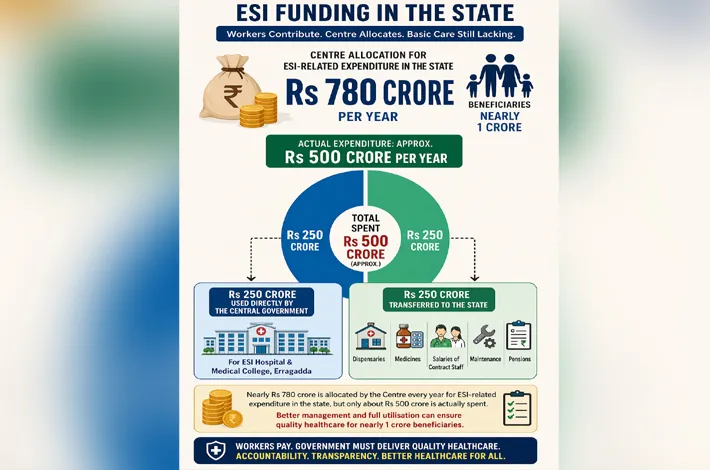
Despite this, only about Rs 780 crore per year is reportedly allocated by the Centre for ESI-related expenditure in the state. Of this, roughly Rs 500 crore is actually being spent, including Rs 250 crore directly used by the Central government for institutions like the ESI Hospital and Medical College at Erragadda, and Rs 250 crore transferred to the state for dispensaries, medicines, salaries of contract staff, maintenance, and pensions.
However, allegations are growing that the state government is diverting part of the funds received from the Centre to other schemes, leading to delays and shortages in ESI infrastructure. Earlier, such fund diversion issues even reached the Prime Minister’s Office following complaints from associations of medicines and suppliers, after which warnings were issued.
On the ground, ESI dispensaries are reportedly suffering from severe shortages—buildings exist without staff, or staff without doctors, or doctors without pharmacists. Basic facilities like seating, infrastructure, and medicine supply are inconsistent, and many dispensaries are difficult for beneficiaries to even locate properly.
Officials say while the Centre is capable of allocating up to Rs 780 crore annually, poor infrastructure expansion and lack of recruitment by the state have limited actual allocations to about Rs 250 crore. At the same time, the state is accused of not efficiently utilizing even the funds it receives.
Reports also suggest that a recent administrative move to restructure 26 dispensaries and relocate them into government buildings with a mandated minimum distance of 5 km between centres is part of a strategy to show “reorganization” and potentially increase fund inflows, though critics argue it may not improve services.
ESI beneficiaries allege that both governments are shifting responsibility onto each other. The Centre says states must ensure proper implementation, while states claim insufficient funding. Meanwhile, workers continue to pay fully into the system but receive poor healthcare services in return.
With rising dissatisfaction, beneficiaries describe the system as a “failed paid service model” where neither government invests its own budget, yet both exercise control over funds collected entirely from workers and employers. The result is a collapsing healthcare structure where nearly one crore people are left struggling for basic medical services despite contributing thousands of crores every year.