3 October, 2026 | 2:51 AM


Didi’s Courtroom Power Play
11-02-2026 12:00:00 AM
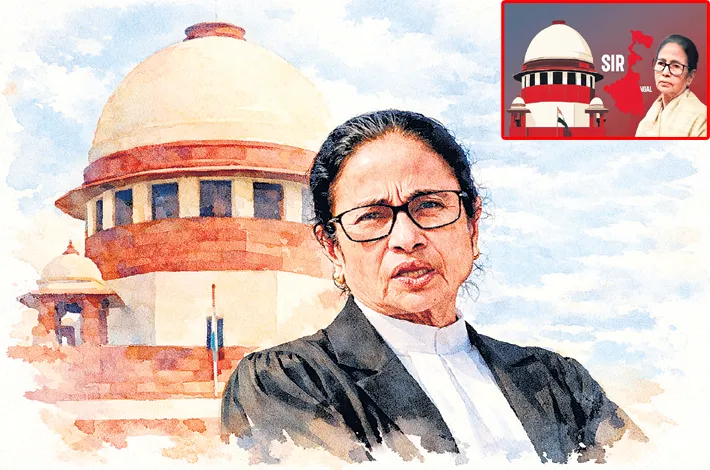
West Bengal Chief Minister Mamata Banerjee’s latest political move — appearing before a three-judge Bench of the Supreme Court to challenge the Election Commission’s Special Intensive Revision (SIR) of electoral rolls — has once again brought her political persona into sharp focus. The development comes at a crucial time as the State Assembly elections draw closer, underlining what many observers describe as the enduring strength of “Brand Mamata,” built over nearly five decades of political struggle, grassroots engagement and her image as a determined, combative leader.
The decision of a sitting Chief Minister to personally approach the apex court signals the seriousness of the issue as well as the political messaging behind it. Mamata Banerjee’s appearance is being seen as an attempt to convey to the people of West Bengal that she is willing to go to any extent to safeguard what she calls the voting rights of citizens. The case, which questions the legal validity of the entire SIR exercise, has generated intense debate, with the Trinamool Congress (TMC) alleging that the revision could disenfranchise large sections of voters.
Political observers believe the move is also part of Mamata Banerjee’s strategy to gain an upper hand over the Bharatiya Janata Party (BJP), which has emerged as the principal Opposition party in the State. With elections approaching, Banerjee appears keen to shape a strong political narrative positioning herself as a defender of democratic rights and constitutional safeguards. Her direct legal intervention, therefore, is not merely a judicial exercise but also a carefully crafted political message aimed at strengthening her outreach among voters.
amata Banerjee, the first woman Chief Minister of West Bengal, turned 71 in January this year. Her political journey has been marked by intense struggles and confrontations. The agitations she spearheaded in Singur and Nandigram remain defining moments in her career. These movements ultimately helped her end the 34-year rule of the Left Front in West Bengal and propelled her to power in 2011, marking a historic political shift in the State.
However, her political battles did not end after assuming power. Since then, Banerjee has faced continuous challenges, particularly from the BJP leadership under Prime Minister Narendra Modi and Union Home Minister Amit Shah. The BJP mounted an aggressive campaign in the 2021 West Bengal Assembly elections and succeeded in replacing the Left as the principal Opposition force in the State. As the State moves towards another Assembly election, the contest between the TMC and the BJP is expected to intensify, with both parties preparing for a high-stakes political showdown.
Banerjee’s Supreme Court appearance is being viewed as part of a larger political strategy aimed at reinforcing her image as a leader willing to confront institutions and political opponents alike. Unlike several other prominent women leaders in Indian politics, Banerjee has consistently projected herself as an independent and assertive political figure. Significantly, she holds a law degree and has previously appeared in courts during the Left Front era to secure relief for her party workers and supporters who were allegedly jailed during political confrontations.
Her current challenge to the Election Commission’s SIR exercise includes multiple objections. According to Banerjee, the deployment of over 8,000 micro-observers from outside the State undermines the authority of Electoral Registration Officers and Block Level Officers. She has also raised concerns about large-scale deletions of voter names, reportedly amounting to nearly 1.4 crore, citing reasons such as surname changes among married women or minor spelling differences in names. Banerjee alleges that such discrepancies could disproportionately affect minority voters and lead to exclusion of legitimate citizens from the electoral rolls.
The Trinamool Congress has also criticised the Election Commission for prioritising deletions rather than additions to the voter list. Traditionally, the Special Summary Revision process focuses on including newly eligible voters before elections. However, the shift towards Special Intensive Revision has drawn criticism from the TMC, which claims the exercise is being used to identify and remove alleged illegal immigrants, particularly those suspected of being from Bangladesh. Banerjee has strongly rejected this approach, asserting that many genuine Indian Muslim voters are at risk of being removed from the rolls. The legal proceedings have taken a complex turn, with the Supreme Court reportedly rejecting a petition that argued a sitting Chief Minister cannot personally plead a case, citing procedural and protocol concerns. Nevertheless, Banerjee’s legal challenge continues to draw political attention, reinforcing her image as a leader who blends legal arguments with mass political mobilisation.
Banerjee’s rise in politics has often been described as dramatic and unconventional. She first gained national prominence in 1984 when she defeated veteran Communist leader Somnath Chatterjee in the Jadavpur parliamentary constituency, earning the tag of a political “giant killer.” Later, she resigned from her ministerial position in the P.V. Narasimha Rao government in 1993, choosing to focus on State politics. After differences within the Congress leadership, she eventually parted ways with the party and founded the Trinamool Congress in 1998, setting the stage for her long-term political ambitions in West Bengal.
Her mass mobilisation campaigns during the Singur and Nandigram land acquisition protests significantly strengthened her political standing. Her 26-day hunger strike during the Singur agitation in 2006 and her active leadership during the Nandigram protests in 2007, where police firing led to multiple casualties, cemented her image as a grassroots leader fighting for farmers’ rights.
After assuming power, Banerjee cancelled several controversial land acquisition projects and introduced welfare initiatives focusing on rural development, cottage industries and public distribution reforms. Schemes such as Duare Ration and promotion of handloom and cottage industries helped consolidate her support base, particularly in rural areas.
As Banerjee prepares for a potential fourth consecutive term as Chief Minister, the upcoming Assembly elections are expected to test her political dominance. Whether the BJP can successfully challenge her electoral strength or whether Banerjee’s latest legal and political strategies will reinforce her hold over West Bengal remains one of the most closely watched political developments in the country.
— Anita Saluja (Writer is Delhi-based senior journalist, political commentator and analyst. Views are personal.)