17 September, 2026 | 4:51 PM


Do away with the whip: Manish Tewari
09-12-2025 12:00:00 AM
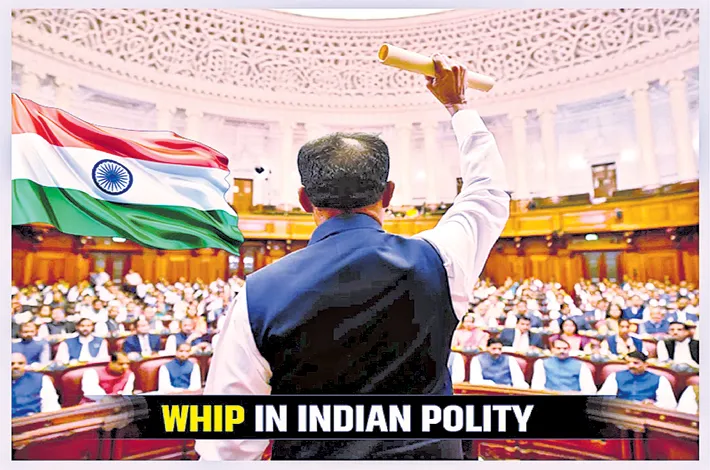
Supporters of the whip system have historically viewed it as essential for political stability and party cohesion. In 1985, during the law's introduction, Rajiv Gandhi argued it would prevent horse-trading and ensure governments could function without constant threats of collapse
In a bold move during the winter session of Parliament on December 5, Congress MP Manish Tewari from Chandigarh introduced a private member's bill aimed at amending the 10th Schedule of the Indian Constitution, commonly known as the Anti-Defection Law. This marks Tewari's third attempt at such reform, following similar proposals in 2010 and 2021. The bill seeks to curb the "whip-driven tyranny" that, according to Tewari, has reduced lawmakers to “mere numbers," voting mechanically without regard for conscience, constituency, or common sense.
Central to this proposal is limiting the enforcement of party whips—directives issued by political parties to ensure members vote in line with party policy—to only critical matters affecting government stability, such as no-confidence motions, money bills, or adjournment motions. For all other legislation, MPs would be free to vote independently without fear of disqualification. The concept of the party whip, borrowed from British parliamentary traditions, has long been an important feature of Indian democracy.
However, its rigidity intensified with the Anti-Defection Law of 1985, introduced via the 52nd Constitutional Amendment under Prime Minister Rajiv Gandhi. This law, added to the 10th Schedule, aimed to curb the rampant "Aaya Ram, Gaya Ram" politics of the 1960s and 1970s, where defections destabilized governments. It penalized legislators for switching parties or defying whips, with disqualification as the ultimate penalty.
Supporters of the whip system have historically viewed it as essential for political stability and party cohesion. In 1985, during the law's introduction, Rajiv Gandhi argued it would prevent horse-trading and ensure governments could function without constant threats of collapse. This sentiment echoed in the 1990s amid political turbulence. For instance, in 1999, during the Vajpayee government's no-confidence motion, BJP leaders praised the whip for maintaining alliance discipline, averting a crisis.
Similarly, in 2019, Karnataka's then-Home Minister G. Parameshwara welcomed a speaker's decision legitimizing whips, stating it aligned with the Anti-Defection Law and deterred lured defections. The Karnataka Congress echoed this, noting that violators deserved disqualification. Former Lok Sabha Speaker Sumitra Mahajan, reflecting in 2025, emphasized its role in parliamentary democracy: "A party ticket elects someone who agrees with its ideology and policies, necessitating discipline." , she remarked.
Proponents also highlight the whip's practical utility. P.D.T. Achary, former Lok Sabha secretary-general, noted in 2025 that whips ensure MPs' presence during critical votes, signalling party strength. In 2023, Shiv Sena MP Priyanka Chaturvedi defended whips in the Maharashtra crisis, arguing the speaker must disqualify those defying legitimate party directives. Yet, the whip system has faced mounting criticism over decades for stifling dissent and undermining representative democracy. As early as 1985, opponents like legal scholar K.V. Viswanathaiah argued in a 1967 journal (prefiguring the law) that whips curtail lawmakers' freedom, turning parliaments into echo chambers.
In 2003, the 91st Amendment raised the defection threshold from one-third to two-thirds of party members, but critics like PRS India in 2022 called it ineffective, citing failures in stabilizing governments amid wholesale defections. The 2010s saw intensified backlash. In 2019, Congress leader Sanjay Jha proposed stringent amendments to the Anti-Defection Law, advocating immediate disqualification for whip violations, including abstentions as "quasi-defections."
Legal analyses, like a 2019 Bar and Bench article, lambasted it for undermining representative democracy. Recent years have amplified these voices. In 2022, Jishnutosh Majumdar wrote in Jurist that the law harms legislative functioning and government stability. Vice President Jagdeep Dhankhar, in January 2025, questioned whips' compatibility with democracy: "Why should there be a whip? It curtails expression, freedom, and subjects representatives to servility. Tewari's rationale draws from global comparisons: no major democracy enforces such coercive whips. He proposes independent tribunals—Supreme Court benches for Parliament and high courts for states—to handle defection cases, addressing biases like those in the 2020 K.M. Singh Supreme Court suggestion for neutral tribunals.
The debate evolves with India's maturing democracy. The 1985 law stabilized politics but at the cost of debate; amendments like 2003's aimed to plug loopholes but enabled mass defections. Today, amid low parliamentary attendance and minimal scrutiny, Tewari's bill reignites calls for reform. et, balancing stability and freedom remains elusive. Private bills rarely pass, but this one underscores a perennial tension: should loyalty trump conscience in the world's largest democracy?