1 October, 2026 | 2:05 PM


Parliament reduced to mudslinging arena
05-02-2026 12:00:00 AM
What has happened to India, the world’s largest democracy? Parliament was once a forum where debates enlightened the public on vital national issues and oratory reached inspiring heights. In earlier decades, Prime Ministers such as Jawaharlal Nehru and Indira Gandhi faced formidable opposition leaders who challenged them fiercely yet constructively. Today, however, the Lok Sabha is often adjourned at the slightest provocation, reflecting a worrying decline in parliamentary standards.
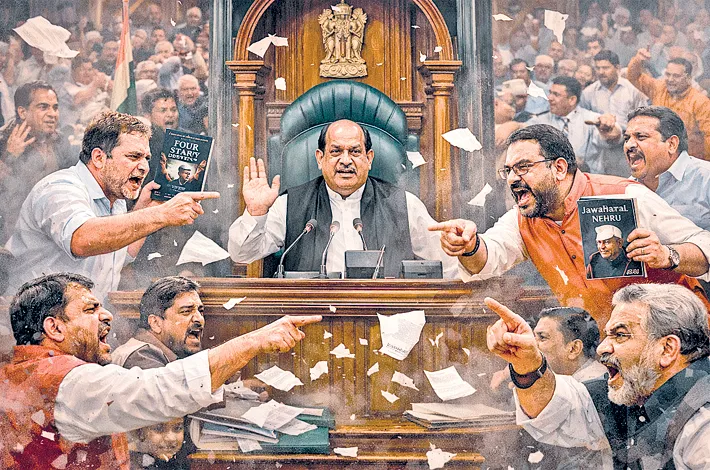
Instead of reasoned debate, Parliament increasingly appears to be a battleground where ruling and opposition parties exchange accusations and personal attacks. The Speaker, who is expected to maintain order and neutrality, often seems reduced to a spectator amid the chaos. A recent instance involved Leader of the Opposition Rahul Gandhi displaying a book by former Army Chief General Manoj Mukund Naravane to question the government’s handling of the India–China military situation. His attempt triggered uproar, with senior ministers objecting and the Speaker ruling in favour of the treasury benches, preventing him from continuing. Forced outside the House, Rahul escalated his criticism, dragging unrelated international issues into domestic political discourse.
Soon after, BJP MP Nishikant Dubey countered by citing books targeting former Prime Minister Nehru with harsh allegations, prompting Priyanka Gandhi to question the Speaker’s decision to allow such references without authentication. The incident illustrated how Parliament has shifted from policy-centric debate to personal and historical mudslinging.
Who bears responsibility for this deterioration — the opposition, the ruling party, or the Speaker? In truth, all share accountability. Parliamentary democracy thrives when the opposition is allowed to voice concerns and the government responds with reasoned rebuttals. The long-standing principle has been that “the Opposition has its say and the Government has its way,” meaning debate is essential but the elected government ultimately decides policy. Fielding senior leaders to counter criticism through facts and arguments, rather than disruption, would strengthen democratic practice.
History shows that even during national crises, Parliament functioned with dignity. During the 1962 China war, a young Atal Bihari Vajpayee demanded an immediate session, and Nehru conceded, allowing open criticism in the midst of conflict. Similarly, Parliament remained active during the 1971 India–Pakistan war. Prime Minister Indira Gandhi not only addressed the House during hostilities but also engaged the opposition and tabled emergency decisions transparently. Even major scandals like Bofors in 1987 were debated openly, with the Prime Minister making formal statements in Parliament.
In the current climate, moments of compromise do arise. When procedural objections were raised about quoting written material, Rahul Gandhi shifted focus to broader security concerns. Such openings present opportunities for floor managers to restore decorum and move discussions forward constructively. Unfortunately, these chances are often lost to political one-upmanship.
The real issue is not whether allegations are made inside or outside Parliament, but the erosion of civility and trust. Democracy is best served when disagreements remain respectful and grounded in facts. Continuous mud-slinging damages India’s global democratic image and discourages capable individuals from entering politics. Reviving the culture of informed debate, mutual respect, and institutional dignity is essential if Parliament is to reclaim its role as the true voice of the people.
(Writer is Delhi-based senior journalist, political commentator and analyst. Views are personal.)