29 November, 2026 | 12:01 AM


Dump the Delimitation!
29-11-2026 12:00:00 AM
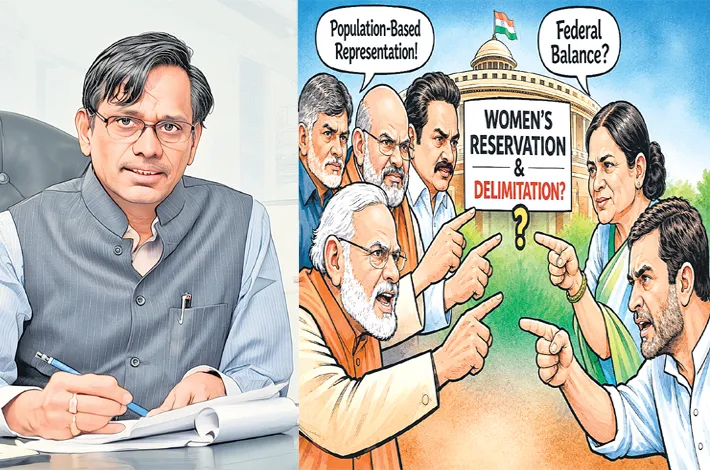
- More Legislators, Less Accountability, more corruption
- Why Expanding Parliament Through Delimitation Betrays the People
CL Rajam
The proposed Delimitation exercise, sold as a democratic upgrade for better representation and women’s reservation, threatens to multiply costs, deepen corruption, and entrench power imbalances while ordinary citizens continue to face hollow legislatures. On paper, raising the number of MPs and MLAs appears sensible. Population has grown. More representatives should mean closer attention to public grievances, stronger oversight of government, and laws that serve development. In practice, India’s parliamentary record over the past decade shows the opposite: fewer meaningful discussions, rushed legislation, chronic disruptions, and representatives often prioritising personal gain over public welfare.
Look at the functioning of Parliament. In the 17th Lok Sabha (2019-2024), roughly 35 percent of bills passed after less than one hour of discussion. Only about 16 percent of bills went to departmental standing committees for detailed scrutiny, a sharp drop from 71 percent in the 15th Lok Sabha. Budgets have routinely been guillotined. Analyses show 67 to 80 percent of budget proposals in recent years cleared with little or no debate. Question Hour utilisation has been weak. Many sessions lost large portions of scheduled time to adjournments and protests. Some Monsoon and Winter sessions recorded productivity as low as 15-21 percent in the Lok Sabha. Hours of scheduled work vanished while critical laws moved forward by voice vote amid chaos. The entire budget has been passed without a single word of discussion in certain sessions. These are not isolated failures. They form a pattern of declining deliberative quality even as the volume of legislation continues.
Sessions have ended with multiple bills cleared in minutes. One recent Monsoon session saw 11 or 12 bills pass with almost no debate in the Lok Sabha. Farm laws earlier, criminal law overhauls, and other significant measures advanced with truncated scrutiny. Mass suspensions of opposition members have cleared the floor for faster passage. The cost of disruptions alone runs into thousands of crores of public money over a decade. Parliament is meant to be the people’s platform. Too often it has become a theatre of boycotts, walkouts, and procedural shortcuts where real public issues receive secondary attention.
Against this backdrop, increasing seats looks less like reform and more like expansion of an underperforming system. Extra MPs mean extra annual expenditure. Conservative estimates put the direct cost of one MP, including salary, allowances, office support, and related benefits, in the range of tens of lakhs to several crores when broader facilities and the Member of Parliament Local Area Development Scheme are included. Adding hundreds of new members would impose hundreds of crores more every year on the taxpayer simply for maintenance, leave alone infrastructure, security, and housing strain in the capital. For state assemblies the multiplier is larger. Moreover there will be more people to loot then public. Percentages of MP’s /MLas who work for public welfare is reducing day by day. Indication of increase of wealth before and after becoming MP/MLA in most cases is indication that how public money is being misused.
Election spending reveals the deeper problem. Take the illustration of Telangana. An additional 60 MLA seats, contested by three major parties at roughly Rs 100 crore each, produces around Rs 6,000 crore in campaign expenditure. The corruption required to recover and profit from such outlays can easily reach several times that figure—estimates of Rs 20,000 crore or more for one state alone. Scale this across the country and the numbers become staggering. Political office becomes a high-stakes business investment rather than public service. Most sitting legislators already struggle with attendance and substantive work. Boycotts are common. Proceedings often proceed with sparse benches. The primary incentives for many remain protecting personal and business interests, accessing privileges, and consolidating local power networks. Adding more seats multiplies these incentives without fixing the culture of accountability.
Women’s reservation is a positive principle.
Greater diversity in legislatures is desirable. The problem is the vehicle. Expanding the House while leaving the same incentives, the same weak scrutiny mechanisms, and the same pattern of rushed law-making intact does not magically produce better governance. Representation without responsibility is empty. What the public needs are enforceable standards that compel legislators to prioritise welfare and development—attendance norms with consequences, transparency in assets and business dealings, strict limits on election spending, and mandatory referral of major bills to committees with public input. Without those reforms, larger numbers simply enlarge the class of beneficiaries who extract value from the system.
Delimitation is presented as demographic justice and democratic deepening. The ground reality is different. Parliament has already shown it can pass laws with minimal discussion, absorb massive losses of time to disruption, and enact measures that tilt institutional power. Expanding the numbers without fixing the incentives multiplies expenditure, multiplies election-time corruption, multiplies the ranks of those who treat public office as private enterprise, and risks locking southern and other performing states into reduced influence. The people pay the bills—through taxes, through poorer laws, and through weaker accountability. True reform would demand that every additional seat come with enforceable duties to the public, not just more perks and more opportunities for extraction. Until that happens, increasing the size of the House remains a costly exercise that serves political arithmetic far more than the ordinary citizen.
Special laws needs to be taken up to stop misuse of power by MLA’s MP’s before exercise of increase of MP/MLA delimitation process is taken up.