15 October, 2026 | 1:10 AM


Education for sale
29-06-2026 12:00:00 AM
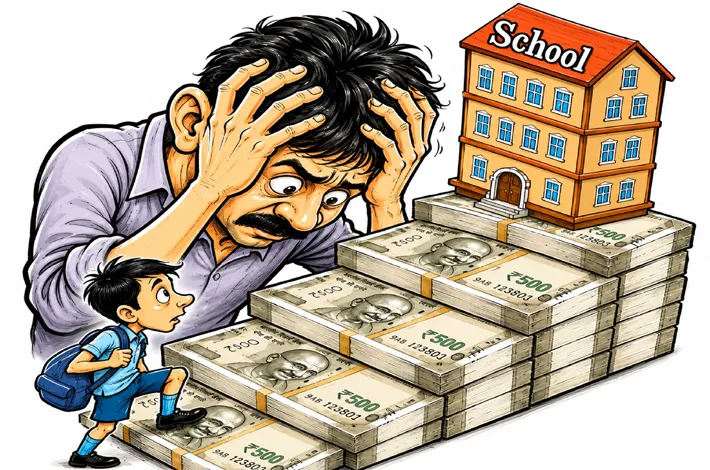
RS 15,000-CRORE SCHOOL FEE BUSINESS THRIVES WITHOUT REGULATION
■ Hyderabad ranks second only to Delhi in collecting admission donations running into lakhs of rupees.
■ Several schools in Warangal charge Rs.90,000-Rs.1 lakh for LKG/UKG, while Hyderabad CBSE schools collect Rs.1-1.5 lakh per student annually.
■ Telangana has nearly 12,000 private schools with around 36 lakh students studying up to Class X.
■ Nursery and LKG admissions in Madhapur and Kondapur reportedly cost up to Two lakh Rupees.
■ Telangana still has no comprehensive law regulating private school fees.
metro india news I hyderabad
Education, once regarded as a public service, has increasingly become one of Telangana's most lucrative businesses. Over the past two decades, allegations of rampant fee exploitation by private and corporate schools have intensified, with parents, student organisations and education activists accusing institutions of charging exorbitant fees in the absence of effective government regulation.
Education experts estimate that private school education in Telangana is now a Rs.11,000-15,000 crore annual industry. Tuition fees alone generate nearly Rs.11,000 crore, while donations, books, uniforms, transport and activity charges contribute another Rs.3,000-4,000 crore. Hyderabad is reportedly second only to Delhi in collecting admission donations running into lakhs of rupees.
Driven by aspirations for quality English-medium education, parents are increasingly opting for private schools. However, fees in many institutions now exceed those charged by engineering colleges. Schools in Warangal reportedly charge Rs.90,000-Rs.1 lakh annually for LKG and UKG, while CBSE schools in Hyderabad collect Rs.1-1.5 lakh per student. Even schools following similar curricula charge between Rs.50,000 and Rs.1 lakh.
Parents allege that many schools increase fees by 30-40 per cent annually, despite expert recommendations that hikes be capped below 10 per cent. Hostel facilities for Class X students in some institutions cost Rs.2-3 lakh a year, while budget private schools charge Rs.30,000-50,000.
According to Education Department statistics from the previous academic year, Telangana has nearly 12,000 private schools with around 36 lakh students studying up to Class X, nearly 60 per cent of them in Greater Hyderabad.
The National Sample Survey (80th Round) estimates annual parental expenditure at Rs.35,104 in rural private schools and Rs.41,475 in urban schools. Even assuming an average annual tuition fee of Rs.30,000 per student, tuition collections alone total about Rs.11,000 crore, with overall revenues touching Rs.15,000 crore after additional charges.
Education experts also claim that investors from Singapore and Hong Kong have invested Rs.500-1,500 crore in Hyderabad's school sector by acquiring institutions. They argue that the cost of these investments is eventually passed on to parents through continuous fee hikes. Even budget schools in rural areas have shifted to the CBSE curriculum and now charge at least Rs.50,000 annually.
Despite repeated assurances, Telangana still lacks a comprehensive private school fee regulation law. Both the previous BRS government, which ruled for nearly a decade, and the Congress government, now in office for over two-and-a-half years, promised legislation but instead constituted committees whose recommendations remain largely unimplemented.
The Professor Tirupati Rao Committee, constituted by the BRS government, submitted its report in 2020 recommending annual fee hikes be limited to 10 per cent, with increases beyond 15 per cent requiring government approval. The report was never implemented.
In July 2024, the Congress government formed a ministerial sub-committee comprising Ministers Sridhar Babu, Seethakka and Ponnam Prabhakar. Subsequently, the Telangana Education Commission, headed by Aakunuri Murali, submitted a draft Telangana Private Unaided School Regulatory and Monitoring Commission Bill. It proposed limiting tuition fee hikes to 8 per cent once every two years, linking revisions to the Consumer Price Index and requiring State-level approval for higher increases.
In January 2025, the government constituted the Telangana Education Policy Committee under Dr. K. Keshava Rao, with former minister Dr. Kadiyam Srihari, Aakunuri Murali, Chief Secretary K. Ramakrishna Rao, Education Secretary Yogita Rana and others as members. The committee is yet to finalise its recommendations.
Parents and student organisations argue that successive governments have spent over 12 years appointing committees while allowing unchecked fee escalation between 2017 and 2026.
Existing government orders provide only limited safeguards. GO No.1 of 1994 mandates that fee structures be decided by committees comprising school management, principals, parents and student representatives, with only 5 per cent of collections retained as management surplus. GOs 90, 91 and 92 (2008) require district-level committees to determine fee structures and prohibit schools from using labels such as "International", "IIT", "Olympiad" and "Concept" without eligibility. GO No.88 prescribes minimum playground and fire safety norms, while the Right to Education Act requires schools to display approved fee structures and reserve 25 per cent seats for economically weaker sections.
However, education activists allege that these norms are rarely enforced. Inspections are usually complaint-driven, while many schools reportedly lack adequate playgrounds, laboratories and teacher-student ratios despite charging premium fees.
SFI State Secretary T. Nagaraju alleged that although GO No.42 fixed fee limits of Rs.9,200 in rural and municipal areas and Rs.12,500 in urban areas up to Class VI, private schools secured a High Court stay and continue charging far higher fees. He claimed LKG admissions in areas such as Madhapur and Kondapur cost up to Rs.2 lakh, with parents also compelled to purchase uniforms, books and accessories exclusively from schools.
AISF State President Kasireddy Manikanta Reddy alleged that corporate schools have commercialised education by charging up to Rs.1 lakh even for LKG admissions while collecting additional fees for books, uniforms and other essentials. He also accused schools of misusing labels such as "Techno", "IIT" and "Olympiad" for marketing and urged the government to enact a comprehensive fee regulation law without further delay.
1700 teachers get FRS notices
More than 1,700 teaching and non-teaching staff in Mahabubnagar district have reportedly been issued show-cause notices over irregularities in the Facial Recognition System (FRS) attendance records, triggering concern among teachers. The action follows a review by the Telangana School Education Department, which found low FRS attendance compliance.
According to department sources, the district has over 4,600 teaching and non-teaching employees. Officials found that several staff members had either failed to register attendance through the FRS app or had not updated their leave details online. In some cases, teachers went on sanctioned leave without uploading the information, while school heads allegedly failed to record approved leave in the system. Authorities also suspect a few employees remained absent without authorisation. District Education Officer I. Vijayakumari has reportedly directed the employees concerned to submit explanations within three days.
Teachers, however, blamed technical glitches and administrative lapses, claiming the system wrongly marked them absent despite regular attendance. They argued that errors by headmasters in updating leave records should not result in disciplinary action. Officials said the explanations would be examined before any further action is taken.