27 October, 2026 | 9:32 PM


EVERY BORDER NOW DEMANDS A PRICE
27-07-2026 12:00:00 AM
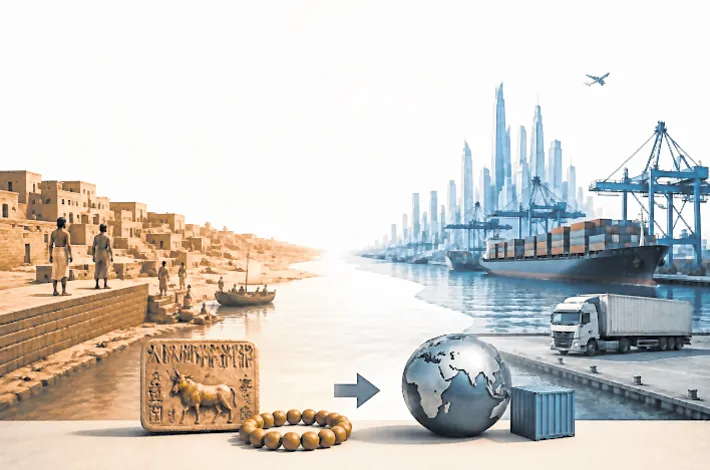
From the Indus Valley civilisation to modern tariffs, discover why trust has become humanity’s ultimate passport to global prosperity today
“Trade once asked, ‘What can you sell?’ Today, it asks, 'Can you be trusted?”’
Before humanity measured wealth in currencies, it measured prosperity in journeys. Rivers carried boats, caravans crossed deserts and oceans connected strangers long before politics divided them. Commerce flowed like water—indifferent to frontiers, languages and empires—carrying not merely goods, but hope, ideas and the quiet promise that cooperation enriches everyone.
Long before passports, tariffs and customs declarations, merchants from the ancient Sindhu (Indus Valley) civilisation traded cotton, beads and craftsmanship with distant lands. India’s philosophical tradition later offered the timeless ideal of Vasudhaiva Kutumbakam—the world is one family. One celebrated the freedom of commerce; the other affirmed the dignity of humanity.
Perhaps the ultimate purpose of economics has never been merely to create wealth, but to widen the circle of those able to share it. Every generation dreams of a world where birthplace matters less than human worth, where journeys become easier because trust becomes deeper, and where opportunity is determined more by talent than geography.
Reality, however, is moving in another direction.
From July 24, the US has replaced its temporary Section 122 tariffs with a new Section 301 framework covering 60 trading partners. India joins economies including Australia, Canada, the EU and the UK in the lower 10% tier, while many others face an additional 12.5% duty.
The stated objective is stronger enforcement against goods produced through forced labour. Whatever one's view of the policy, it reflects a broader shift in the global trading order.
For three decades after the Cold War, many believed increasingly open markets would gradually make borders economically less important. That age of optimistic globalisation is quietly giving way to an era of conditional connectivity. Today, access to markets depends not only upon price and quality, but increasingly upon strategic trust, labour standards, environmental compliance, technological resilience and national security.
Borders are no longer merely lines on maps. They have become economic filters. Tariffs, export controls, sanctions, investment screening and digital regulations increasingly determine who trades, how they trade and on what terms.
For India, this changing landscape presents both challenge and opportunity.
Being among the economies subject to the lower 10% additional duty is relatively favourable within the new framework, but competitive costs alone will not secure lasting success. Reliable institutions, resilient supply chains, transparent regulation and international credibility will increasingly define economic strength.
Five thousand years ago, merchants crossed rivers and oceans asking whether markets existed. Today, markets still exist, but they increasingly ask a different question before opening their gates: Can you be trusted?
Tariffs may determine the cost of crossing borders. Trust will determine who is invited to cross them. Every border now demands a price.
Next Monday: Another week. Another lens. Another perspective.