5 November, 2026 | 10:12 PM


GIZ, PepsiCo India and Bayer partner to maize-based farming
05-11-2026 09:36:38 PM
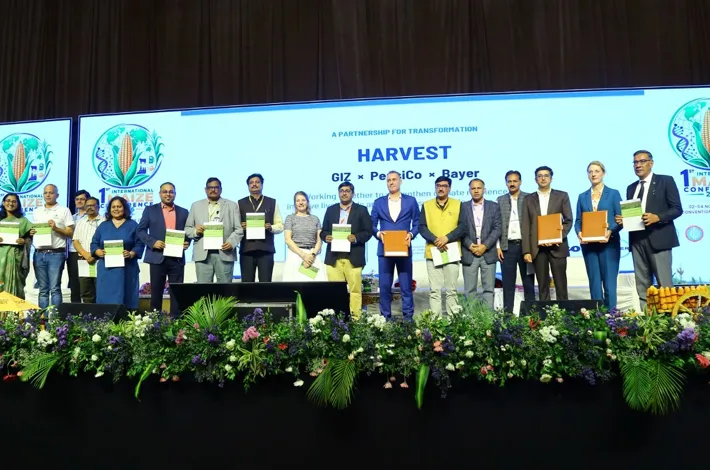
Hyderabad: Deutsche Gesellschaft für Internationale Zusammenarbeit (GIZ) GmbH, PepsiCo India Holdings Private Limited and Crop Science Division, Bayer AG, today announced HARVEST (Holistic Agricultural Climate Resilience and Versatile Ecosystem Strengthening Techniques), a public-private partnership programme aimed at advancing regenerative agriculture and strengthening the climate resilience of maize-based farming communities in India.
Implemented under the develoPPP programme on behalf of the German Federal Ministry for Economic Cooperation and Development (BMZ), HARVEST will work with farming communities in Maharashtra and Madhya Pradesh. The partnership will bring together scientific expertise, farmer capability building, practical on-ground interventions and value-chain engagement to support more resilient and sustainable agricultural production. Over its three-year duration, the initiative aims to reach 35,000 farmers through training and capability building.
PepsiCo and Bayer have partnered for over two decades in the potato value chain. With GIZ joining as a partner and research support from the Indian Institute of Maize Research (IIMR), this collaboration now extends to maize, aiming to strengthen resilience, sustainability and innovation across the food system. PepsiCo and GIZ have also collaborated on a project in Thailand (2021–2025), focused on the potato and rice value chains.
The initiative demonstrated how structured interventions and collective action can deliver meaningful outcomes in improving farmer incomes, advancing regenerative agriculture and reducing emissions. Project HARVEST builds on these learnings and the proven model, scaling its impact in India. Maize is an important crop in India, serving as food, animal feed and an industrial raw material, while supporting the livelihoods of smallholder farmers.
However, increasingly erratic rainfall, drought, rising temperatures and pressure on natural resources are creating greater production risks for farming communities. Addressing these challenges requires solutions that strengthen the resilience of farms while continuing to support farmer livelihoods.