4 November, 2026 | 1:05 AM


Ramky’s Garbage Goldmine
04-11-2026 12:00:00 AM
Ramky rakes in Rs 2.2 Cr daily but recycles a fraction of collected garbage
■ Payment of Rs. 2,200 per tonne
■ GHMC, MMC, and CMC paying around Rs. 2.2 crore daily
■ Average of 10,000 tonnes of garbage transported
■ Payments totalling around Rs. 800 crore annually
* The company takes full amount for recycling but only a fraction is recycled. People in 25-39 villages are suffering
-Maram Sammireddy, Co-Convenor, Dammaiguda JAC
* Nearly three crore tonnes of garbage is accumulated affecting 40 lakh people. If proper recycling happens, these mountains of garbage would not exist
-Sheikh Shawali, Chairman, Jawaharnagar Dumping Yard Relocation Struggle Committee
metro india news I hyderabad : Would you believe that Ramky collects as much as Rs. 2.2 crore every single day from the government (GHMC, MMC and CMC) for garbage collection, transportation and recycling? But the greater question is the recycling is not happening to the desired extent and as a result, the residents of nearby localities are affected with health problems.
The Greater Hyderabad Municipal Corporation (GHMC), Malkajgiri Municipal Corporation (MMC) and Cyberabad Municipal Corporation (CMC) pay Rs. 2,200 per tonne of garbage. For collecting, transporting and recycling the waste generated within the limits of these three municipal corporations, which fall under the Outer Ring Road (ORR), Ramky Enviro Engineers Ltd. (Ramky) receives approximately Rs. 2.2 crore every day for operations at the Jawaharnagar dumping yard.
However, when it comes to whether recycling is actually taking place on such a massive scale, there are few convincing answers. Local residents, activists and Joint Action Committees (JACs) around the Jawaharnagar dumping yard allege that Ramky is demonstrating how garbage can be turned into a lucrative money-making business. They insist that the dumping yard must be shifted.
10,000 tonnes of garbage every day
Around 1.75 crore people live within Hyderabad’s ORR limits. Their daily waste is transported to the Jawaharnagar dumping yard, established under the Integrated Municipal Solid Waste Management Project 15 years ago for recycling. However, the massive garbage mounds raise questions about recycling levels.
The three municipal corporations reportedly generate and transport around 10,000 tonnes daily. At Rs. 2,200 per tonne, Ramky receives Rs. 2.2 crore a day, amounting to Rs. 66 crore monthly and nearly Rs. 800 crore annually. During Dasara, Diwali, Sankranti and Vinayaka Chavithi, waste generation rises to 12,000 tonnes daily, increasing payments further.
Only nominal recycling every day
Although an average of 10,000 tonnes of garbage is transported daily to the Jawaharnagar dumping yard, environmentalists, representatives of ICOS, and local residents strongly allege that recycling is nowhere near that scale. They claim that while 10,000 tonnes arrive each day, only 2,000 to 2,500 tonnes are actually recycled. As a result, the garbage heaps at the Jawaharnagar dumping yard keep growing massively day by day.
Over 3 crore tonnes of garbage on 350 acres
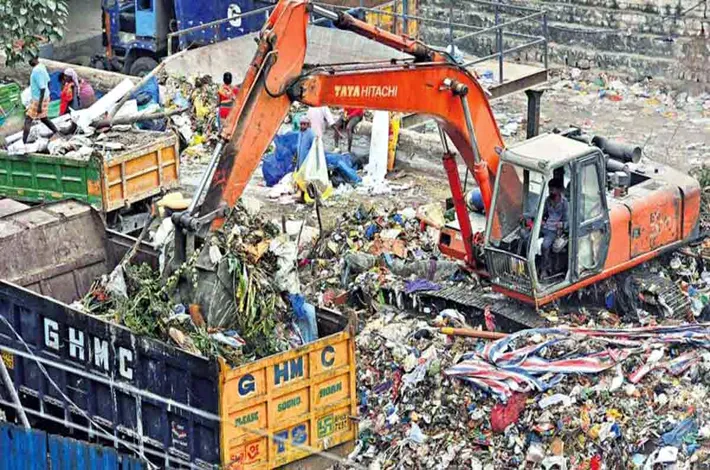
Waste has been dumped at the Jawaharnagar yard for roughly one-and-a-half decades. In the beginning, only 3,000 to 5,000 tonnes arrived daily. With the passage of time and the rapid growth of Hyderabad’s population—now estimated at around 1.75 crore—daily generation has reached about 10,000 tonnes. Locals say that even though this entire quantity is transported, proper recycling is not happening. Although two power-generation plants exist on the site, they too function only nominally. The incoming waste is simply piled into heaps and levelled by machines.
Recycling occurs only to the limited extent possible. It is noteworthy that the municipal corporations continue to pay for every tonne. Residents allege that the waste is neither properly segregated using scientific methods nor adequately recycled. Consequently, the entire 350-acre site has turned into mountains of garbage. Environmentalists estimate that more than 3 crore tonnes of waste have now accumulated. Criticisms are intensifying that while Ramky collects money daily for an average of 10,000 tonnes from the municipal corporations, it is not segregating and recycling the waste at the corresponding scale.
Lakhs of people are falling ill with various diseases—ranging from cancer to ailments that cannot even be properly diagnosed. With air, water, and soil all contaminated, the situation has become such that people in the vicinity will not be able to live here for another 50 years.