27 November, 2026 | 12:01 AM


Hindus Taken for Granted?
27-11-2026 12:00:00 AM
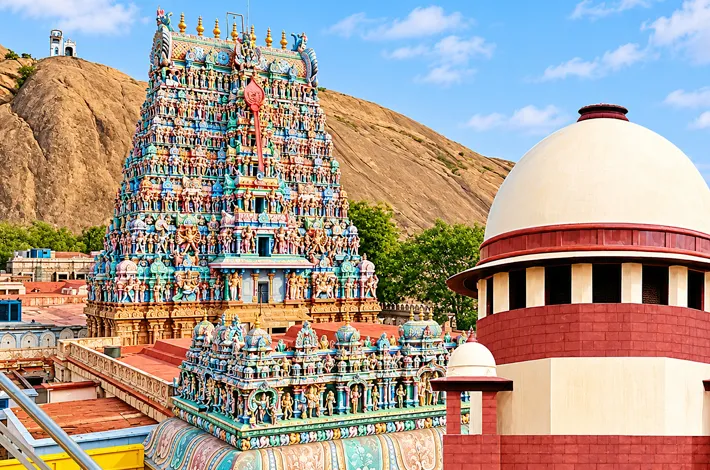
- IS SECULARISM TALKING ON BEHALF OF MUSLIMS?
- ■ Rahul Gandhi, Akhilesh, Mamata, Uddhav keep mum on Deepam issue in TN
- ■ Dare to defy even SC
- ■ Hindus have no place in Bharat
- ■ Why should one go to Courts to get justice on religious formalities?
metro india news I New Delhi
A heated political debate is going on and has zeroed in on a long-simmering question: Are Hindus being taken for granted parties such as the Congress, Samajwadi Party and their allies? The discussion gained urgency amid rising tensions over seat-sharing talks between the Congress and SP ahead of the Uttar Pradesh assembly elections.
Spokespersons from the BJP, Congress, SP and independent analysts arguments hinge on drawing on electoral data, historical voting patterns and recent political developments to examine whether major opposition parties treat the Hindu majority as a reliable but secondary vote bank while prioritising minority consolidation.
Hindus constitute roughly 80 per cent of India’s population according to census figures, forming the demographic backbone of every major state. Participants supporting the proposition argue that parties projecting a secular image have repeatedly assumed this large community would remain divided along caste lines or simply default to them out of habit, allowing focused outreach to Muslims and other minorities.
In Uttar Pradesh, where the next assembly polls scheduled in Feb-March, the SP’s traditional Muslim-Yadav formula and the Congress’s limited organisational presence are held up as examples. The BJP stand point is that in successive elections since 2014, the party has expanded its support among non-Yadav OBCs, upper castes and significant sections of Dalits by emphasising cultural and developmental issues that resonate with broader Hindu identity.
Electoral numbers feature prominently. In the 2022 Uttar Pradesh assembly elections, the BJP-led alliance secured a clear majority while the SP-Congress combination struggled outside core pockets. The Congress, contesting in alliance, managed only a handful of seats and a vote share well below 3 per cent in many analyses of the state’s results. Nationally, the 2014, 2019 and 2024 Lok Sabha outcomes showed the BJP consolidating a substantial share of Hindu votes across regions, while opposition alliances often maximised returns in constituencies with higher minority concentrations. Participants cited internal surveys and post-poll studies indicating that when Hindu voters perceive themselves as secondary to minority vote-bank arithmetic, they shift in large numbers toward parties that openly address temple-related concerns, personal laws or cultural pride.
Congress and SP representatives pushed back vigorously. These parties stand for inclusive governance and reject majoritarian politics. A Congress voice argues that focusing on poverty, unemployment, farmers’ distress and institutional accountability serves all communities, including Hindus who form the bulk of the poor and middle classes. The SP highlights the party’s outreach to backward castes and its claim of representing the underprivileged across religious lines. Both sides point to welfare schemes and reservations as evidence that their politics is not anti-Hindu but anti-privilege. Critics of the proposition warn that framing every electoral calculation in religious terms risks deepening polarisation and distracts from governance failures or successes.
The timing of the debate amplifies its intensity. Seat-sharing negotiations between the SP and Congress in Uttar Pradesh have grown contentious, with reports of the SP offering a limited number of seats while the Congress initially sought a much larger share. BJP standpoint has always been the seeming reluctance of other parties to take clear positions on issues such as the Ram temple movement in earlier decades, responses to temple-related court orders, or statements by some leaders that appeared to downplay Hindu festivals or sentiments. Recent controversies, including those involving festival practices and Supreme Court directives in southern states, are referenced as further examples where secular parties were accused of hesitation.
Data on caste and community voting receives close attention. Analysts note that the Hindu community is far from monolithic. Upper castes, dominant OBCs, non-dominant OBCs, Dalits and Adivasis often vote differently. Secular parties have historically performed better when they successfully cleaved these groups, particularly by consolidating Dalit and Muslim votes alongside select OBC sections. The BJP’s success, according to its defenders, lies in reducing those cleavages through a combination of welfare delivery, infrastructure messaging and cultural assertion. Voter turnout patterns and constituency-level results from recent assembly and parliamentary elections show that in many Hindi-heartland seats, a unified Hindu preference has proved decisive.
Independent voices offer a more measured assessment. No large community remains permanently loyal and that political parties of every stripe engage in vote-bank calculations. The real question is whether the language of secularism functions as a cover for competitive minorityism, creating space for a counter-mobilisation. Economic data also enters discussion: rising incomes, expanded access to electricity, toilets, housing and direct benefit transfers under successive governments alter the material conditions of many Hindu households that form the core of opposition support. When material grievances ease, cultural and identity concerns can gain salience.
Parties that treat the majority community as an afterthought eventually lose ground. Opponents countered that genuine secularism requires resisting the majoritarian temptation and focus on constitutional values that protect every citizen.
With assembly elections approaching in key states and national politics remaining competitive, the relationship between secular parties and the Hindu electorate continues to shape candidate selection and campaign messaging.
Whether secular parties adjust their approach or double down on existing formulas will influence outcomes in the years ahead. For now, the political weight of the country’s largest community remains at the centre of public argument.
UP a test case
The debate repeatedly returned to Uttar Pradesh as the ultimate test case. With more than 400 assembly seats and a complex social mosaic, the state has rewarded parties that stitch together broad coalitions. The SP’s strength among Yadavs and Muslims is well documented, just as the BJP’s ability to attract non-Yadav backward castes and sections of Dalits has been measured in successive verdicts. The Congress’s diminished organisational footprint has left it negotiating from a position of relative weakness, a fact that itself became a talking point about whether the party still commands organic support among any significant Hindu social group in the state.