13 October, 2026 | 5:20 AM


India-US trade pact brings tariff relief for exporters
10-02-2026 12:00:00 AM
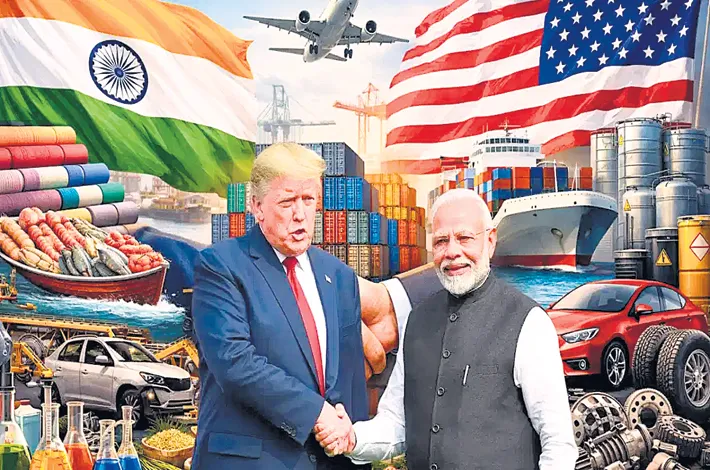
Trade specialists noted that India now enjoys a lower tariff rate than key competitors such as China, Indonesia, Vietnam and Bangladesh, giving domestic exporters a relative edge in the US market
The finalisation of a framework for an India–US trade pact has brought immediate relief and clarity to Indian exporters by ensuring greater certainty on tariffs, trade experts said on Sunday. The framework is being seen as a significant step towards improving predictability in bilateral trade at a time of global economic and geopolitical uncertainty.
Under the agreed framework, the United States will reduce reciprocal tariffs on Indian goods to 18 per cent from the earlier 25 per cent. In addition, the US has already withdrawn the extra 25 per cent punitive tariff that was imposed on India over its purchase of Russian crude oil. Experts point out that the revised tariff structure places India in a stronger competitive position compared to other exporting nations.
Trade specialists noted that India now enjoys a lower tariff rate than key competitors such as China, Indonesia, Vietnam and Bangladesh, giving domestic exporters a relative edge in the US market. The development is expected to support export growth across several labour-intensive and manufacturing sectors.
Rudra Kumar Pandey, Partner at Shardul Amarchand Mangaldas & Co, said the framework offers much-needed operational clarity following recent tariff changes. He explained that the agreement clearly confirms a reciprocal tariff rate of 18 per cent across multiple Indian export segments, including textiles and apparel, leather and footwear, plastics and rubber, organic chemicals, home décor, artisanal products and select machinery categories.
According to Pandey, the certainty provided by the framework is crucial for exporters planning production, pricing and long-term contracts. He added that the relatively lower tariff could translate into incremental market-share gains for Indian exporters, especially in sectors where competition from other Asian economies has been intense.
Pandey also highlighted India’s stated intention to purchase USD 500 billion worth of goods from the US over the next five years. These imports, spanning energy, aircraft and aircraft parts, capital goods and technology products, are aligned with India’s infrastructure expansion, aviation growth and digital economy objectives, he said.
Echoing similar views, Gulzar Didwania, Partner at Deloitte India, said the focus on removing non-tariff barriers on both sides would further facilitate smoother trade flows. He described the framework as a positive development that is likely to benefit Indian exporters in both the short and long term.
Industry leaders have also welcomed the pact. Aqeel Panaruna, Chairman of Florence Shoe Company, said the agreement would significantly boost India’s footwear and leather sector. He noted that Indian footwear exports earlier faced tariffs of up to 50 per cent in the US, hurting competitiveness. With tariff rationalisation expected, he said companies are now planning capacity expansion and fresh investments to scale up exports with confidence.