28 September, 2026 | 1:10 AM


India’s record capital spending stalled by project delays
05-03-2026 12:00:00 AM
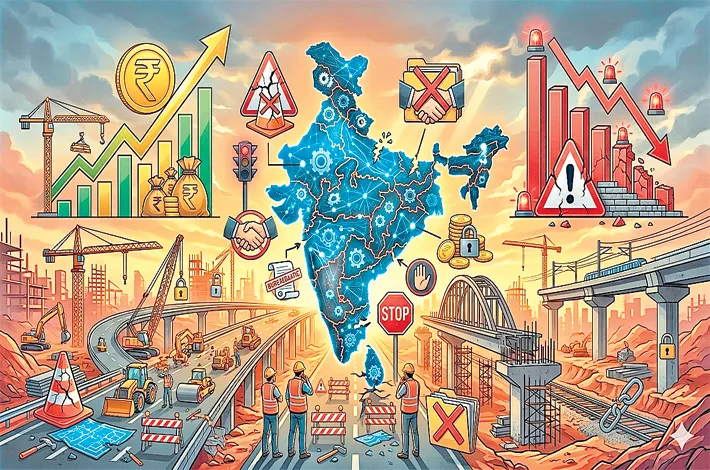
India’s public capital expenditure for the fiscal year 2026-27 is projected at a historic Rs 12.2 lakh crore, yet this accounts for only 3.1% of the country’s GDP. While the consistent rise in capital outlays reflects ambitious development plans, the slow pace of project execution exposes a persistent paradox. Despite high allocations, expected growth benefits remain limited, primarily due to project delays, cost overruns, and regulatory bottlenecks.
The post-COVID recovery strategy emphasized infrastructure investment to boost economic growth, targeting logistics corridors, railway expansions, waterways, and airports. However, the anticipated transformation of expenditure into productive assets has been slow. High capital spending has not consistently translated into faster asset creation or productivity gains. Structural inefficiencies in planning and execution undermine the multiplier effect of public expenditure. Evidence from other countries shows that nations with robust appraisal and implementation systems achieve greater returns from similar levels of investment.
According to the Ministry of Statistics and Programme Implementation, as of March 2024, 779 of 1,873 central projects valued above Rs 150 crore were delayed, representing roughly 42% of projects. The average delay was 35 months, with cost overruns of Rs 5–5.7 lakh crore per project. Although the Economic Survey estimates a short-term public capital expenditure multiplier above 2, these gains are not realized in practice. Nearly half of central projects face delays approaching three years due to structural inefficiencies, indicating challenges beyond individual project-level issues.
Several high-profile projects illustrate these difficulties. The Udhampur–Srinagar–Baramulla Rail Link, sanctioned in 1994 to connect Jammu and Kashmir to India’s national rail network, was completed only in June 2025. The delays were caused by underestimating construction challenges in mountainous terrain and insufficient upfront surveys, leading to both time and cost escalations. The Navi Mumbai International Airport, conceptualized in the 1990s, received environmental clearance only in 2010 due to concerns about mangroves, river diversion, and coastal regulations. Rehabilitation and compensation for around 3,000 affected families caused further delays, with operations beginning in December 2025.
Other projects, such as segments of the Delhi-Mumbai Industrial Corridor and Ultra Mega Power Projects like Bedabahal and Cheyyur, faced slowdowns due to land acquisition challenges, demand uncertainties, and financially stressed power distribution companies. These examples highlight the complex factors that extend project timelines and limit the efficiency of capital expenditure.
Timely project execution could improve capital-output efficiency, realize multiplier effects, and stimulate economic activity. A predictable and efficient execution environment encourages private investment, which can reduce contingent liabilities and government interest burdens, freeing resources for social and developmental programs.
Addressing these challenges requires thorough project preparation, independent feasibility assessments, and detailed engineering reviews. Enforcing strict timelines through fast-track dispute resolution mechanisms, such as the National Highways Authority of India’s conciliation system, and implementing tools like the Infrastructure Risk Guarantee Fund proposed in the 2026-27 Union Budget can improve risk-sharing in public-private partnerships. Strengthening project management systems while maintaining steady increases in capital expenditure could enhance the growth impact of infrastructure investment.
Successful delivery of infrastructure in India depends on coordinated efforts among multiple ministries, state governments, regulators, and courts. While record allocations mark a significant shift from decades of underinvestment, the real challenge is ensuring execution reform keeps pace with expenditure. Bridging this gap is essential to fully realize the intended growth benefits of India’s capital spending.
–Tamma Koti Reddy, VC (i/c), ICFAI Hyderabad, and Ritika Rao Veerisetti, Research Scholar, ICFAI Hyderabad