23 October, 2026 | 10:29 PM


Is Your Gold Safe in Bank?
15-08-2026 12:00:00 AM
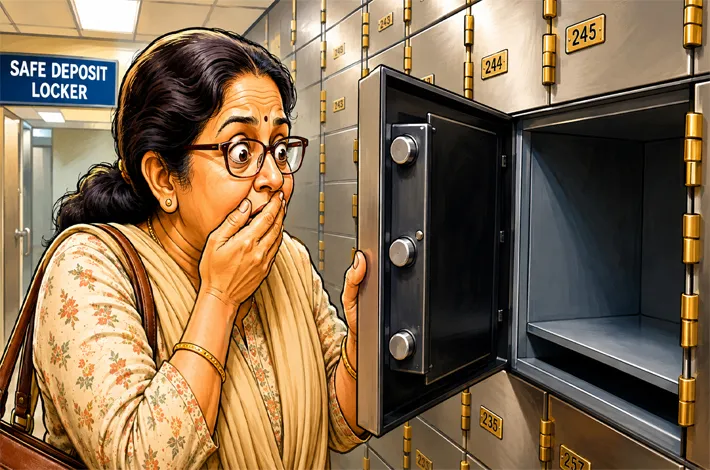
The Indian Bank incident raised doubts among people
Why auction not taken against Senior Officers
Vanishing gold, eroding trust
■ 700 grams of pledged gold went missing from Indian Bank’s Mahabubabad branch, with six employees allegedly involved; part of the jewellery was recovered and some was reportedly re-pledged with a private lender.
■ Similar gold irregularities have surfaced at Indian Bank branches in Secunderabad, Bengaluru and Rajkot, raising concerns over gaps in dual custody, audits and staff oversight.
■ Repeated incidents are eroding customer trust, highlighting the need for stricter audits, stronger digital custody systems and greater vigilance over pledged gold.
metro india news I hyderabad
In the first half of August 2026, an audit at the Indian Bank branch in Mahabubabad, Telangana, uncovered a stark breach of trust. Around 700 grams of gold jewellery, pledged by customers against loans, was found missing from the bank’s custody. Preliminary findings pointed to assistant manager Bhukya Raju and five other employees who allegedly removed the ornaments.
Police recovered a portion from Raju’s residence; some of the gold had reportedly been re-pledged with a private lender, Manappuram. Mahabubabad Town circle inspector Raghupathi Reddy registered a case. Customers who had entrusted their family ornaments gathered at the branch seeking answers about the safety of what remained. The bank manager offered assurances that steps were being taken, but the incident left a clear message: even sealed gold packets inside a public-sector bank vault are not immune to internal theft.
Mahabubabad lies in Telangana, within the broader Hyderabad region’s economic and administrative orbit. The episode is not isolated. In Secunderabad’s Sindh Colony branch of Indian Bank earlier this year, a software professional named Joseph discovered that much of the roughly 200 grams of gold he had pledged in January 2025 was missing when he sought to redeem it. Only a few rings remained; the rest had disappeared. He filed a police complaint demanding recovery and action against those responsible. These Telangana cases fit a wider pattern of gold-related irregularities involving Indian Bank employees.
In Bengaluru’s Girinagar branch in early 2026, assistant manager Kiran Kumar was arrested for systematically removing gold from 24 of 207 pledged packets over several months, allegedly to fund online gambling. The haul was estimated at about 2.7–2.8 kg, valued at more than Rs 4 crore. Some ornaments had been re-pledged with private financiers; partial recovery followed. Similar locker and pledged-gold misappropriation cases have surfaced at Indian Bank branches elsewhere, including Rajkot, where two employees faced an FIR over gold worth Rs 64 lakh that went missing from pouches under their dual custody.
Indian Bank is a public-sector bank with a significant presence in southern India, including Telangana. Gold loans form an important retail product, especially among middle-class and small-business customers who treat family jewellery as liquid collateral. The bank’s internal systems theoretically rely on dual custody of keys and packets, periodic audits, sealed packets, and CCTV.
Still repeated incidents show these controls failing when staff collude or when one employee gains unsupervised access. In the Mahabubabad case, the discrepancy surfaced only during an audit; in Bengaluru, it emerged when a customer sought redemption. Lagging detection, incomplete dual-control enforcement, and the ease with which stolen gold can be re-pledged outside the formal banking system point to systemic weaknesses rather than isolated “bad apples.”
Broader data on bank frauds underscores the scale of the problem for public-sector lenders. According to Reserve Bank of India figures, the amount involved in reported frauds across banks and financial institutions rose sharply in recent years even as case numbers fluctuated. In FY26, the total amount reached about Rs 48,021 crore across roughly 10,114 cases, with public-sector banks accounting for the bulk—around Rs 35,709 crore.
Advances-related frauds dominated the value. Earlier years showed similar concentration of high-value fraud in PSBs, while private banks often reported higher volumes of smaller digital and card frauds.
Reclassification of older cases under Supreme Court guidelines on natural justice also inflated reported amounts in some periods. Indian Bank itself has recorded decline in the number of fraud cases in certain years, consistent with some other PSBs, still individual high-profile staff misconduct cases continue to surface. These statistics do not mean every branch is compromised, nor do they erase the fact that most routine banking transactions occur without incident.
Deposit insurance under the Deposit Insurance and Credit Guarantee Corporation covers bank deposits up to Rs 5 lakh per depositor per bank. Gold pledged as collateral, however, sits in a different legal category: the bank acts as bailee and is expected to return the exact ornaments or compensate for loss. When staff remove the gold, customers face months of police and bank processes, potential interest continuation on the loan, and the emotional cost of losing heirlooms.
Partial recoveries and re-pledging to private financiers complicate restitution. In several documented cases, the motive has been addiction to online betting or simple personal enrichment, enabled by access privileges that outpace oversight. Why does this keep happening? Gold is compact, high-value, and relatively easy to liquidate through the parallel gold-loan market. Dual-key systems and packet seals are only as strong as the integrity of the people holding the keys.
Branch-level audits can lag; CCTV footage is useful after the fact but does not prevent removal during quiet hours or when managers are absent. Staff transfers after internal inquiries, as seen in some cases, do not always prevent the original loss. Customers in smaller district headquarters or busy urban branches may lack the leverage or information to demand real-time verification of their packets. For residents of Hyderabad and Telangana, the practical implication is caution.
Prefer banks or non-banking finance companies with stronger recent track records on gold custody if possible; insist on photographic or video evidence of sealed packets at the time of pledging; monitor loan accounts closely; and consider the opportunity cost of leaving high-value ornaments in any single institution for extended periods. Diversifying collateral or using other secured products where feasible reduces concentration risk. Regulatory pressure from the RBI, faster forensic audits, stricter dual-control technology (including biometric or digital seals), and zero-tolerance prosecution of staff can help, but customers cannot outsource vigilance entirely.
The Mahabubabad disappearance of 700 grams, the Secunderabad shortfall, and parallel cases elsewhere do not prove that dealing with Indian Bank is uniquely or universally unsafe. They do demonstrate that internal controls have repeatedly failed to protect pledged gold in Telangana and beyond. Public-sector banks remain central to India’s financial inclusion, still repeated staff-level breaches of trust erode the confidence that ordinary depositors and borrowers place in them.
Until audits become more frequent, custody technology more robust, and accountability more immediate, customers in Hyderabad and Telangana have every reason to treat gold loans at Indian Bank—and similar arrangements at other lenders—with heightened scrutiny. The ornaments represent more than collateral; for many families they represent security, memory, and hard-earned savings. When those disappear from a bank vault, the institution’s claim to safety rings hollow.